KVALSUND, Norway — The mine was dripping. Carved into a bare blue-black mountain face, its tunnel gaped like a wound, bleeding rainwater that slipped in long streams down the rocky slope beneath it. Extending from its recesses, a massive yellow ventilation bag spat gases and exhaust through a blue two-story fan with a relentless roar.
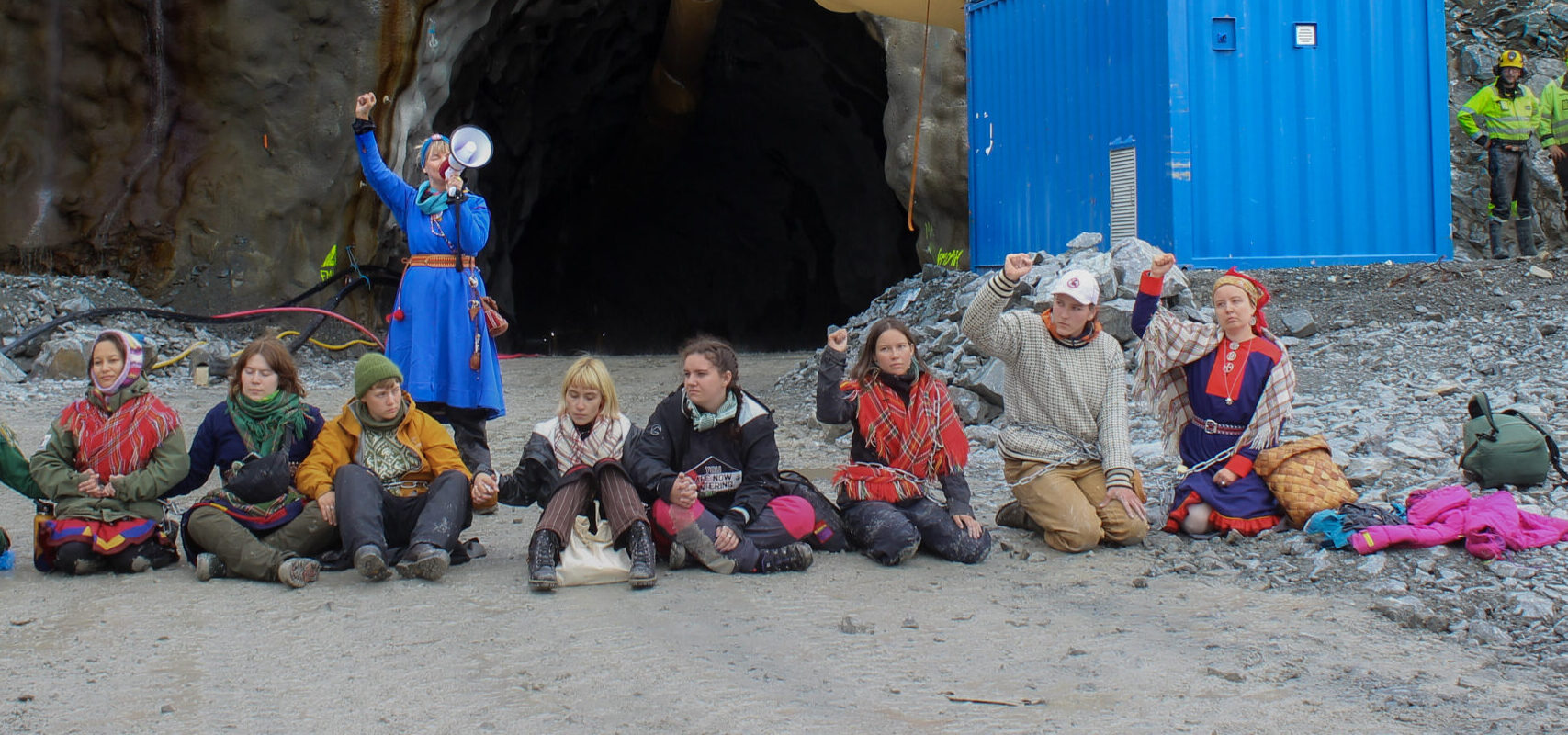
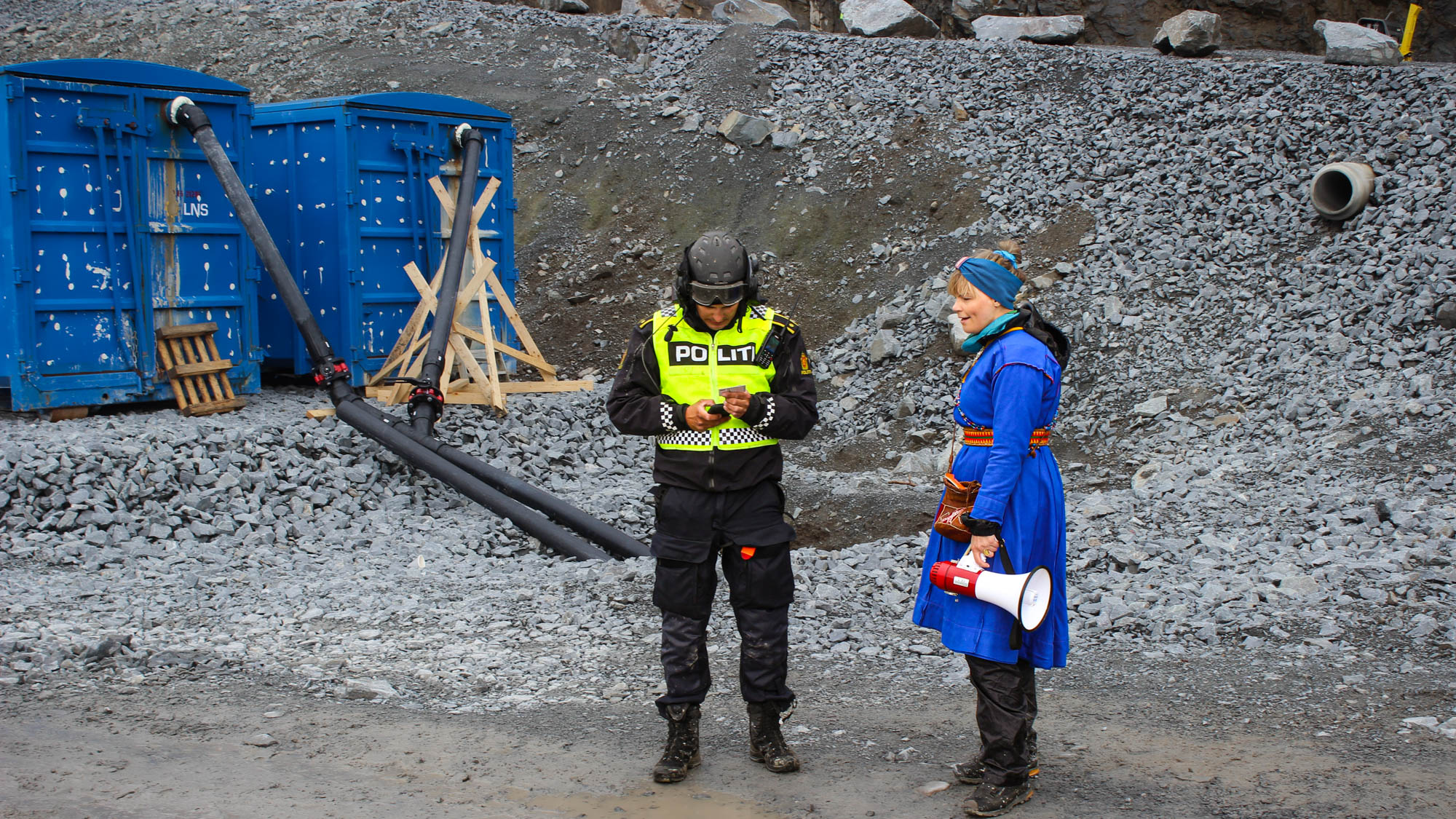
Just in front of the opening, 10 young adults sat on gravel to block its entrance. Bundled in traditional multicolored scarves of the Indigenous Sami people, with a heavy steel chain wrapped around each of their waists, they held hands. Next to them, a woman in a blue gakti, the Sami dress, stood holding a megaphone high. Over the noise of the fan, her voice echoed in the unmistakable haunting tones of a yoik, the once-banned form of Sami singing.
It was a wet, chilly August day, only four hours south of the northernmost tip of continental Europe. The activists were organized by Nature and Youth, Norway’s largest environmental organization composed of 13 to 25-year-olds, many of whom delay university to commit to full-time activism. Every week for the previous month-and-a-half, protesting on behalf of both the environment and Indigenous rights, they had gathered here to block construction on the Nussir copper mine. Every week for the past month and a half, police had forcibly removed them from the site. It was a calculated strategy: The law-enforcement force here is small, and it took hours each day for reinforcements to travel hundreds of miles across Norway’s largest and northernmost county. By the time enough officers arrived to break the activists’ chains, swaddle them in canvas bags, load them into vans and bring them to the local station, the mining workday was often already over.
The Nussir copper company secured national approval in 2019 to extract copper from this mountain and pump 30 million tons of mine waste onto the seabed of the adjacent fjord, named Repparfjord, a crucial spawning area for coastal cod and wild salmon, both threatened species. Only two countries on the planet still allow marine mine tailings disposal, Norway and Papua New Guinea. The Repparfjord is also sacred to Sami people, and the mine site is planned directly on Sami reindeer calving territory.
For the government, the mine represents a crucial contribution to Europe’s energy security. In 2023, the European Union passed the Critical Raw Minerals Act to expedite EU and EU-allied extraction projects. This past June, the bloc named the Nussir mine a “strategic project” under the act, expediting approvals for operations. In the Norwegian Arctic, the mine is one of an ever-growing list of projects that promise to power Norway and Europe to its renewable future.
At the same time, for more than two decades now, the fight for the Repparfjord—pitting environmental and Sami activists against the state and its renewable energy goals—has become emblematic of a bizarre climate calculus in Norway’s race to “green” the north.
When the Canadian company Blue Moon Metals bought the Nussir mine in January 2025, it was an astounding full-circle moment for me. This had been the project that first sparked my interest in climate contradictions in the Norwegian Arctic six years ago. But I’d thought, perhaps naively, that the plan had been abandoned. I hadn’t expected to be covering it again.
In late 2019, I was a student at the UC Berkeley Graduate School of Journalism enrolled in an international environmental reporting class. I became fascinated by the “Arctic Paradox”: that the world’s fastest-changing region was also “opening” for exploitation. I soon learned that Norway has its own paradox: The nation’s oil exports help fund its domestic renewables agenda. And many of its most ambitious projects—including windmill farms, hydropower and power cables—were planned in highly vulnerable Arctic environments, often on Indigenous land. Nussir was marketing itself as the “world’s first zero-emissions” mine. And it had federal support: The trade and industry minister at the time said the project was “necessary for the green shift to tackle climate changes.”
Students in my Berkeley class received small grants to make reporting trips over spring break. We all booked tickets for the first week of March 2020—which didn’t happen, of course, thanks to the pandemic. But over the next year-and-a-half, the story became a side obsession as I dreamed about merely leaving my house, forget the country. While pursuing other stories and finishing my degree, I dove into the history of Indigenous rights and climate policy in Norway, stayed in touch with sources and enrolled in a Norwegian language class. I pulled together a patchwork of grants from the UC Berkeley Human Rights Center, Pulitzer Center for Crisis Reporting, Overseas Press Club Foundation and elsewhere. In July 2021, I sold the story to National Geographic.
That summer was transformative for me. Over two and a half months, I got to know the Skums, a Sami reindeer herding family with four young children, who traveled to this coast for the summer calving season before migrating back east in November. I joined a Sea Sami salmon fisherman for a day on his boat and learned legends about trolls who live in island rocks and spirits that dwell beneath the waves. At a muddy camp overlooking the Repparfjord, I sat on reindeer hides and shared coffee with many Sami and environmental activists, including the future (current) president of the Sami Parliament, Silje Karine Muotka. Later in Oslo, I spoke to representatives of the Environment Ministry who reminded me the mine would bring jobs to the north, and that even environmental decisions “aren’t made in isolation from society,” meaning that societal benefits like jobs could still outweigh environmental costs.

Over the course of that summer, “Redd Repparfjorden” (“Save the Repparfjord”) protests rocked Norway, drawing media from around the world and even social media support from Greta Thunberg. It seemed to work. Weeks after I returned home from Norway, Nussir’s German investor, a multinational metals company named Aurubis, terminated its $100 million contract with Nussir, citing both environmental and Indigenous rights concerns. So the mine lay dormant, languishing in partly built, fund-less purgatory.
Until last January. Now revived on a continent transformed by war, it seems more unstoppable than ever. Just months after the project’s downfall in late 2021, Russia’s invasion of Ukraine and subsequent Western sanctions against Russian energy prompted a European energy crisis. Since then, the conversation about energy security has also raised concerns about Chinese mineral dependence. Suddenly, Nussir looked appealing again. It was listed as an EU Critical Raw Minerals Act “strategic project” in June. In July, construction restarted for the first time in nearly four years.
“A mine project should never be at the cost of indigenous and human rights,” local Nature and Youth leader Helene Sofie Smith told me. “And if it pollutes and kills an important coastal ecosystem, then how can we say it’s a climate project?”
* * *
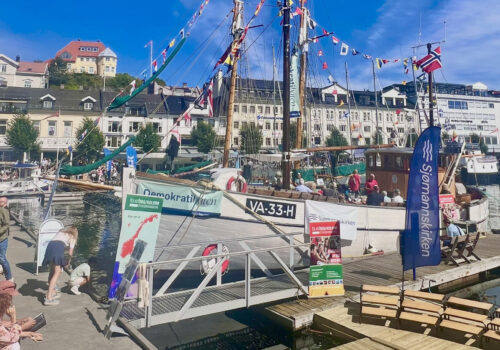
On the mid-August Saturday I arrived, it still felt unexpected to be there. The entire previous week, I was in the southern city Arendal for Norway’s democracy festival. I’d been in touch with Smit since the direct actions had started a month earlier. “You should get here as soon as possible,” she told me now.
A recent development had changed the protests’ atmosphere. In June, parliament had voted to arm the entire police force for the first time in history. Smit said the police in Kvalsund were noticeably emboldened and more aggressive. Back in 2021, although they were constantly present, not a single protester had been arrested. This year, it was suddenly routine.
In July, a chilling echo of history took place. Every Norwegian knows about the “Alta Controversy,” a 1979 reindeer-herder starvation protest against a hydropower dam planned on a grazing valley in Alta, just an hour from Kvalsund. The state’s military response was so shocking, it prompted a national reckoning over Indigenous rights, which eventually led to the 1989 formation of the Sami Parliament and ratification of the United Nations Convention of the Rights of Indigenous Peoples (UN ILO 169) the following year.
One morning in July, five members of the local Feittár reindeer-herding district joined the protest. They were arrested and carried from the mine site along with the other activists. It marked the first time since the Alta Controversy that Sami people were forcibly removed from their own lands.
“Things are changing quickly,” Smit said.
So on Friday evening, I flew north, rented a car and drove as far as I could along the six-and-a-half-hour route northeast. Around 1 o’clock in the morning, I pulled over near Kåfjord—famous for the Tirpitz, a German battleship still sunk on its seabed—quickly set up a tent in the rain and slept briefly before rising early to continue along.
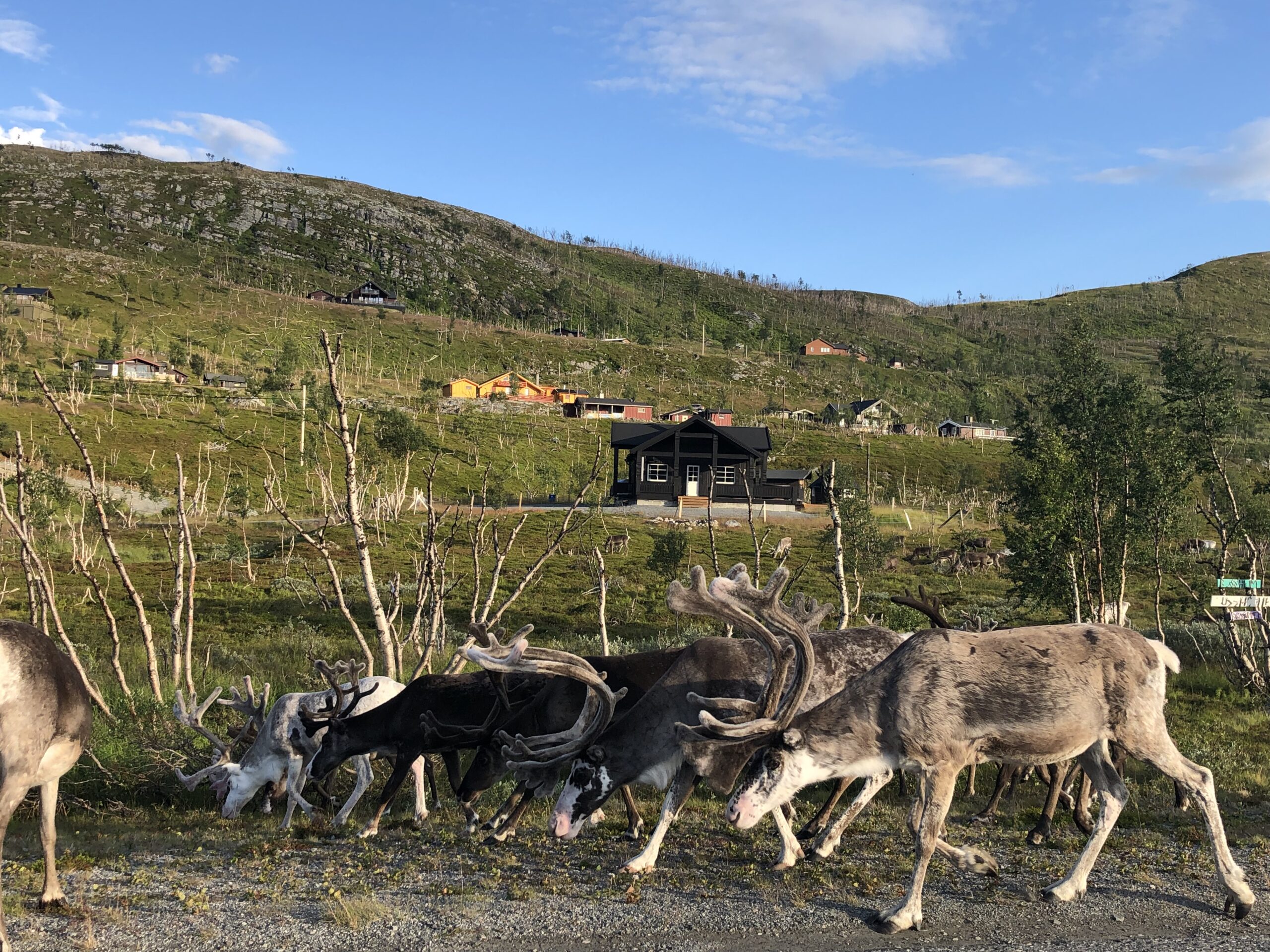
Wending my way north felt like driving back in time. I hadn’t been on these roads since 2021. But they felt increasingly familiar. Tall pines and sharp mountains flattened into tundra, green hills dotted with round shrubs and wide brown plains streaked with flinty rivers. This was Finnmark, Norway’s largest county. It’s also the Norwegian section of Sapmi, the Sami word for their northern territories spanning Norway, Sweden, Finland and Russia. Soon, reindeer were everywhere. I drove slowly and stopped several times for antlered wanderers with patchy summer hides followed by tottering calves.
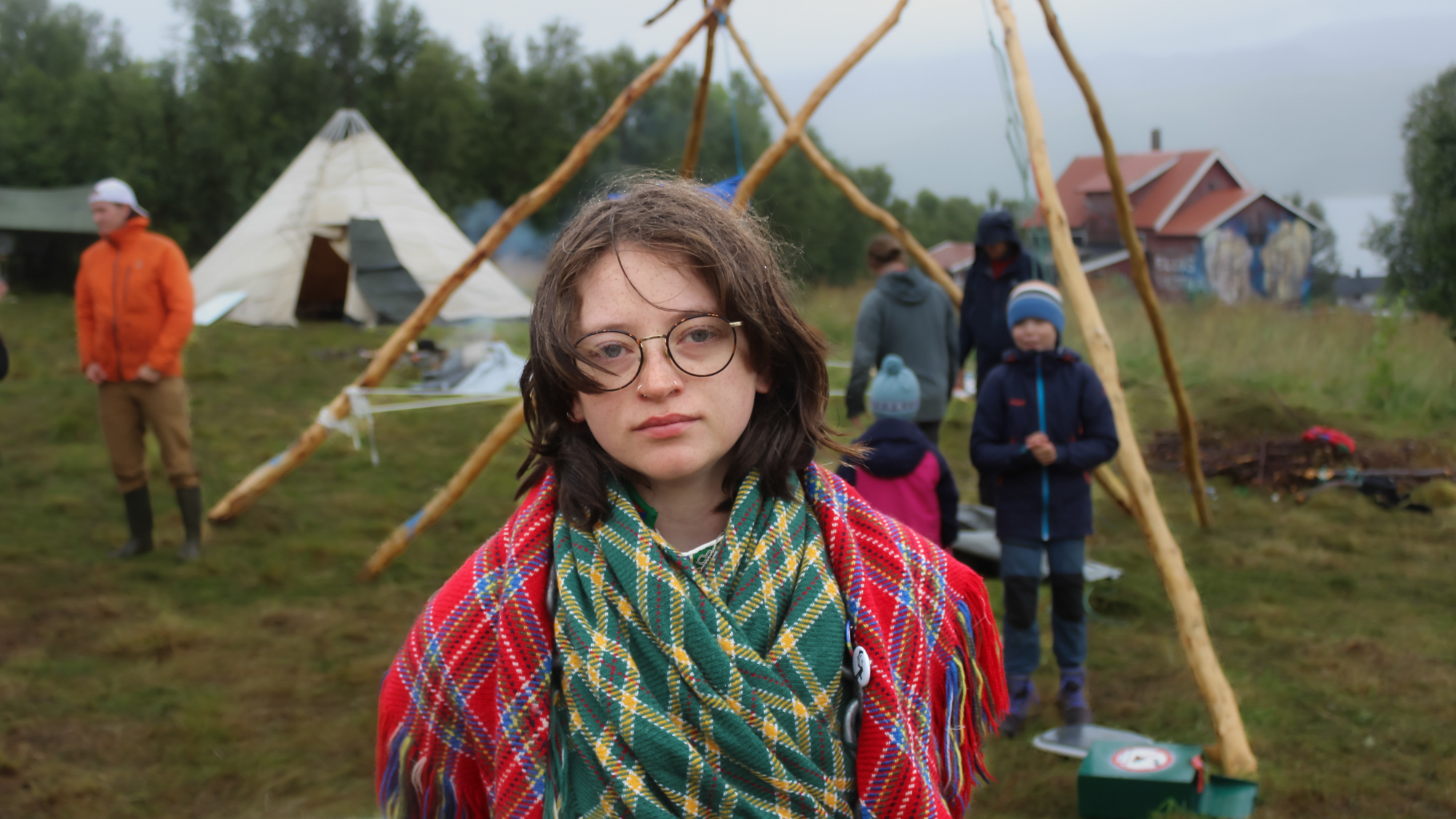
I arrived at the protest camp mid-morning, opening my car door to a rush of cold wind and the trill of birds in the treetops. As I walked through a line of trees on a ridge above the fjord, the echo of four-years-prior turned uncanny. Dotted across the muddy hillside field lay multicolored nylon tents, wooden structures built around fire pits and two large lavvo, Sami canvas tents. Scents of smoke mingled with saltwater as dozens of people of all ages milled around, bundled up in Norwegian wool sweaters, traditional Sami regalia, Gore-Tex pants and hiking boots.
The faces were largely unfamiliar. The camp is run by Nature and Youth, and many of its members had aged out since 2021. Still, its goals and methods remained, and all the young people present had trained for direct action and civil disobedience. The 10 protesters entering the mine site that day, aged 19 to 29, were prepared to accept fines for trespassing. They were hefty, the equivalent of $1,300 for the first violation, $1,500 for the second and $1,800 for the third.
“It’s an important part of civil disobedience that everyone accepts the same consequences, including openness about who you are and paying the fine,” Smit, an auburn-haired 20-year-old, told me. “Still, it’s a high consequence that is unfair for very young people to pay to stop a state action that is itself illegal.”
Just days earlier, Nature and Youth and Friends of the Earth Norway had enjoyed a precedent-setting victory: A Norwegian court had ruled against a similar mine waste dumping project at Førdefjord in the south. The organizations had fought the legal battle for more than a decade since 2007, when the government approved dumping 170 million tons of tailings into the fjord. In mid-August, the court found that the mine had failed to comply with the European Union Water Framework Directive, which Norway has ratified, and that its permits were therefore invalid.
Many of the activists felt hopeful that the Repparfjord had an even stronger case since Indigenous rights were also at stake. But others worried that the EU Critical Raw Minerals Act would work against them. As they still wait for the Nussir mine’s many lawsuits to work their way through the courts, Blue Moon Metals has already started digging.

“We have to stand up for each other and defend Indigenous rights one way or the other,” said the Sami woman sitting at the end of the line of 10 protesters, the ruffles of her traditional skirt edged with mud. She had grown up in a nearby reindeer herding district, she said, and had come to support her neighbors. “We have tried for many years. Now it has to come to this, that we sit in the mud and scream.”
At that, she began chanting, and her companions joined in. Far behind them at the tunnel’s edge, three mine workers in neon work gear stood with arms crossed, silently watching. I was inside the mine site, standing near them, but I had been told my time was probably limited. Because this was private property, my press pass wouldn’t protect me, and a non-citizen arrest could mean deportation. Once someone noticed me and asked me to leave, I would have to comply.
For a while, the handful of police at the site were busy with other matters: driving ATVs around the muddy ridge, checking the protesters’ identification cards and standing in huddles as they waited for backup to arrive from around the county.
“It’s such a waste of police resources,” a young protester said. “All of Finnmark’s police are coming here to drag us away. Who made them Nussir’s private security?”
Smit had warned me that the police had been aggressive at times. But from what I saw, the handful here seemed mostly defensive and a bit bored. After about an hour, I asked one officer if I could see his badge since I was curious which county he came from. Technically, he’s legally obligated to keep the badge visible. But he told me he didn’t have time to talk and then walked away to talk with another officer. The second officer took down my information and asked me to leave the premises.
As I walked down the long gravel road, the chanting continued echoing behind me.
* * *
The line of demonstrators stood at the fjord’s edge, fists raised in the air, eyes lifted. High on a ridge above them, Beaska pressed her megaphone against a chain link fence, yoiking to supporters gathered below. The two dozen or so ranged from very elderly to small children, some in gaktis and some in rain jackets. A small gray-haired man, sitting wrapped in a blanket with a drum between his knees, began tapping rhythmically. Soon, some onlookers joined the singing.
I had met Nils Utsi Sara, leader of the Feittár reindeer herding district, in 2021. He wasn’t there that day, but his family was well-represented. At one point, I approached a circle of young people with their hands in the pockets of Carhartt work jackets, talking quietly. They were reindeer herders, they said, and they’d all be affected by the mine. When I asked which families they came from, they looked at each other and exchanged smiles.
“We’re all Saras,” a young man in a dark beanie said.
The history of Sami people in Norway is a dark, colonial one. From the 1850s to the late 1970s, they faced aggressive “Norwegianization,” or forced assimilation policies. Children were made to attend boarding schools and punished for speaking their own language. Traditional dress, yoiking and other customs were banned. “Sea Sami” along the coasts were hit particularly hard, since Norwegians also fish. But reindeer herding, which only 10 percent of Sami practice, managed to survive. Still, prejudice and misconceptions abound to this day. At a dinner party in my base in the city of Tromsø slightly further south, I heard firsthand an otherwise liberal-seeming Swedish man explain, with a regretful cringe, that many Sami reindeer herders “are just after government money.”
The Nordic nations of Norway, Sweden and Finland are known for their progressivism. But their own Indigenous peoples are often cast as the not-in-my-backyard opponents of the same progress. All three nations have ambitious climate goals and all three have renewable energy and mining projects planned on Sami reindeer herding territory. Other legal battles are underway. In 2022, for instance, the Swedish government approved a mine planned for reindeer migration routes and the Laponia World Heritage site, a wilderness protected for its biodiversity and cultural value. When a Sami reindeer district appealed the decision in 2024, the country’s highest court ruled in the government’s favor.
Of the three countries, Norway has the most comprehensive legal protections for Sami peoples. But those laws are complicated. The 1968 Reindeer Herding Act enshrines Sami rights to herd reindeer where they’ve traditionally practiced it. But they coexist with other Norwegian rights to develop natural resources such as roads, power lines, windmills, hydropower and mines. Only when a court determines that development would violate international human rights law is a project stopped. Otherwise, the law requires herders to be financially compensated for disruption to their culture.
Because Norway ratified UN ILO 169, which protects the cultural heritage of Indigenous peoples, there must be “free, prior and informed” consent before their lands may be developed. The Sami Parliament and Feittár district have waged a legal battle against Nussir since 2019, citing both national and international law. They say the land was expropriated without their consent and that permits were granted without full consideration of the impact on their culture and reindeer husbandry.
From my reporting in 2021, I knew that local tensions between and among Norwegians and Sami in Kvalsund ran high. The municipality approved the mine, and many locals support it. But more than a century of forced assimilation complicated questions of identity in the north. Many people with Sami heritage had simply never learned about it because of both law and generations of caution. I have spoken with those who resent the protections that the reindeer herding minority seem to enjoy. And I’ve met teenagers who said that although their parents are Sami, they’re “not one of those reindeer people” themselves.
In late July, the protesters arrived at the mine entrance to find a reindeer skull spray-painted red and mounted on a wall. Many took it as a direct threat.
“We are in a dark side of history now,” a Sami activist named Aslak Henrik Lango told me on a recent phone call. “I don’t think all of the young people take the threat very seriously. But I think it is very serious.”
Lango’s brother is Feittár district leader Nils Utsi Sara. Lango had supported the protests from afar for years and largely left the activism to his older sibling. This year, however, his astonishment at the pace and ferocity of the mine’s return—plus what he sees as a global trajectory toward fascism, violence and injustice—inspired him to fight on the ground.
“I decided not this time and not on my watch,” he said. “It’s a collective society, Sami culture. It’s only the Norwegian state that divides us from each other. As long as we can stay together and look past that unjust way of dividing people, I believe that we can win.”
In fact, Norway has great ambitions for this region. And Feittár and two other herding districts lie at ground zero. In Hammerfest, only about 5 miles away, construction is underway on what Prime Minister Jonas Gahr Støre calls “the biggest climate project ever passed by a Norwegian government,” transitioning a liquified natural gas power plant to run on renewable electricity. Norway needs the project to reach its Paris Climate Agreement goals, since the plant, on a small island called Melkøya, is one of its biggest point-source polluters. But the climate accounting raises serious questions: As long as the fossil fuels are burned abroad, Norway gets to call it net-zero.
The cost to Indigenous lands and high north biodiversity doesn’t enter the equation. The state-run company developing the project, Equinor, has already installed a power cable, which runs directly through Feittár as well as the neighboring Fála and Gearretnjára reindeer districts. Powering the LNG plant will require thousands more windmills. The plans are universally unpopular in the north, not least because they will drive up energy prices and install many more windmills on undeveloped land.
In June, a court ruled against the Sami Parliament in a case demanding that the government evaluate all windmill projects powering the Melkøya plant electrification under one environmental impact assessment. (Currently, they’ll be considered separately as piecemeal ventures.) Not only did the Sami Parliament lose the case but it was also forced to pay the government’s legal fees.
“We’ve worked a lot against the electrification of Melkøya, and it’s really hard to sit here at Nussir and watch the helicopters fly in materials.” Smit said. “It opens the perspective overall for Finnmark: There will be more companies like this, looking for minerals and places to develop.”
* * *
I missed the arrest, which took place after I was asked to leave. But I watched the videos over and over on social media during the following weeks. The cast rotated to minimize the financial burden on each, but the pattern was the same: Protesters lay on the ground as the police approached. Two officers operated large clippers breaking one body free of the steel chain at a time. A slow and strangely intimate process followed: Lifting limp limbs and rolling torsos, officers wrapped each demonstrator in a canvas bag. It took four to carry one person to the back of a van. The whole job took about an hour.
As a brief late-September warm spell quickly dissipated in October snow, the demonstrations and arrests continued. The camp passed 100 active days, beating the 2021 record for the longest-running protest settlement in Norwegian history. To this day, demonstrators continue to lie on freezing gravel, swapping sweaters for snowsuits, holding out until winter weather halts construction.
More recently, activists set their sights on a more prominent target. Last month, a group of protesters stood outside the London offices of Hartree Partners, one of Nussir’s major financial backers. Its portfolio targets renewable energy investments. The activists, led by the Sami popstar Ella Marie Haetta Isaksen, had repeatedly requested a meeting with the group but received no response. Instead, she and a dozen others stood outside the office in Sami traditional regalia, holding signs and singing. When company representatives finally emerged, Isaksen handed over a letter demanding divestment from the project.
“As Sami artists and cultural workers, standing up against land-grabbing in Sapmi isn’t a choice, it’s a responsibility. Our lands are our culture, our culture is our survival,” Isaksen said in a video she posted on Instagram. “Hartree claims to care about the planet and human rights. If that is true, now is the time to prove it.”
Top photo: In Kvalsund, Norway, in mid-August, Nature and Youth group and Sami demonstrators chained themselves together to block construction on the Nussir copper mine.