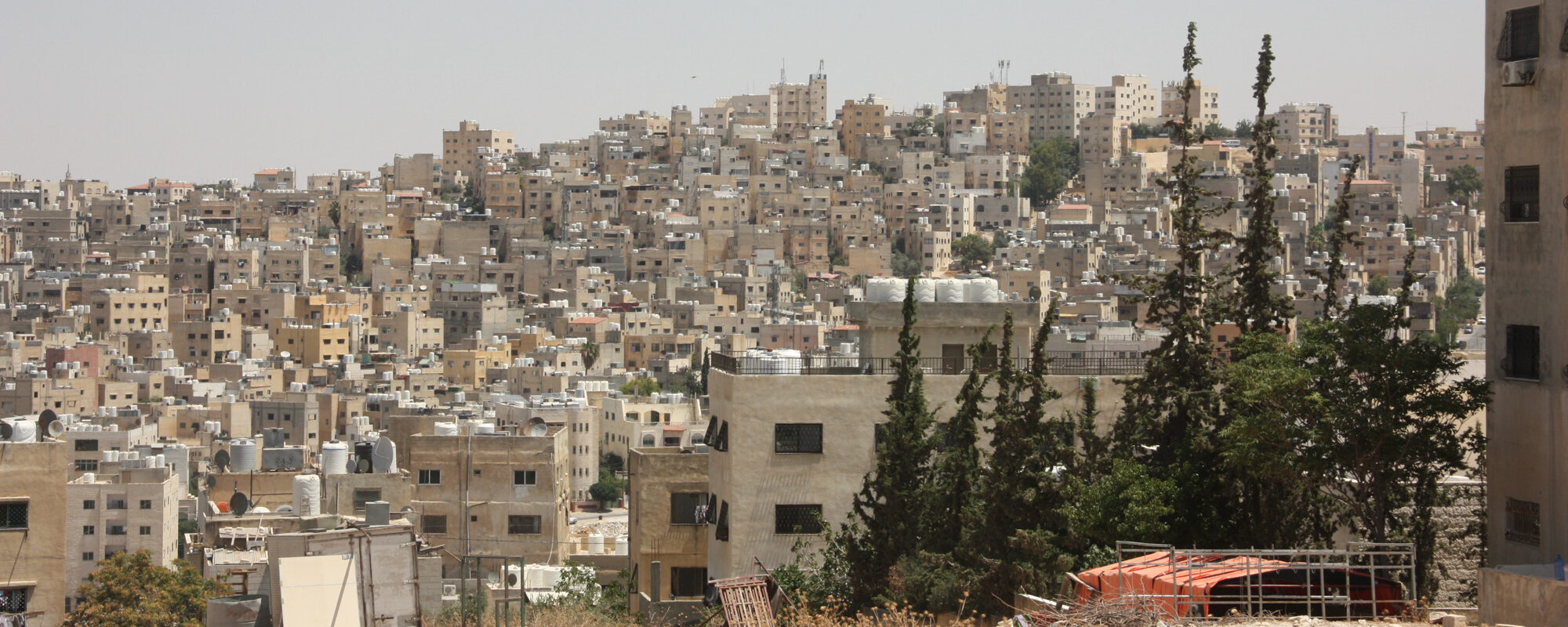
AMMAN, Jordan — A short drive east of this city’s historic center, in a valley nestled between steep hills carpeted in a dense array of gray apartments, stands a hulking concrete structure 12 stories tall. It towers over the scrapyards and gas stations that fill this industrial corner, a neighborhood called Wadi Al-Rimam. According to legend, locals began calling it by that name, meaning “valley of carcasses,” after a deadly flash flood swept through, engulfing a caravan of camels. Framed by automotive parts shops and an old Ottoman railway bridge, the concrete behemoth was shocking to behold. Squinting, I could just make out the faded letters on its sheer face: MEGA MALL.
I first spotted the building from the back of a taxi several weeks after I had arrived in Amman to begin my Institute of Current World Affairs fellowship examining how Middle Eastern societies are responding to environmental, economic and political crises. I thought a good place to start would be to look at how the city is trying to build more parks to help alleviate a severe dearth of green spaces—particularly essential as climate change and rapid urbanization make an average summer here hotter than ever before. But as soon as I saw it through the window, I was transfixed by Mega Mall.
I dug up all the information I could. In the mid-2000s, a company called Beitna Investment began drumming up funding for a massive mall complex in the eastern part of the city. More than 9,000 small-scale investors poured their savings into the project, no doubt expecting returns they could use to finance their children’s educations and other needs. Construction began in 2004 and was supposed to be only the first phase of a massive development that would include multiple towers, bridges and rivers suspended in the air.
But Beitna collapsed after the 2008 financial crisis, absconding with investors’ money. Some people lost their life savings; many protested outside the company’s offices to no avail. The lone tower that had been constructed stood as a testament to the devastation.
As I learned more about Mega Mall, I found the project increasingly fascinating. Amman is filled with malls where families with children, couples and packs of teenagers converge on an average weeknight. But this one stood out because all the other malls are in the city’s west; Mega Mall is in the east. The divide between the two halves isn’t marked on any map. But it’s glaringly obvious on even one drive through Amman and becomes clearer the more time you spend here.
West Amman is filled with leafy residential districts and car dealerships, Pinkberry and Starbucks. East Amman is denser, more crowded, the streets narrower. There are fewer trees. Many of the buildings are made of unfinished concrete while those in the west are clad with the city’s characteristic yellow-gray limestone. Living in the west comes with a connotation of wealth and refinement; in the east, with poverty and potential danger.
Of course it’s important not to oversimplify differences; Amman is diverse, filled with pockets of relative wealth and poverty in all cardinal directions. And as with any generalization, the designation of east as “poor” flattens the area’s distinct and historic identities into overarching stereotypes. But I couldn’t ignore something everyone I spoke to acknowledged was clear and didn’t really question. I also hadn’t previously questioned it despite having lived here for several months during my junior year of college and visiting over the years since. This time, however, the differences smacked me in the face. Amman was never partitioned into two halves like Berlin or Beirut. Why, then, is the contrast between east and west so clear?
I’m not the only one to notice the split. The 2003 Lonely Planet travel guide to Jordan notes that “residents talk openly of two Ammans.” Western districts are called “shiny” and draw comparisons to Paris; the east, meanwhile, “is home to the urbanized poor.” The west is filled with trendy cafes, bars and art galleries; the east, cement factories and landfills.
The difference wasn’t always so distinct. According to a Jordanian journalist named Ahmad Abu Khalil, the terms “east” and “west” Amman caused an “uproar” when they were first mentioned in a local newspaper in the mid-1970s. At the time, different social classes still interacted in the thriving downtown district and other parts of the city. Over time, however, the shared spaces began disappearing and the divide crystallized. “Today, the issue has become clear, and everyone talks about it,” Abu Khalil told me in Arabic.

The causes behind the stark differentiation go back to the era immediately after World War II, when a newly independent Jordan turned to British planning models to try to regulate the city’s growth. The new authorities divided the city’s land into four zones with different rules for housing construction. Zones A and B, located mostly in the west, required buildings to be set farther apart and surrounded by gardens. Zones C and D, clustered in the east, allowed for much denser housing. At the time, it seemed like a natural approach to development in a city that was already drawing a massive influx of new residents around Palestinian refugee camps in the east, while wealthier families were settling on empty plots in the west.
The planning decisions sought to create a more orderly metropolis if not exactly one that encouraged mixed-income housing. Today, however, the historical policies uphold self-reinforcing feedback loops, where poorer and more crowded neighborhoods have more difficulty receiving basic services and improving their quality of life. At the same time, Jordan has poured billions into megaprojects to try to attract foreign investment—projects like Mega Mall. I wanted to understand how residents in the east were responding to their challenges and whether it’s possible to create solutions at a neighborhood level when large-scale urban revitalization seems like a far-off dream. But I first had to understand the history of urban policy in Amman.
* * *
Like Rome, Amman was originally built on seven hills. The city’s history goes back more than 3,000 years to when it was the capital of the Ammonites, a people mentioned in the Bible. It was conquered by ancient Egyptians, Romans and Arabs under the Damascus-based Umayyad dynasty. Over ensuing centuries, however, it declined to little more than a village.
Its fortunes changed in 1921 after the Ottoman Empire fell and the area now known as Jordan came under British control. After the Hashemite Emir Abdullah I, the first king of independent Jordan, named it his capital, the city began to rapidly expand. Today, Jordan is a constitutional monarchy with a parliament, where the king maintains ultimate legislative and executive authority, directing the country’s economic policies as well as managing its political climate by appointing the prime minister and frequently dissolving the legislature.
When Israel declared itself a state in 1948, destroying Palestinian villages and expelling their residents, as many as 100,000 Palestinian refugees poured into Jordan. Although many of the first arrivals received citizenship and spread throughout Amman, thousands were officially registered as refugees with the United Nations and settled in camps in the east of the city; their descendants remain there to this day, reserving their right of return to Palestine. With the arrival of more refugees after Israel occupied the West Bank in 1967, the neighborhoods in and around the camps grew denser. The settlements were informal and unplanned, lacking running water, sewage and other basic services.
The government sought to alleviate some problems, providing electricity and water to the camps and eastern neighborhoods that ballooned around them. It also helped residents obtain formal ownership of their land and houses, while also building health clinics, mosques, parks, playgrounds, schools and community centers. But well-intentioned policies clashed with the financial realities of a globalizing economy.

Although Jordan has few natural resources or domestic industries, throughout the 20th century, its government has heavily invested in education and subsidies for its population, as well as in the military. By 1989, the country’s debt reached $8 billion, more than double its GDP. That’s when Jordan signed its first deal with the International Monetary Fund, worth about $275 million at the time, in exchange for enacting austerity. The kingdom began to privatize public transportation, trash collection and other city services. The era of welfare spending was over and neighborhoods in the city’s east were largely left to fend for themselves.
The west, by contrast, was attracting a new wave of government and foreign investment. King Abdullah II, who succeeded his father King Hussein in 1999, decided the city would have a new shopping and administrative district called Abdali, featuring a mall complex, national mosque and parliament building. The project required moving the central bus station north of the city, which lengthened commutes for 70,000 people who could not afford cars. Elsewhere in the city, office towers, gated complexes and massive roads and bridges aiming to accommodate increasing traffic began springing up in districts far from the historic city center, including Abdoun and Swefiyeh.
That style of urban development isn’t unique to Amman, of course. Cities around the world increasingly began chasing foreign investment in the neoliberal 1980s, often prioritizing public austerity over meeting immediate local needs. Investors called for increasing land values and attracting high-value industries such as banking and tourism instead, a process the geographer David Harvey calls the “spatial fix.” In the Gulf, oil wealth would be channeled into physical infrastructure and real estate that would generate returns, helping transform Dubai, Abu Dhabi and other cities from modest fishing towns into globalized metropolises with gleaming skyscrapers.
In 2019, Mohsen Aboutorabi and Bushra Zalloom, architecture professors in Britain and Jordan, described the prioritization of economic growth as having “transformed the traditional cityscape” from one specific to its place to “a global one with no reference to its historical background.” Glass office buildings, shopping malls and massive concrete highways are ubiquitous, homogenizing cities “to an extent that one of them can represent the whole urban character of the era.” In Amman, the process has led to the decentralization of landmarks like its vibrant downtown, where people of different socioeconomic backgrounds used to gather.
Today, the country clearly recognizes the need for urban development policies that would do more to center residents’ immediate needs. In 2024, the Council of Ministers approved the Jordan National Urban Policy, developed in collaboration with the United Nations, laying out plans for creating cities that are “environmentally sustainable,” “economically prosperous” and “well-connected.” The document acknowledges the need for greater public transit, more parks and decision-making that draws residents into the planning process. But it’s hard to see how that would happen without adequate financing. After the 2008 financial crisis and 2011 Arab Spring protests, many of the city’s more ambitious plans have been cut or downsized.
Meanwhile, other government policies continue promoting further privatization and land speculation. Myriam Ababsa, a geographer and urban planner associated with the French Institute for the Near East (IFPO), told me that Amman, like many other cities in the region, is suffering from a “hidden housing crisis.” Meanwhile, nearly a quarter of apartments are vacant, built by investors who don’t live in or rent them but see them as a source of future returns. (The numbers are similar in Beirut and Cairo.) Since the government doesn’t tax undeveloped land, vacant plots also dot the city like missing teeth. East Amman, meanwhile, is suffering from overcrowding, particularly among refugee populations. Multiple generations share the same home because families can’t afford apartments for their married sons.
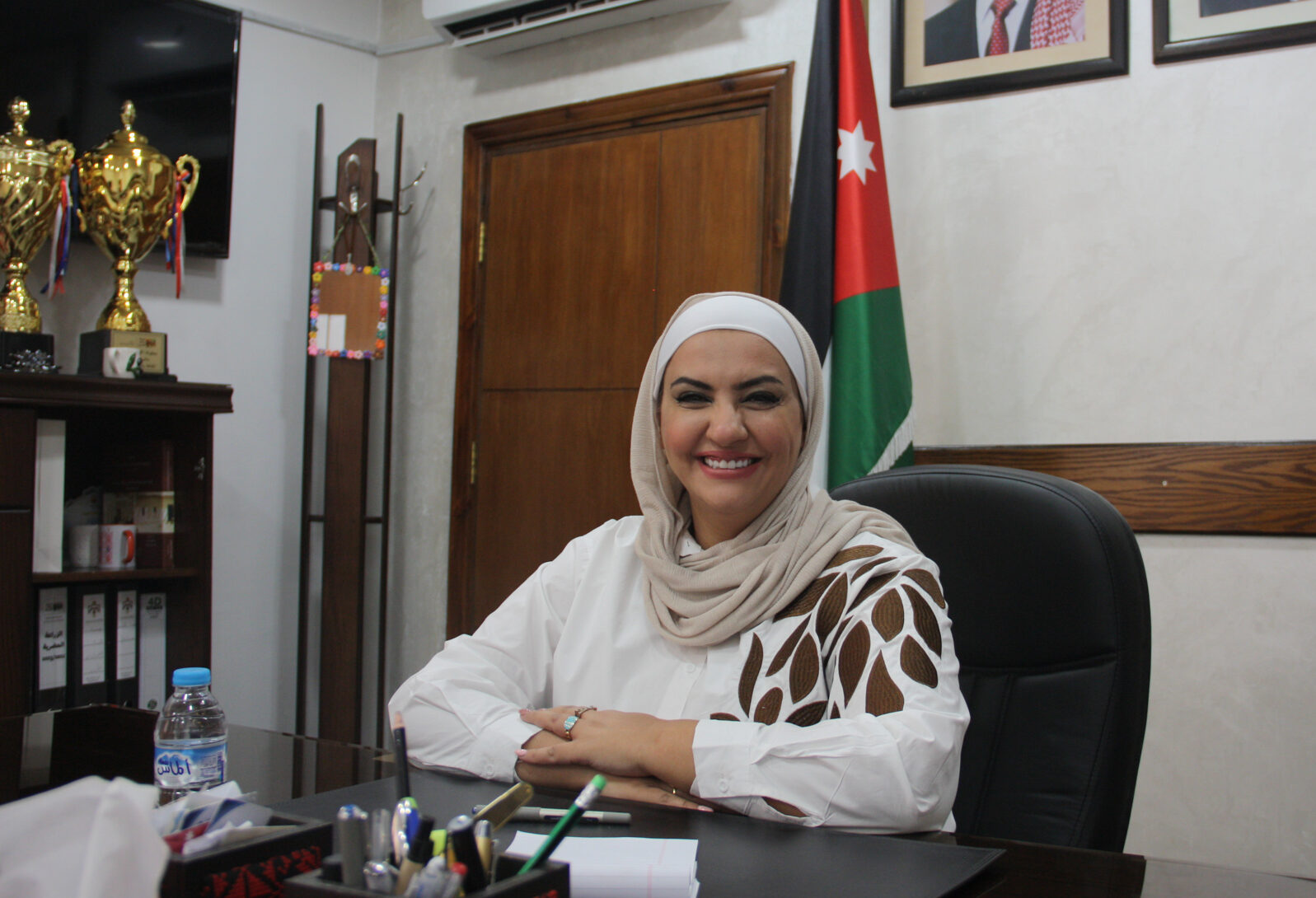
Despite voicing support for making the capital city more livable for those worse off, the government instead seems poised to try to shift its population elsewhere. Late last year, Prime Minister Jafar Hassan announced plans would move forward to build a new “smart city,” to be known as Amra, in the desert east of Amman. The project was first proposed as a new administrative capital in 2017 but delayed by the Covid-19 pandemic; the updated vision clarifies that it would not actually be a government center but rather a solution for “managing population growth” and “creating investment opportunities,” according to the state news agency.
Amra is set to feature mega projects that would put Abdali to shame, including an international exhibition and conference center (slated to be completed by next year), a sports city with an international soccer stadium, an Olympic city, car-racing track, 250-acre park and an “entertainment city.” Rapid bus lines would in theory connect the new city to Amman.
But it’s not clear who will be able to afford to buy a home there. The plans parallel those of other countries in the region constructing new cities from scratch—most notably Egypt, which built New Cairo City with the ostensible goal of easing overcrowding. Instead, it has functioned mainly as an upscale satellite city for wealthier residents and remains mostly vacant.
* * *
Examining the city’s history brought me back to Mega Mall. The project was initially pitched as a solution to the problems plaguing east Amman—lack of job opportunities, green spaces and entertainment. A 2007 article in Al Rai, Jordan’s newspaper of record, described it as “the first commercial and investment project to be established [in the] east of Amman,” saying it would “meet the needs of residents” and “improve their living standards.” But its eventual collapse demonstrates the risk of outsourcing to a private company aiming to make a profit for its backers.
Many of the problems the Mega Mall project was supposed to help address remain largely unchanged. Today, residents of eastern districts have more difficulty accessing services from health clinics to schools. Jobs are largely located in the west, and without decent public transportation, many are deprived of work opportunities, especially women, who are much less likely to drive than men. The denser populations also throw the lack of green space—an issue throughout Amman—into sharp relief. Children need more spaces to play; teenagers don’t have enough places to socialize.
Other new projects have attempted to address these issues in a way that centers people’s needs over profit. To understand how, I spoke to the architect Mariam AlAzzeh, founder of the firm Erth, which aims to introduce modern construction to Jordan using a traditional material: earth. AlAzzeh founded the firm in 2023 after struggling to develop housing solutions for low-income families while working with nonprofits. Building materials were too expensive for the projects to afford; all new structures had to be made with concrete and reinforced steel that must be imported. Rammed earth, formed by heavy machinery that compresses dirt into a stable building material, could be an alternative.
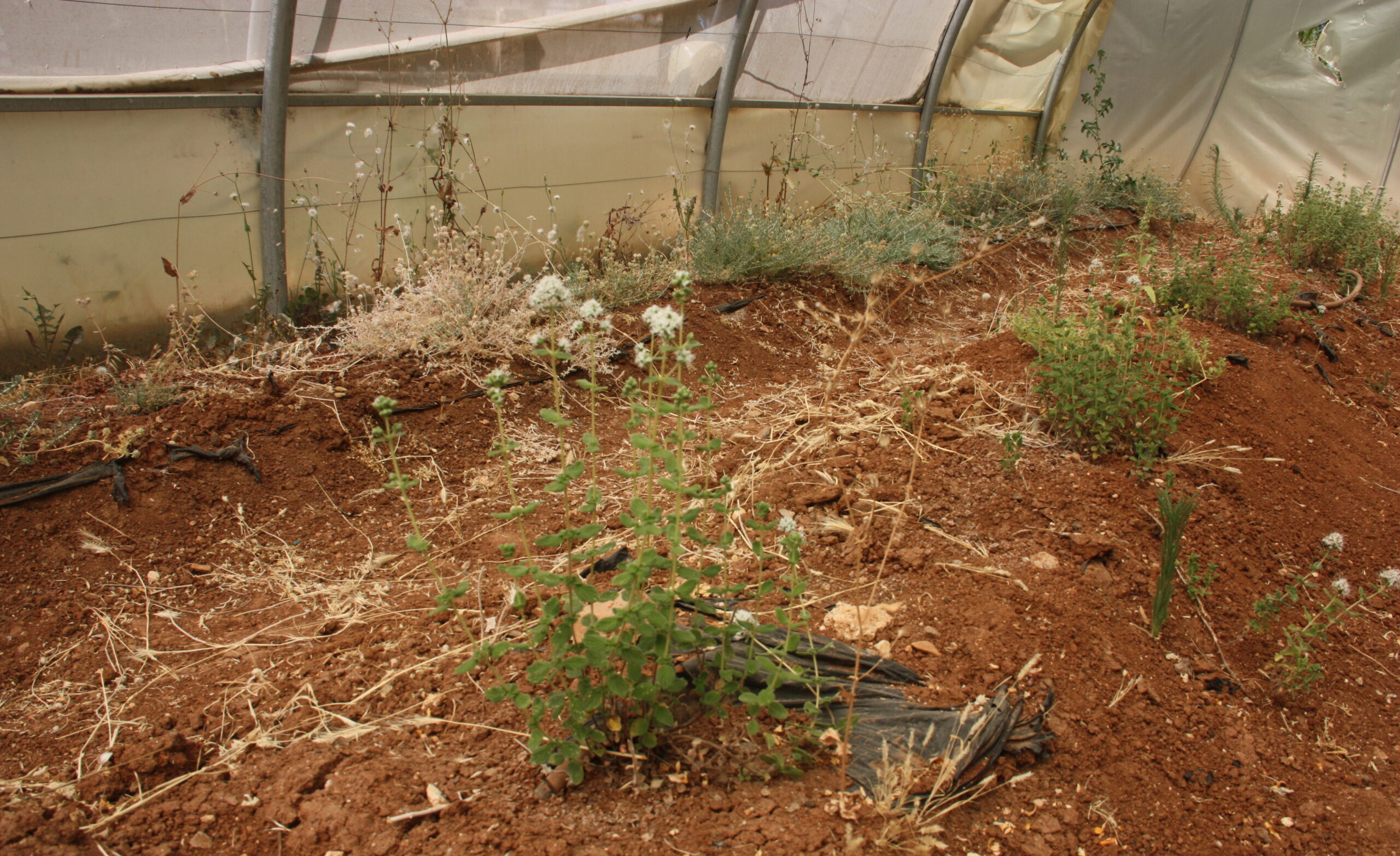
Building with rammed earth isn’t legal in Jordan, however, and regulations take time to change. But AlAzzeh is working with the country’s engineering association to demonstrate earth buildings can be safe. Rammed earth could provide a cheap, efficient alternative to concrete, she said, and help address the city’s housing crisis. (Such buildings are legal in France and many other countries.) The company name “Erth” not only evokes the material; it’s the Arabic word for “heritage.” Jordanians once built their homes with earth and stone, and AlAzzeh sees her project as a natural reclaiming of tradition.
“We are opening up other alternatives for the people,” she told me. “In case of any interruption of the supply chain, I care about people being able to find material to build their houses.” Supply chain shocks were devastating during the Covid-19 pandemic and, more recently, the US-Israeli war against Iran. “This is a way to have resilient communities,” Al Azzeh added.
Another way is by investing in the city’s parks. On a bright, sunny Sunday morning—the start of the work week in Jordan—I took a taxi to Queen Rania Abdullah Park in the Umm Nowarah neighborhood of east Amman, just south of Mega Mall. The park sits atop a steep hill surrounded by multistory apartment buildings. Rasha Shawarbeh manages the park on behalf of the Greater Amman Municipality, the local administration. She’s worked here eight years and described its role in the community with obvious pride. “The residents care for this park more than the city does now,” she said with a smile.
It has tree-lined pathways, benches for the elderly and a playground. It also has vocational training facilities for hairdressing and tailoring. The park offers a free summer camp for children and workshops teaching how to responsibly use AI. (One of residents’ biggest questions, Shawarbeh told me.) When I took a walk around the grounds with Ibrahim, who lives in the neighborhood and works at the park, he showed me the urban garden, where residents learn to grow fresh produce they can consume at home or sell in the local markets.
“If I give you something here—you benefit from it, but the benefit isn’t going to be very great,” he told me in Arabic. “The greater benefit comes when you learn to do it yourself, when you use your own hands and plant with your own hands. Then you’ll learn how to grow things yourself.”
Queen Rania Abdullah Park is just one park in a city of four million people. It relies on financing from the city government as well as international institutions including the United Nations Human Settlements Program and GIZ, Germany’s main foreign development agency, so it’s not exactly self-sufficient. It demonstrates what’s possible, however, when people’s needs are centered in designing truly public spaces. Later, as I drove home, I passed once again under the shadow of Mega Mall.
Top photo: East Amman