
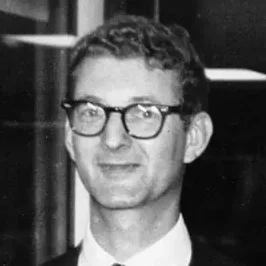
After earning a bachelor’s degree in European studies at Yale in 1943, Richard H. Nolte served as a US Navy pilot in World War II. After the war, he returned to Yale and earned a master’s in international relations, followed by a Rhodes scholarship. At Oxford, he began studying Arabic, Arab history and Islamic law. Dick’s ICWA fellowship sent him to Beirut in 1951, where he and his wife lived four years. He followed his fellowship with a turn as Middle East specialist for the American Universities Field Staff.
Dick became ICWA’s second executive director in 1959, remaining with the institute until 1978. He expanded ICWA’s traditional field of study in diplomacy and journalism to award fellowships in music, health and other disciplines. And he appointed ICWA’s first woman fellow, Barbara Bright. His interest in the Middle East remained active, leading to publishing his 1963 book The Modern Middle East.
In 1967, President Lyndon Johnson appointed Dick to be US ambassador in Egypt. He reached Cairo in May, but two hours before he was to present his diplomatic credentials to President Gamal Nasser, the Six-Day War broke out. Nasser refused to approve his accreditation, so Dick’s first and only job in Cairo was to help evacuate American citizens stranded in Egypt before he himself was expelled from the country on June 10. In a September 1967 article, The Washington Post described Dick’s tenure as “one of the shortest and most hectic diplomatic careers on record.” (The Americans Dick helped evacuate from Egypt were shipped onward to Greece, where fellow ICWA alumnus Phillips Talbot received them as US ambassador.)
Dick served as the chairman of the American Geographical Society from 1988 to 1996, and was a member of the Near East Foundation, the World Academy of Art and Science and the Council on Foreign Relations.