THE HAGUE — Massive floor-to-ceiling slate grey curtains hung unmoving behind the widest, thickest glass panels I had ever seen. I was seated in the public gallery of the International Criminal Court (ICC), surrounded by members of the international press, diplomatic corps from ICC state parties—the court’s 125 member countries—and representatives from many civil society organizations. In this nondescript amphitheater, filled with anticipatory murmurs as everyone settled in, I felt more like I was in a cinema than witnessing the start of a major international trial.
Without warning, the curtains silently parted and the court’s security members gruffly bid the audience to “All rise!” We watched raptly as the courtroom was revealed several feet below us, as nondescript and inoffensively colored as the gallery room, the only recognizable decoration the ICC logo framing the judicial bench. Mapping each of the groups set up across the chamber—some faces I recognized, public-facing figures like Deputy Prosecutor Mame Mandiaye Niang and Defense Counsel Nicholas Kaufman—I keenly felt the distance between the proceedings and onlookers, set up like spectators in a coliseum before gladiators about to engage in battle.
Three Pre-Trial Chamber judges—Iulia Motoc, Reine Alapini-Gansou and María Socorro Flores—glided in wearing royal blue robes. All parties bowed toward the judges, who bowed in turn, and then we were all seated.
Conspicuously missing was the defendant himself, former Philippines President Rodrigo Duterte, who had waived his right to appear. As I scanned the floor, it was not immediately clear where he would have sat amid the simple office-like layout of courtroom tables, divided between the prosecution and the legal representatives of victims (LRVs) on one side and defense on the other.
I expected that Duterte’s decision to stay in his prison cell, only a few blocks away from the court, would inform how the lawyers would shape their legal arguments and counterarguments over his guilt for crimes against humanity. Instead, his absence created a vacuum that brought a different focus to the fore: the Filipino people. Over the course of four days, the widely covered hearings operated as a tug of war between the parties vying to land the most resonant and persuasive soundbites tailored to the most important audience, the Filipino populace watching on screens 6,000 miles away. The result was a stirring and contentious display of the country’s recent history and politics, almost operatic enough to rival a Philippine telenovela itself.
* * *
Confirmation of charges proceedings are distinct from typical trial hearings before the ICC. They are the first checkpoint a case must pass before it goes to trial, similar to the indictment process before a grand jury in the American legal system. During the proceedings, the Pre-Trial Chamber reviews evidence put forward by the prosecution to determine whether there are “substantial grounds to believe” the defendant has committed alleged crimes—a standard far below the prosecution’s burden of proof “beyond a reasonable doubt” during trial. The other parties, the victims’ representatives and defense, also present evidence or challenge incriminating evidence during the proceedings.
The case opened with the presentation of charges levied against Duterte: Forty-nine incidents of murder and attempted murder resulting in 78 victims (including children). That’s a fraction of the total number of deaths the Philippine National Police recorded as part of Duterte’s “war on drugs,” representing a little over 1 percent of the nearly 6,000 total deaths. Human rights organizations say the number is closer to 30,000.
As I described in my previous dispatch, Duterte initiated his “war on drugs” as a means of tackling the problem of trafficking throughout the country. In implementing the “tough on crime” approach, police carried out operations that often resulted in shootouts and what human rights advocates deemed extrajudicial killings, pointing to widespread falsification of evidence, deliberate targeting of victims and other abuses. Under the ICC’s framework for international crimes, Duterte’s role in ordering the killings makes him allegedly responsible for crimes against humanity.
The accusations spanned his tenure as mayor of Davao City, on the southern island of Mindanao, from 2011 to 2016, during which he oversaw the activities of the “Davao Death Squad” and during his presidential administration from 2016 to 2019, when nationwide barangay (neighborhood) clearance operations and police attacks against “high-value targets” led to a stunningly high death toll.
The presentations by the prosecution, victims’ representatives and defense rested largely on the technical legal definitions of crimes against humanity under the Rome Statute, the treaty creating the court and its legal framework, as well as the “mode of liability”—the way in which the prosecution would try to prove Duterte’s individual criminal responsibility for the widespread murders—of indirect co-perpetration, an ICC-specific concept developed to describe the guilt of those at the top of organizational hierarchies.
Despite the case’s technically complex aspects, each party’s arguments were clearly oriented toward the audience outside the courtroom.
The prosecution opened its case directly addressing its importance for those in the Philippines, saying that the charges involved a small fraction of the crimes experienced in the country and were meant to represent the larger atrocities experienced by the Filipino people. The victims’ representatives followed by condemning Duterte’s absence for detracting from a full sense of justice. The international prosecution of Duterte, counsel Joel Butuyan said, “symbolically represents the last boat that the victims can board to go on a journey in search of justice for their loved ones who were brutally killed” on his orders.
The rhetoric had its intended effect. Back in the Philippines later, I spoke with Aurora Parong, chair for the Philippine Coalition for the ICC (PCICC)—a group of civil society organizations—who pointed to Butuyan’s boat metaphor. “The Philippines is a country with thousands of islands so we’re very familiar with maritime transportation and livelihoods,” she said. “These images are impactful not only for the families of victims but for Filipinos as a whole.”
Some victims were present in the gallery, but many more congregated at watch parties back in the Philippines, where civil society organizations provided real-time interpretation of the English-language proceedings. Some human rights lawyers were also present in person to help explain legal concepts. “These livestreaming events were a good opportunity for families to understand the otherwise foreign discussion in The Hague,” Mia Baybay of the Philippine Human Rights Information Center (PhilRights) told me later in Manila. While the multinational ICC teams almost always spoke English or French, the Filipino victims’ representatives, fluent in the context and language, used Tagalog, often quoting victims directly when recounting particularly egregious cases of killings, which proved especially effective.
Duterte’s defense also directly addressed those watching at home. Defense Counsel Kaufman opened with a fiery condemnation of President Ferdinand Marcos’s cooperation with Interpol to arrest Duterte back in March 2025, describing it as an “unconstitutional hijacking.” A consummate showman even garbed in the court’s plain black ceremonial robes, Kaufman commanded the courtroom’s stage from his defense podium, his British accent belying a love of distinctly American idioms sprinkled throughout his speeches.
The Philippines’ current president is the son of the formerly deposed dictator, Ferdinand Marcos Sr., infamous for his imposition of martial law from 1972 to 1986 that resulted in widespread killings, disappearances and human rights abuses. With members currently serving in Congress in both the House of Representatives and Senate, as well as governor of their home province Ilocos Norte, the Marcos family remains one of the most prominent political dynasties in the Philippines. But it has been grappling with the Duterte family for influence and power, one of the few who rival the Marcoses in popular support, since 2021. Sara Duterte, daughter of the former president, currently holds the vice presidency, while other Dutertes are in Congress and government positions in their home city Davao.
Characterizing the prosecution and victims’ representatives’ accusations against Duterte as “political demagoguery,” Kaufman placed the case in the context of the broader political rivalry between the Marcos and Duterte families, arguing that the current prosecution was a means of affecting regime change by taking Duterte out of power—made even more outrageous, he said, because of the widespread popularity that helped elect Duterte to office as the nation’s president and, more than seven times, mayor of Davao.
Lauding Duterte as a “unique phenomenon,” Kaufman pitted the two presidents against each other, saying Duterte’s obsession with “law and order” originated from his upbringing during Marcos Sr.’s martial law era. In contrast to the Philippines under the current president, Kaufman argued, thanks to Duterte’s leadership, “Davao City is now one of the safest in the world,” prompting laughs and guffaws from the gallery. (In 2025, the World Travel Index ranked Davao City 1,132nd of 3,028 cities in perceived safety.)
With elections approaching in 2028 and Sara Duterte planning to run for president, the pivots away from the case’s legal elements toward the perceptions of Filipinos took on larger importance. It appeared to be a bid to affect voters’ hearts and minds, back home and among the widespread diaspora, rather than addressing the immediate matter at hand.
In contrast to the hearings’ legal jargon, the presentations by the prosecution and victims’ representatives vividly described the experiences of the drug war’s victims and lived experiences of their families. To underscore the brutality of the killings, the prosecution presented a well-known photograph taken after one of the murders, informally known as “Pietà.” Shot by Raffy Lerma, a photojournalist who was also in the gallery, the portrait depicts the partner of an extrajudicial killing (EJK) victim, weeping and cradling his body to her chest while a cardboard sign labeled “[Drug] pusher” lies a foot away. Outside the court, Lerma spoke to a group of human rights advocates about the photo and his years-long coverage of the drug war. He said he still pictures crime scenes years later—murdered victims, grieving families—when he passes the same sites at busy roadsides and underpasses.
Pietà went viral during early news media coverage of the drug war in 2016, and those watching the hearings had likely seen the image before. Still, I could hear audible reactions when video monitors displayed the image, as if we were seeing it for the first time.

The heaviness of the depictions of violence and reactions of those in the gallery seemed integral, or intentional, to the presentation of the case. Those watching remotely, Baybay told me, also found it an “overwhelming experience and highly emotional.”
In one presentation, victims’ representatives described how drug war operations often resulted in the killings of men who were breadwinners, consigning their already impoverished families to further destitution, damaging children who were orphaned or had to drop out of school, and replicating the harm across entire communities targeted by the operations. The woman sitting next to me—one of the victims who had travelled to The Hague—began to silently cry; I saw her wipe tears away in the reflection of the courtroom glass.
After the depictions of suffering, the prosecution went on to describe Duterte through his own statements, presenting direct quotes reflecting his indifference to the violence and mockery of the victims. Video clip after video clip played on the monitors: Duterte at campaign speeches, Duterte being interviewed in newsrooms, Duterte speaking before crowds of military and police. That, too, had an immediate effect: The highly responsive gallery reacted with gasping, scoffing and commenting. Duterte’s swagger and coarse language of violence seemed to transcend his physical absence.
In a clip of a speech in Hong Kong, Duterte proclaimed to a Filipino crowd that his legacy would be best cemented by erecting a statute in his honor. But it shouldn’t portray him holding a book like the Filipino national hero and author José Rizal. His monument would best depict him with a gun, he said. As I glanced at the empty chairs on the defense’s side of the courtroom, I thought about how that bravado—displayed just three days before he was arrested and sent to The Hague—appeared so at odds with his avoidance of the hearings.
* * *
In an interlude between hearings, I spoke to an ICC staff member on condition of anonymity at the court’s cafe, one of the few publicly accessible places on the uber-secure premises. (Inside the gates, no photos are allowed.) Given that hearings’ participants—prosecution, victims’ representatives, defense and interns alike—mingled there freely, it was a prime location for eavesdropping. Members of the counsel chatted during lunch intermissions with reporters and other attendees, sometimes still garbed in their ceremonial court robes.
It was in this collegial, open atmosphere that the ICC staff member clued me into what had created such a buzz around the current proceedings. Among the ICC’s record, the Duterte case has been exceptional for its extensive media coverage back in the Philippines, the situational country. (“Situations” are the court’s term for open investigations into a territory.) In previous prosecutions of crimes committed in countries such as Mali, the Democratic Republic of Congo and elsewhere, many victims lived in rural areas without access to the internet and broadcasts of hearings.
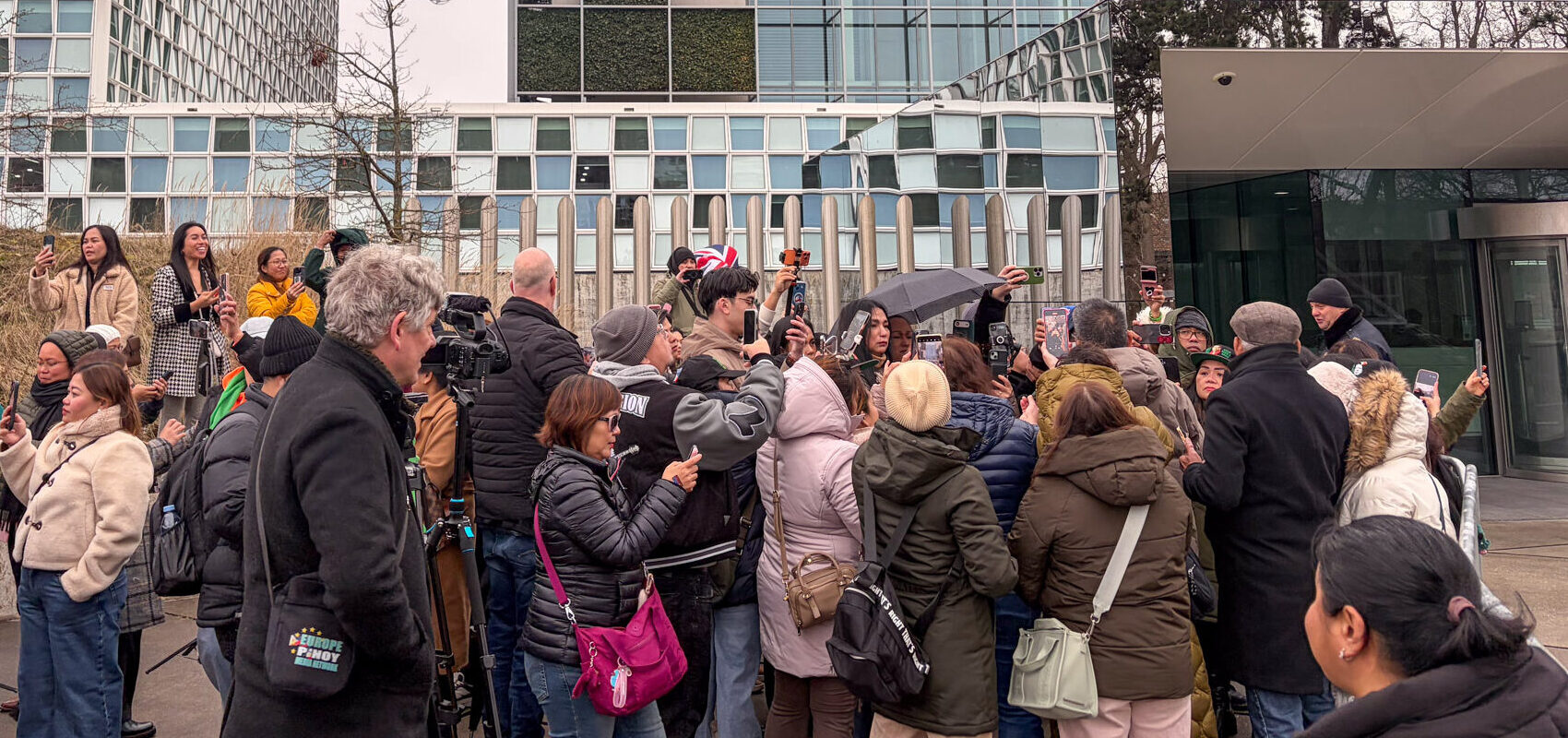
Some international media invited to cover the hearings declined when Duterte waived his right to attend, Aurora Parong of the Philippine Coalition for the ICC told me. Filipino news outlets, by contrast, followed every hearing session, and victims’ groups’ news conferences took place constantly. Each afternoon, I watched victims’ advocates make it only a few feet out of the door to the ICC atrium before being accosted by reporters with boom mics and iPhones on selfie sticks. Pro-Duterte groups (nicknamed DDS or “Diehard Duterte Supporters”) chanted “Bring him home, bring him home!”
“If this case goes to trial, thousands of people will be watching and the trial lawyers will become famous simply by virtue of their presence on screen,” the ICC staff member told me with a wry smile. “They’ll be scrutinized down to what lipstick they’re wearing.”
With rallies of pro-victim groups and counter-rallies by DDS held most mornings in the causeway leading to the court, it was hard to imagine how the ICC and its members could function under such disruption. Some staff and counsel used a back entrance to avoid the crowds, others timed their escapes into cars waiting by the curb.
In one post-hearing encounter, I watched journalists follow Nicholas Kaufman, Duterte’s defense lawyer, from the court entrance to a crosswalk, coalescing around him like a school of fish. His expression was inscrutable—somehow both harried and satisfied with the attention—as he turned and started walking my way. I was waiting by the curb for a rideshare among a small crowd of trial attendees, including Duterte’s former legal counsel and spokesperson Salvador Panelo.
Kaufman had mentioned Panelo and five other Filipino lawyers several times during proceedings when describing the composition of the defense team. That prompted a motion by the prosecution to compel him to clarify whether the group’s members—none of whom had been admitted before the court—had been improperly receiving confidential information about the case. Several of the men had been appointed to government positions by Duterte or worked on his presidential campaign. The chamber’s decision about the matter, and whether it poses victims and witnesses a security risk, is pending.
Enveloped by the crowd and chaos, both Kaufman and I tried to enter the same rideshare, haggling with the driver over the passenger details. Once I was inside, however, he hopped into a different car. Panelo and the other Filipino lawyers disappeared into an official-looking passenger van bearing plates with the prefix “CD”: Corps Diplomatique. I resolved to take the bus next time.
* * *
International criminal tribunals are no strangers to complex political pressures and intense scrutiny over their performance, selection of cases and use of resources. While the International Criminal Tribunals of Yugoslavia (ICTY) and Rwanda (ICTR) were primarily funded by UN member states, the ICC runs on contributions from the more than 125 Rome Statute party states. They have a vested interest in the legal subject matter before the court because the statute grants it jurisdiction over crimes on state parties’ territory. Duterte’s case, brought after he withdrew the Philippines from the Rome Statute in 2019, has sparked controversy over the court’s reach and his position as both a defendant and former head of state.
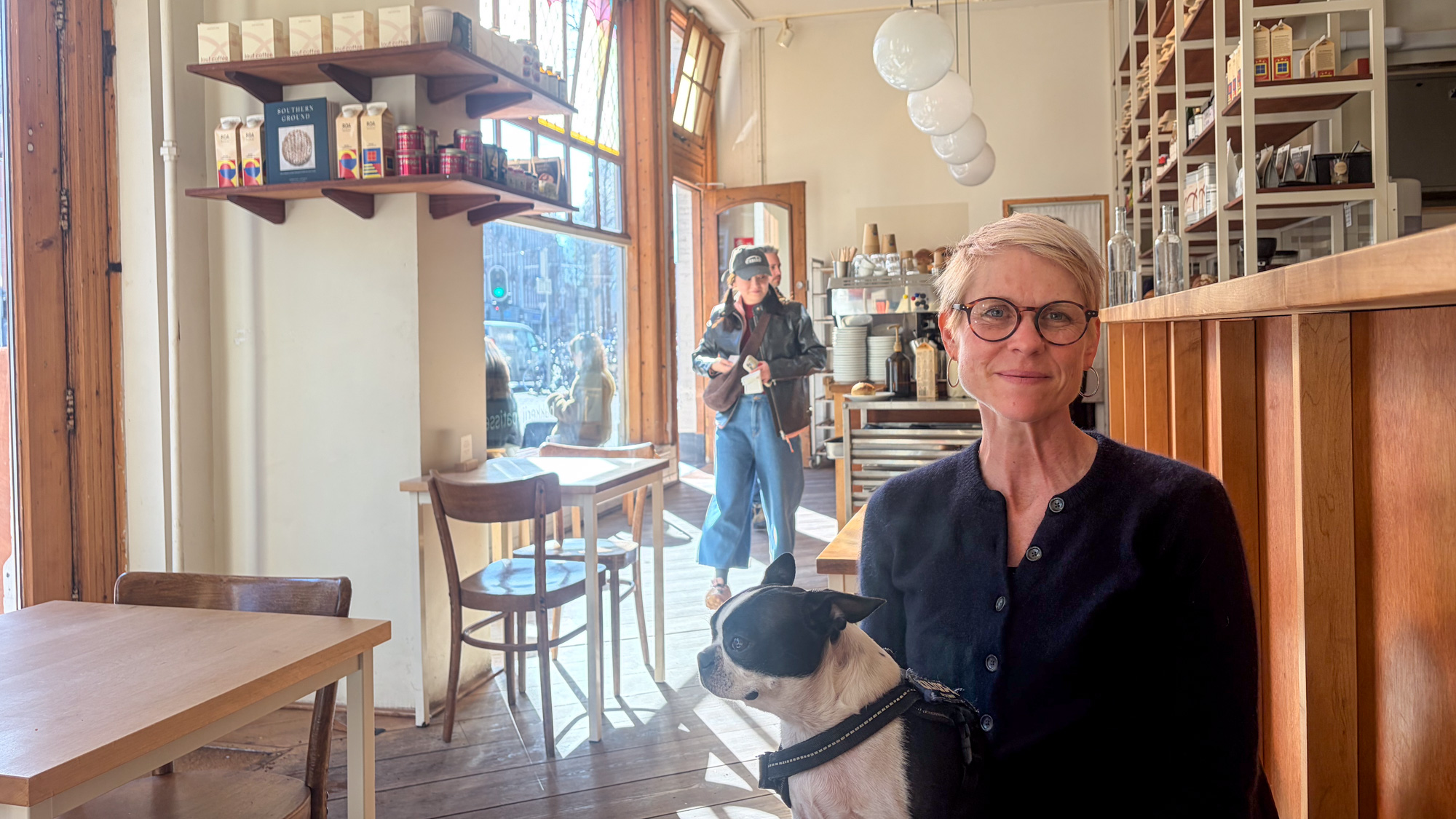
To learn more about the realities of building cases and seeing them to trial, I met Kate Vigneswaran, director of the Global Accountability Initiative at the International Commission of Jurists—a Geneva-based NGO—in a small cafe in Amsterdam, 40 miles northeast of The Hague. Her seven-year-old Boston Terrier Bailey sniffed around our feet as she reflected on the engagement of international courts like the ICC with victims through case selection and management. “Victims come first, along with the needs of the impacted communities,” she said, “and given the ICC’s reparative justice framework, if certain crimes aren’t charged, then there are no available reparations claims down the line for victims.”
Needless to say, the ICC’s staff—particularly the prosecutorial team investigating atrocity crimes—has a legal duty to analyze both incriminating and exonerating evidence. But in today’s ever-shifting geopolitical context, it can be hard to appear neutral when the investigation and prosecution of certain crimes are politicized by outside actors. That complicates the court’s work.
“The ICC in particular needs leverage to physically access and arrest perpetrators, even low-level ones,” Vigneswaran said, “while previous tribunals [like over Yugoslavia and Rwanda] were able to act with a higher level of state cooperation.” Within its limitations, the ultimate discretion to bring a case against an alleged perpetrator or close an investigation altogether rests with the ICC’s office of the prosecution.
Under the ICC’s framework, the prosecutor also acts as investigator. When she was a prosecutor at the Yugoslavia tribunal, Vigneswaran said, her team had to decide how to prioritize indicted charges for trial based on the strength of the available evidence, linkage between crimes and perpetrators and prospects for conviction. While strategic considerations also played a part—establishing facts in order to speed the judicial process in anticipated later cases, for example—long-term policy goals also played a part. Among them, bringing cases that would help develop international jurisprudence for gender-based crimes and criminal destruction of cultural heritage.
One of the ICC’s main challenges is its role as the first truly “global” institution of its kind. The Yugoslavia and Rwanda tribunals, by contrast, had scopes limited to the military conflicts in those countries. The ICC has seen an increasing backlash for having extended its reach to hear cases originating in territories even outside the state parties, part of wider criticism for its management of investigations and cases.
In fact, the Trump administration’s recent sanctions on ICC judges and prosecutors rest on a criticism that the court is overreaching by investigating crimes committed in Palestine and issuing an arrest warrant for Benjamin Netanyahu. (The State of Palestine joined the Rome Statute in 2015, accepting the court’s jurisdiction over crimes committed on its territory. Israel is not a member of the ICC and contests its jurisdiction on the grounds that Palestine is not a state. The matter is pending before the court.)
A lawyer who has prosecuted international crimes before various courts, and who asked to remain anonymous, criticized the ICC for what he said was persistently extending its reach. Rather than a court for the world, he said, it’s meant to serve only the state parties to the Rome Statute. The idea that it’s capable of delivering truly global justice feeds into a critical flaw in the court’s approach to criminal prosecution, he said: a focus on targeting high-profile perpetrators.
International criminal law is largely envisioned to meet several goals: deterrence, establishing truth (by formalizing a historical record) and accountability or the fight against impunity. When the prosecution prioritizes long, resource-intensive pursuits of those most responsible for atrocity crimes, the ICC ends up meeting none of those goals, the lawyer argued.
“Look at the court’s relatively sparse case docket and poor conviction record compared to the ICTY and ICTR,” he said about the Yugoslavia and Rwanda tribunals. The former indicted 161 individuals and convicted 90 for international crimes over its 24-year period, while the tribunal for Rwanda indicted 93 alleged perpetrators with cases resulting in 61 convictions over a similar period.
Formed in 2002, the ICC has issued 74 arrest warrants in total for crimes under the Rome Statute, with 22 of those people having appeared before the court, culminating in only 14 convictions.

As we discussed the outcomes of these international tribunals, I began to see the variation in how different members of the public might assess the contributions, and ultimately the success, of the ICC. For lawyers and judges, the value of the court’s international prosecutions doesn’t necessarily lie in who the defendants are—whether they were formerly presidents or foot soldiers committing war crimes—but in what the court is able to show the rest of the world about the nature of the crimes it adjudicates.
The ICC is crucial for the development of international law to better address atrocity crimes. There’s an almost constant dialogue between international and domestic judicial systems, the lawyer explained. Regional and national courts, such as the European Court of Human Rights and the District Court of The Hague (which hears cases addressing international crimes under its universal jurisdiction), use the ICC’s fact-finding and judicial reasoning to help determine how to handle their own cases.
“It’s like parachute-jumping,” he said, explaining that the ICC’s legal reasoning provides a parachute for lay judges to ”jump” by making decisions about international crimes they try in their own courts. “National courts feel more secure in saying ‘This was clearly a genocide or here is the required context for crimes against humanity’ when there’s established jurisprudence saying so from the ICC.”
Specific strategy and prosecutorial expertise also filter down. The dynamic nature of testing evidence and procedural approaches in cases against low- or middle-level perpetrators helps prosecutorial teams prepare for cases against higher-level perpetrators, whose criminal liability often rests on more complex circumstances. Through the appeals process, prosecutors are able to better understand the position of appellate judges on issues regarding the scope of evidence and other relevant procedures, and use that knowledge to plan strategy for other cases emanating from the same investigations down the line that will likely end up before the same judges.
If his case moves to trial and the prosecution succeeds, Duterte would be the first former head of state to be convicted at the ICC. Previous cases against high-level perpetrators of international crimes fell apart early in court proceedings due to witness intimidation or insufficient evidence.
If you go after the king, you’d better not miss.
* * *
On the final day of hearings, the presiding judge Iulia Montoc announced the conclusion of the pre-trial stage, saying the chamber would decide whether to confirm the charges within the next 60 days. As she spoke, statements and images of the recent sessions echoed in my head: counsel Butuyan’s call for the “last boat on the journey to justice,” Kaufman’s fiery tirade against “political demagoguery,” the prosecution’s religiously inspired depiction of the drug war’s very own “Pietà.”
After the rollercoaster of rhetoric over the previous four days, the lack of immediate resolution was an anticlimax, reflected in the mood of the gallery crowd as we shuffled out into the grey late afternoon light. Undeterred by lightly falling rain, throngs of reporters and pro-Duterte crowds circled the court exit to catch any summary reflections of the week-long proceedings.
The next day, the United States bombed Iran, and my outgoing flight to Manila was cancelled. Somehow, I had to find a new way home.
* * *
Two months is a blip in typical legal timelines. Cases before the ICC can last five to eight years once they reach trial stage, not including potential appeals. Under the Rome Statute, the trial chamber has no deadline for reaching a decision, nor does the appeals chamber. The confirmation of charges has the quickest resolution throughout the entire international criminal justice process.
Despite the widespread media coverage during the hearings, social media discourse about the ICC was quiet when I arrived back in Manila a week later, grateful to shed my winter coat. Other concerns dominate day-to-day life, and there’s no opportunity to fill the time waiting around for the court’s decision about whether to put Duterte on trial.
Having sat next to them in the public gallery, I reconnected with Nymia Pimentel from PhilRights, along with PhilRights officers Mia Baybay and Vincent Oville, to debrief about the hearings and unpack the public response.
Until the chamber releases its decision, it’s “business as usual,” for human rights organizations, Pimentel told me. Focusing on continual documentation of cases from the drug war, PhilRights is also training families to document cases themselves—forming wider “human rights defender committees” in the communities most affected and targeted by the drug war.
Such capacity-building to respond to threats and human rights violations is critical in light of the underlying security concerns many victims’ families still face. Meanwhile, recent survey data indicates positive perceptions about the ICC are falling among Filipinos. “This shows that the machinery of the pro-Duterte camp to vilify the court has been working,” Oville said. Reporting on the drug war is also dropping off after the hearings, especially in the shadow of other global events.
“The conflict in the Middle East directly impacts our country and tamps down the importance of the ICC,” Oville said. But when the court’s decision comes out in April, he predicts, public interest will rise again.
Back in my own neighborhood, I eavesdropped at the laundromat on two workers lamenting fuel price hikes brought on by the recent conflict, while Eid al-Fitr and Semana Santa—two holidays involving travel and gathering with family—were quickly approaching. The news headlines announced another former politician being prosecuted for his hand in mass flood infrastructure corruption, and the Marcos administration’s latest focus on extraditing him from Europe.
In light of all the domestic and international turbulence, one fueling the other, the court’s physical distance is felt even more keenly. Filipinos have moved on from this latest legal episode, at least until the court has something to say.
Top photo: After each day of hearings ended, crowds of journalists, victims rights groups and Duterte supporters rushed the exit to catch observers’ statements and livestream their reactions on social media.