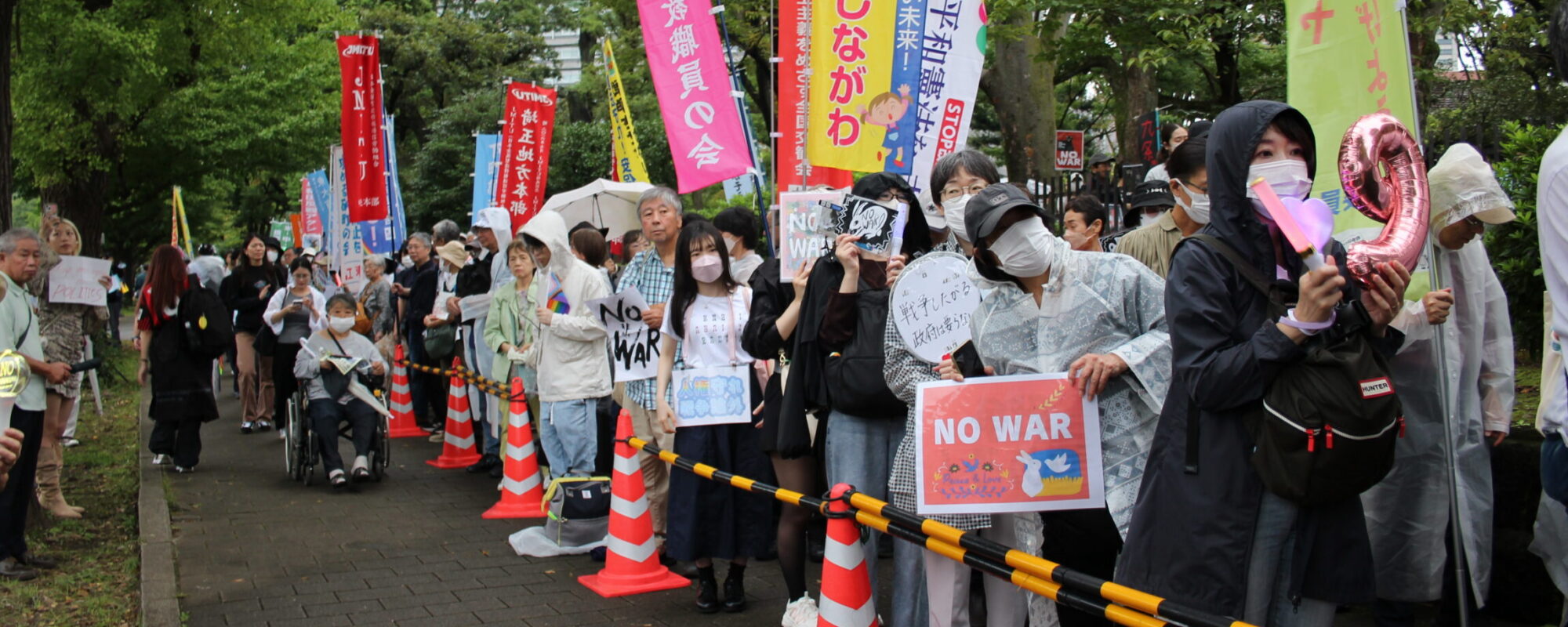
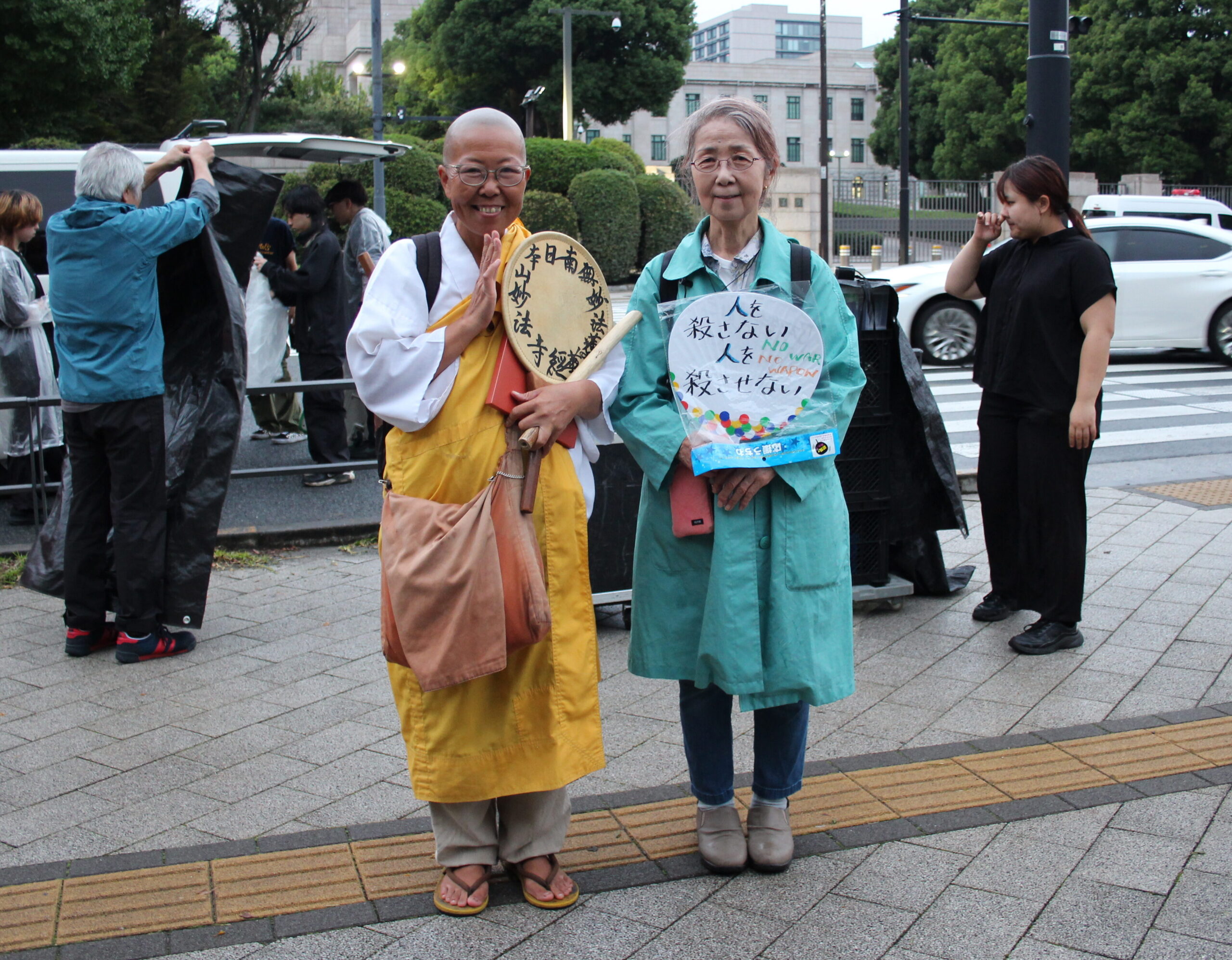
TOKYO — A light rain fell as I stood chatting with Yuki Yako, a Buddhist nun, and her mother on the sidewalk across from the main gate of parliament, the National Diet. To our right, a clean-up crew was packing equipment from the day’s demonstration into a van while police officers lingered nearby. The park on either side of the street was nearly empty, although only minutes earlier it had held some 15,000 people who had joined the 130th “19th Action,” a monthly protest against Japan’s expanding defense capabilities.
I had asked the two women what percentage of protesters who come to such events are young people, in their 30s and younger. Yuki thought for a moment before she responded. “About 20 percent.” Then her mother, sitting nearby on a stone retaining wall, cut in. “But compared to how many there used to be,” said Ms. Yako, who declined to provide her first name, “there are many more young people coming now.”
Nineteenth Action is one of the most visible fixtures of Tokyo’s contemporary protest scene, and I thought it would be an ideal setting through which to begin exploring the questions at the heart of my Institute of Current World Affairs fellowship. From now until August 2027, I will be investigating how youth civic participation is being redefined in an aging society where traditional avenues for social change are increasingly constrained, and where young people are developing new ways of acting “politically.”
I’m a literary comparativist by training, currently a PhD candidate in English and Comparative Literature at Columbia University, but my work on seemingly “apolitical,” “cozy” popular media in post-Bubble Japan has increasingly drawn me toward questions about the boundaries of political life. At 19th Action, I wanted to know how a new generation of Japanese demonstrators understands its relationship to political activism and the possibility of social change.
Yuki, age 51, who belongs to the Nipponzan-Myohoji order, is a longtime peace activist. She told me that she tries to attend demonstrations like these whenever she can. She has also been involved in other peace actions across East Asia, including the yearly East Asia Peace Walk and Okinawa Peace Camp. Her mother’s involvement stretches back even further—to the turbulent protest years of the 1960s and ’70s, an era of mass student anti-war mobilization.
“In my mother’s generation, huge numbers of young people demonstrated,” Yuki said. “And they lost, didn’t they? That memory is probably still there. Japanese people have never won through demonstrations.”
Her comments point to a long history of the suppression of protest movements in Japan. For young people of the 1960s and ’70s, that participation also came with a personal cost. Ms. Yako recalled how difficult it was for former student activists to find a job: Openly held political beliefs could make it impossible to get hired, while entering the workforce often meant abandoning the long hair and alternative styles associated with the student movement in favor of short haircuts and suits. The pressure to conform, she suggested, persists today. “I think there are plenty of people working at companies who want to participate in demonstrations but feel they can’t,” she said.
When our conversation turned to the growing numbers of young people coming to demonstrations in recent years, however, Ms. Yako’s comments turned optimistic. In earlier decades, protesters tended to take part in groups organized by unions and other organizations, but now, they frequently come of their own accord.
Her observations appear to reflect a broader transformation in the structure of activist spaces, as the researchers David Slater and Patricia Steinhoff describe. In their overview of multiple ethnographic studies of Japanese social movements, “Rejecting the Radical New Left,” Slater and Steinhoff argue that in contrast to the rigorously hierarchized activist organizations of the ’60s and ’70s, the social movements of recent decades are much more “open” and hierarchically “flat.” That is, while organizations may involve a core of dedicated leaders, the vast majority of those who attend demonstrations come as “participants,” rather than group “members.”
Of course, social media has been a major factor in that shift toward a looser, more open form of activism. While the model may have drawbacks, Ms. Yako sees advantages as well: Those who come to demonstrations now, she said, are those “with a very strong sense of engagement.”
Asked why more young people are attending, she said, “I think it’s a sense of crisis.”
“Now people are learning what they see as the truth, and all kinds of people share information. Then they think, ‘This is serious.’”
* * *
The changes I encountered at 19th Action were only one hint of a broader shift in youth political engagement that I’ll explore over the course of my ICWA fellowship. Indeed, in the wake of Sanae Takaichi’s election as prime minister last year, 2026 is emerging as an important year for mobilization among Japan’s young people. Although surveys in recent years have pointed to a deep sense of distrust in institutional politics and a low sense of political efficacy among young people, this year’s data points to a profound shift: In 2019, the Nippon Foundation reported that fewer than one in five 18 year-olds agreed with the statement “I believe I can change my country and/or society,” but in a 2026 version of the same survey, more than one in two agreed with an equivalent statement. Although Japan’s largest voting bloc comprises citizens over 65 and younger generations have limited electoral influence, those results suggest that a new drive toward social engagement among young people may be emerging. This year’s GPS smartphone data also suggests antiwar rallies are now drawing more people in their 20s and 30s.
Taken together, these developments suggest that Japan may be entering a period of significant change in how its younger generations relate to politics. I am interested in the ways they are finding, or creating, alternative avenues for engagement, even as many remain disillusioned with traditional political institutions. Over the course of my ICWA fellowship, I hope to explore some of these questions: How do today’s young Japanese people engage with issues such as militarization, labor precarity, gender inequality and climate change? How are social media and online networks changing the landscape of engagement? How are young people conceptualizing or re-imagining Japan’s role in the world, especially with respect to the United States, its longstanding ally?
I will begin my exploration in Tokyo, traditionally the hub for organized social movements, and later travel to different regions within Japan. By examining how political expression is being reconfigured, I hope to open a broader conversation about the future of civic engagement in advanced democracies. That includes the United States, where a sense of impasse, political fatigue and disillusionment with traditional institutions seems to have become as powerful as in Japan.
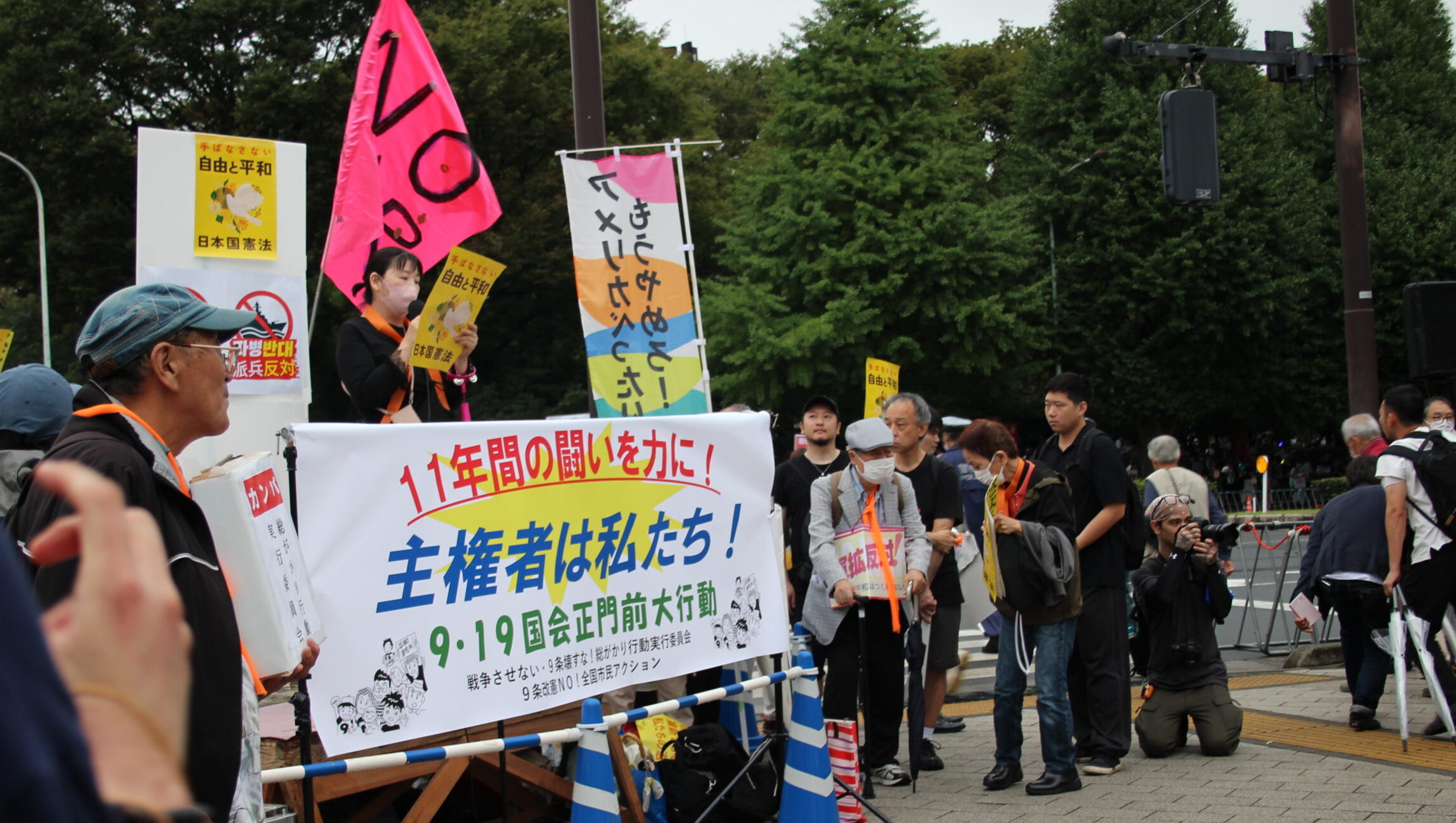
Protest remains a fraught activity, however, especially for younger people, whose livelihoods may remain at risk. At 19th Action, while the crowd’s energy was high, those anxieties were also on display. The day’s speakers included House of Councilors representatives LaSalle Ishii of the Social Democratic Party and Hiroyuki Konishi of the Constitutional Democratic Party, and representatives from anti-war organizations such as Nahoko Hishiyama of the Executive Committee to Stop the Destruction of Article 9 (憲法9条を壊すな!実行委員会). However, two volunteer speakers spoke from behind a panel to keep their identities hidden. One woman, an office worker in her 30s, spoke about how the Takaichi administration’s militaristic posture inspired her to begin attending demonstrations this past May.
“To everyone here today, I know it’s difficult and painful to come every time,” she said. “Even so, let us continue demonstrating, undeterred, and strive for peace.” Her own anonymity underscored the difficulty she described. As she stepped down from the podium, several organizers raised folders to shield her face from view.
* * *
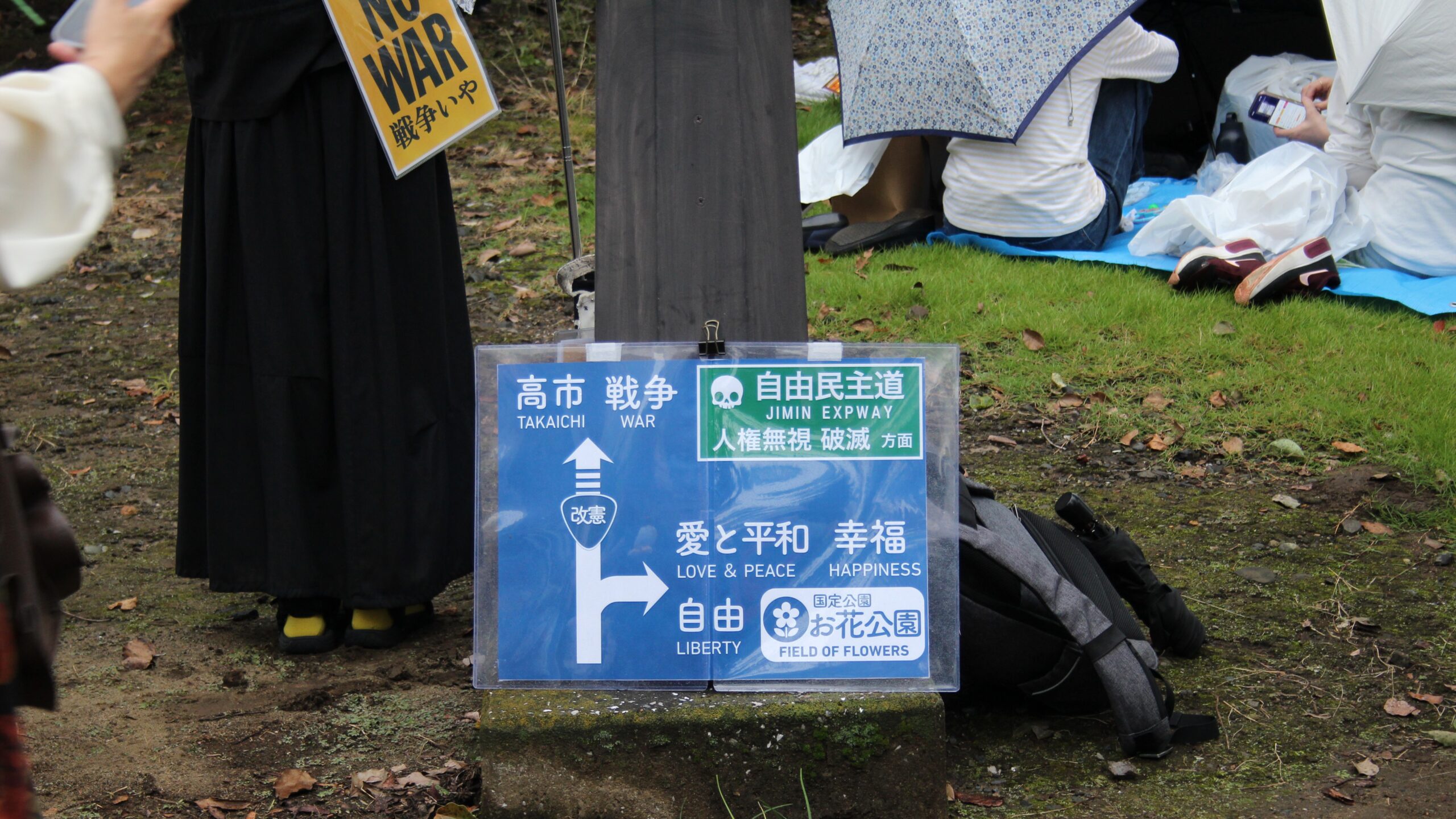
Slogans against the Takaichi administration abounded at the 19th Action protest. Among them, “Stop the Takaichi Administration’s Regressive Constitutional Revision!” and “Stop the War on China! Overthrow Trump and Takaichi!” One placard parodied an expressway junction sign, showing a fork marked “constitutional revision” (改憲) leading to “Takaichi” (高市) and “war” (戦争). An alternative route leads to “love and peace” (愛と平和), “happiness” (幸福), “liberty” (自由) and a “national park” (国定公園) named “field of flowers” (お花公園). The subtitle, framed by a skull, reads, “human rights ignored, bound for destruction” (人権無視 破滅方面).
Such tongue-and-cheek messages are difficult to translate into English, Yuki Yako said jokingly.
“Like ‘Prepare for Disasters, Not for War’ (防衛よりも防災),” her mother added. “That one’s probably difficult to understand.”
That joke was especially pointed given the day’s rain. As of October 5, Tokyo marked the end of its longest streak of rainy days on record—37 days—likely fueled by climate change and this year’s supercharged El Niño. Just two days after the protest, Typhoon Dujuan brought record-breaking rainfall to parts of eastern Japan. Widespread flooding and landslides ultimately killed 14 people in Kanagawa and Chiba prefectures.
The anxieties about natural disasters reflected in the slogan also have deeper roots in the 2011 Fukushima Daiichi nuclear disaster, which devastated large parts of northern Japan. In their 2018 book Re-emerging from Invisibility: Social Movements and Political Activism in Contemporary Japan, the scholars David Chiavacci and Julia Obinger call the catastrophe a “turning point,” inspiring widespread criticism of the political establishment and near-weekly protests outside the prime minister’s residence. Given the extent of activism that has taken place in Japan since then, Chiavacci and Obinger suggest the disaster may have inaugurated a new “protest cycle” that will continue to unfold in years to come.
If the Fukushima disaster helped usher in a new era of protest, the controversy surrounding Japan’s 2015 security legislation would become another defining moment, one that gave rise to 19th Action itself. On September 19 of that year, Japan’s National Diet passed the Legislation for Peace and Security (平和安全法制, known as the “security legislation” or “war bills”) under Prime Minister Shinzo Abe. The law marked a consequential re-interpretation of Article 9, the “pacifist clause” written into the constitution by US occupation forces following Japan’s defeat in the Pacific War, renouncing “war as a sovereign right of the nation” and the “threat or use of force as means of settling international disputes.”
For decades, successive Japanese governments had maintained that Article 9 permitted Japan to defend itself but not use force in defense of allies. That interpretation, developed in the 1950s, provided the constitutional basis for the creation of the Self-Defense Forces (SDF) while ruling out the exercise of “collective self-defense.” However, in 2015, the Abe administration developed a different position: force could be exercised in the event of an attack on “a country that is in close relationship to Japan” if it posed an “existential crisis situation” (存立危機事態), even if Japan itself were not directly targeted. In other words, in the face of such an attack, the Abe administration argued, an exercise of “collective self-defense” could be necessary to ensure the country’s survival.
A centerpiece of the government’s neoconservative program, the proposed Legislation for Peace and Security led to an outcry, including mass protests of up to 100,000 people. Opponents argued not only that it could lead Japan to become involved in overseas wars but also that it was simply unconstitutional. The developments led to the establishment of the first large-scale student-led coalition in decades, Students Emergency Action for Liberal Democracy, or SEALDs. Its activities extended to branches in the central region of Kansai, the northeast region of Tohoku and Okinawa. Demonstrations led by the group regularly drew tens of thousands of participants.
Despite yelling and wrestling in the Diet as opposition party members attempted to delay the vote, the legislation ultimately passed in September 2015. Still, the controversy became a watershed moment for activism, what Chiavacci and Obinger call a “blossoming” of civil society. “We’ve achieved a trend of having citizens raise their voices,” a founding member of SEALDs named Aki Okuda told the Mainichi Shimbun, explaining that the group was founded with the aim of changing the atmosphere of protests so that “ordinary people” could take part. “We want to have a culture marked by participation take firmer root among young people.”
In the years since the Diet passed the security legislation, 19th Action has been held monthly, and with its September 2026 event, it has now marked its 11th anniversary. Although it began as a recurring venue for voicing opposition to the law, it has become a hub for activist groups across sectors, including pacifist, civil-liberties, anti-nuclear, social-welfare, feminist and Japan-Korea reconciliation groups, which converge in resistance to the establishment Liberal Democratic Party (LDP) agenda. Labor union and opposition political party representatives are also frequently found among the attendees.
What’s more, the Takaichi administration’s increasingly hawkish stance toward China has lent renewed urgency to the 19th Action events. The prime minister made headlines in December with comments that a Chinese attack on Taiwan might constitute “a survival-threatening situation,” prompting a China-Japan diplomatic row. This past April, the government also moved to expand the defense industry by lifting decades-long limits on the sale of lethal weapons. Last month, Takaichi publicly instructed Defense Minister Shinjirō Koizumi to carry out revisions to the three central national security policy documents (安保三文書). Adopted in 2022, they provided for an increase in defense spending up to 2 percent of Japan’s GDP by 2027, including the development of missile counterstrike capabilities and other technologies.
The planned revisions would further strengthen Japan’s defense capabilities, accelerating its departure from its traditionally restrained approach to national defense. The Takaichi administration has argued that changes in the global security environment—the development of unmanned systems warfare in Russia’s war against Ukraine and Moscow’s recent cooperation with Beijing and Pyongyang among them—necessitate such changes. It has also emphasized the need to prepare for emerging forms of warfare, including in “outer space, cyberspace and the cognitive domain.”
These developments point to the Takaichi administration’s ambitions to significantly expand Japan’s defense capabilities, fueling fears among critics that the country could once again become embroiled in war. Against this backdrop, the September 2026 19th Action was more than an anniversary. It was also an opportunity for demonstrators to voice dissent about the government’s current direction and assert their vision for Japan’s future.
* * *
Beneath a Japanese Communist Party (JCP) tent at the September 19 protest, several demonstrators sat chatting in a circle. The three red JCP banners attached to the tent’s corners made it easy to pick out in the crowd. Among the group was a young woman who agreed to speak with me on the condition I not use her name.
The Takaichi administration “keeps pushing forward all these things that we don’t want at all,” she told me, describing why she had decided to come to the demonstration. She found the prospect of Japan going to war “really frightening,” she said, mentioning that she was especially disturbed by the LDP’s recent proposal to reduce the number of proportional-representation seats in the Diet, which would reduce representation for smaller parties. The measure is expected to be taken up during an extraordinary session this fall.
The protester told me she’d joined the JCP only a month earlier. Impressed by how consistently JCP lawmakers challenged the government’s claims with detailed factual evidence, she had come to see it as the party most willing to stand up to what she described as the Takaichi administration’s “outrageous” conduct.
“I thought that even if there are things I can’t do by myself, there might be things I can do together with everyone else,” she said.
“So I joined.”
Top photo: Demonstrators at the September 2026 19th Action