TROMSO, Norway — On a dark December morning, the line outside the café snaked down the icy street and disappeared around the next corner. Risø is my daily coffee spot, where I know the other opening-hour regulars. But this morning, scanning the bundled crowd, I couldn’t spot a single familiar face.
“Oi, Brett!” I heard, and was delighted to meet the gaze of Max, a local Scottish tattoo artist and fellow regular, standing in the snow about halfway down the line. He gestured for me to join him. “Welcome to the madhouse,” he muttered in his distinctive brogue, rolling his eyes.
A few minutes later, at precisely 10 o’clock, Risø’s owner Arne pulled the door open, releasing the intoxicating scent of cinnamon buns. The crowd streamed forward, jostling and eager. When our turn came, I followed Max through the doorway—until I felt myself suddenly pulled backward.
“Not so fast!” said a voice with an Australian twang. I turned to find myself face-to-face with the woman who had yanked at my backpack, glaring at me from beneath a fur-lined hood. “I saw you cut,” she said.
Max whipped around. “She’s with me, and we live here,” he growled, glaring back at her, his dark neck tattoos adding to the intimidation effect. He tugged my arm and pulled me inside.
This wasn’t a triumphant interaction for me—I didn’t assume that living here entitled me to special coffee privileges. But it did leave me entirely unprepared for such open animosity before my first cup. In a small city like Tromsø, it never pays to pick a petty fight. And the more I thought about it, the more I realized how incongruous this moment felt with Arctic attitudes toward scarcity.
In a place where weather often threatens access to basic necessities, you learn to cooperate rather than compete. I had perhaps naively assumed a graciousness around greeting a friend, but at the same time, I wasn’t used to queuing. I was ignorant of the tourists’ own social codes, and, considering the many long lines that had recently sprung up around town, I had likely broken a serious one.
Later, as I recounted the story to other locals, I heard groans of sympathy but also some reproach. You should have known better, they told me, than to try Risø in December.
Winter above the Arctic Circle in Tromsø doesn’t mean just dark and snow. It means tourists. From early November to early March, parka-clad masses from around the world descend upon the city’s heated main street: from the United States, Asia, the United Kingdom, throughout Europe and even, apparently, Australia. The main draw is the northern lights, but tourism companies offer many winter-wonderland experiences: Husky dog-sledding, whale watching, snowmobile rides, reindeer tours led by Indigenous Sámi guides. (I know a Sámi herder who started working with tourism companies for supplementary income to feed the reindeer, a dreaded practice becoming necessary as climate change destroys winter grazing conditions.)
But in recent years, something new has become clear: Tourist demand is outpacing the city’s capacity. And locals are paying the price. In Tromsø, we find ourselves seasonally out-competed for space: to gather, to eat, to walk, to sauna and even to sleep. Nevertheless, the industry remains almost entirely unregulated. It is a core local industry, employing about 8 percent of residents. But most of the profits made from Tromsø’s visitors don’t benefit the municipality at all. They overwhelmingly go to the private companies that sell the experiences, many of them third-party online vendors, nowhere near the north of Norway.
For me, the constant churn of this temporary population—much of which hails from my own country—has been an unexpected feature of my nearly two years in the far north. And in so many conversations with locals, I’ve struggled with a set of knotty and interrelated questions: Given the growing frequency of cruises and flights, should it really be so easy to get this far north? How does that accessibility—coupled with the allure from social media—help commercialize and market a “transcendent” experience? And what are the social and environmental costs of the aurora-chasing masses, many arriving here entirely unprepared for the harsh realities of an Arctic winter?
* * *
Before I moved to Tromsø, I can admit to complete ignorance of its winter-destination status. I chose the city in large part for the Arctic Council Secretariat headquarters housed here, as well as its relatively large population (78,000) and its many well-known research institutions. I moved here in August and got to know locals and their businesses during what I didn’t realize was a dramatically slower season. I did detect some clues—like the many tourist shops lining the main street—but I figured that they seemed prominent because the city is so small. As summer slipped into fall, however, I started to hear the warnings: just wait for winter.
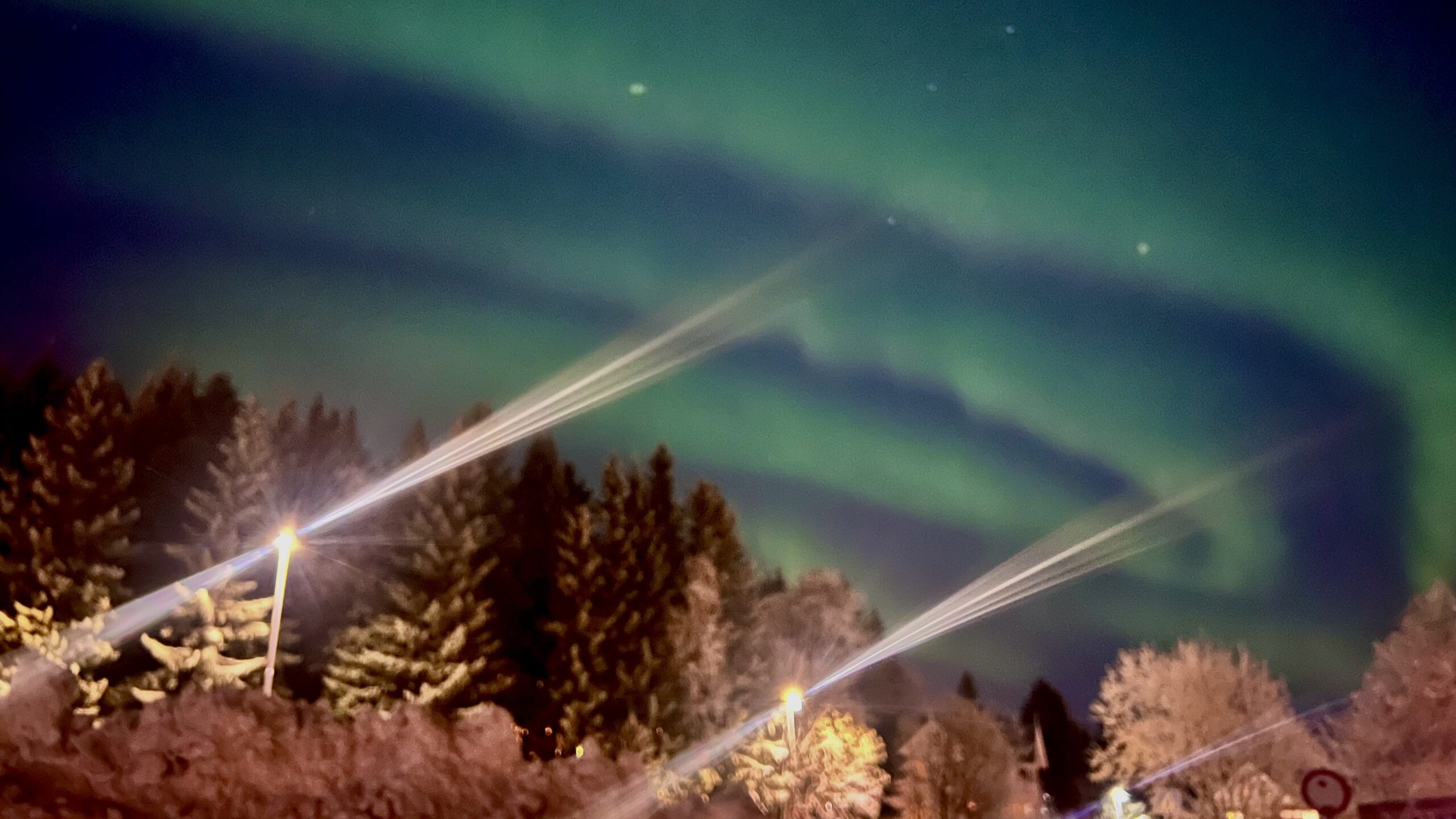
I don’t think even those who cautioned me were prepared for what arrived. Much like the accelerated rise in general Arctic temperatures, both winters I’ve lived here have seen as-yet unheard-of heights in tourism. In 2024, following fresh Tromsø Airport expansions, many major European cities started offering seasonal direct flights. In 2025, airport traffic surged by 40 percent, breaking records and straining even its expanded infrastructure and staff. (On Sundays in December, I’ve seen security lines down the escalators from the departure level.) In 2024 alone, bookings for northern lights tours tripled. Social media has accelerated the effect—viral videos of northern lights and Tromsø city guides have been particularly linked to surges in visits from China, Japan and South Korea. Next year, IcelandicAir is adding a direct route between Reykjavik and Tromsø, which is expected to bring yet more visitors from North America.
But Tromsø remains a small city. And this past winter, local tensions appeared to reach a boiling point. Almost every day, it seemed, the papers covered some aspect of the controversy: The city that once called itself the “Paris of the North,” had become the “Barcelona of the North”—referring to the European city most famous for its tourist problem. Horror stories abounded: travelers throwing bags of trash and even relieving themselves in people’s yards, aurora-chasers wandering into dark and icy road intersections, phones pointed at the sky. On the mainland across the channel from Tromsø island, there’s a funicular that carries you to the mountaintop overlooking the city. (Locals don’t really use it; it’s a whopping $50 per ticket.) Last winter, the line got so long, it blocked the road and driveways of surrounding homes. Adding insult to injury, this funicular hardly benefits the municipality at all. Much like the many tourism companies here, it’s privately owned.
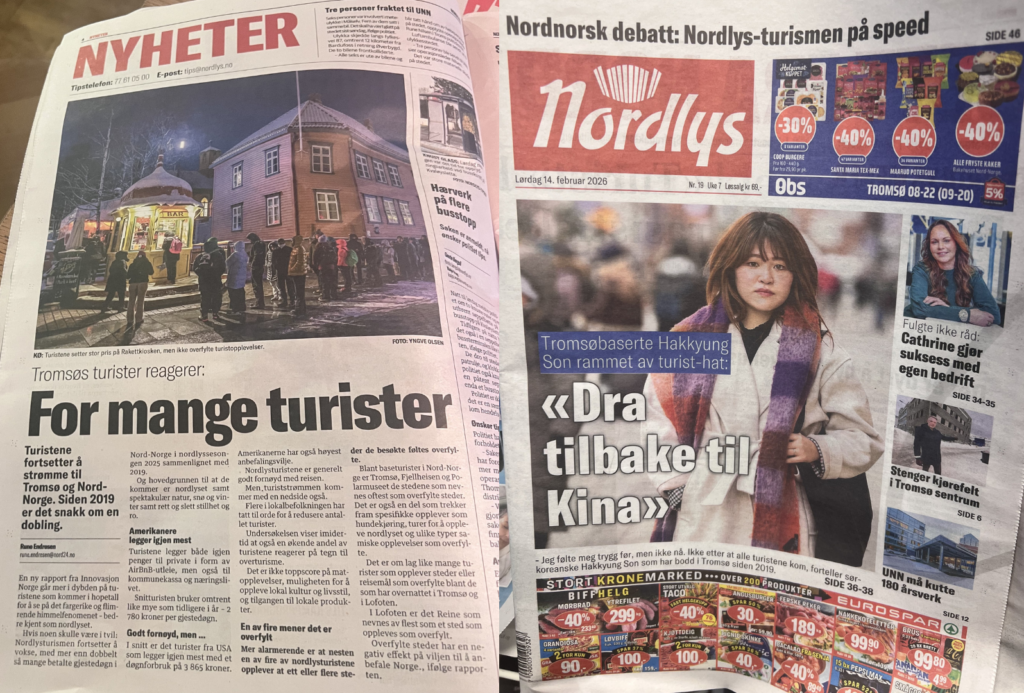
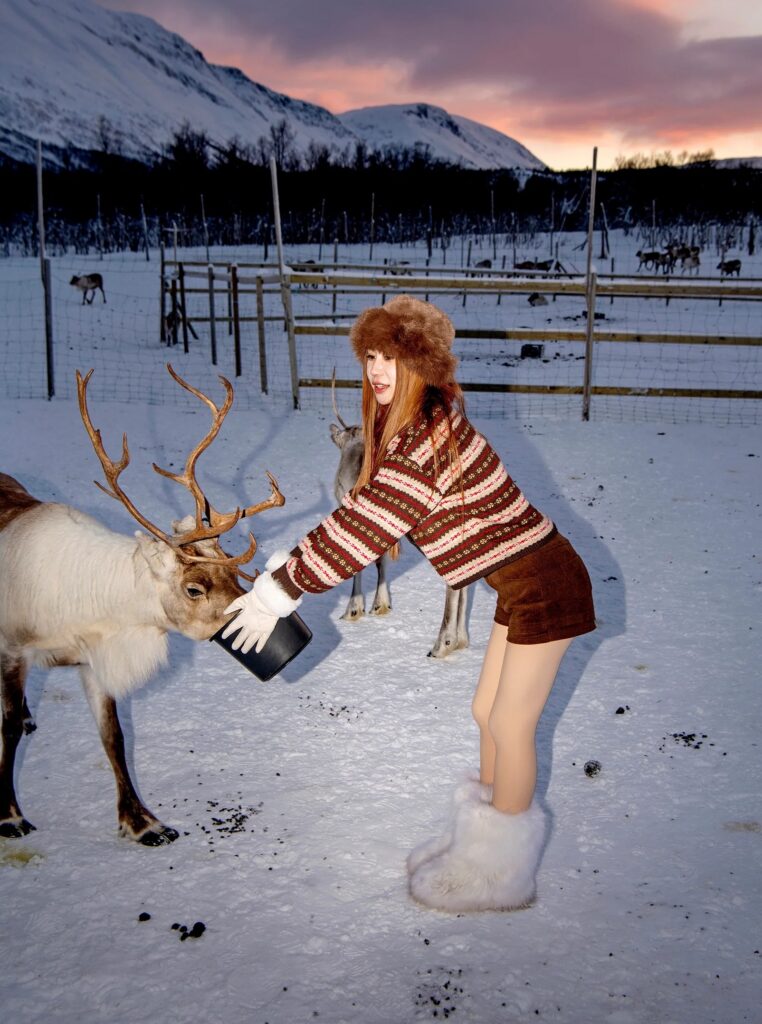
As politicians and activists called on city leadership to intervene, the backlash began to turn ugly— particularly against Asian tourists. In a front-page feature this winter, a South Korean immigrant who has lived in Tromsø for several years recounted her experience frequently mistaken for a tourist. “Go back to China,” the headline read. In early March, the Norwegian magazine DN ran a feature on Tromsø tourism accompanied by photographs of (mainly) influencers posed on icy mountaintops or with reindeer. The majority of the photos, my friends and I noticed, were of visitors from Asia.
* * *
Where did this all begin? And, given that you can see the northern lights from anywhere in the world above a certain latitude, how did Tromsø corner the market? According to a recent local news feature, it all started with a single 2008 BBC documentary, “Joanna Lumley and the Northern Lights.” In the film, Lumley, a popular public broadcast presenter, “chases” the aurora borealis—and put this phenomenon on the tourism map. It soon prompted an influx of commercial offerings centered around this city, and tourism steadily increased. In 2018, TripAdvisor ranked Tromsø third-best place to visit in the world, sparking another uptick. After a brief pandemic slump, visitor numbers are surging higher than ever.
The post-pandemic travel boom has challenged cities across Europe. Venice imposed a tourist tax, Amsterdam banned new hotels and Lisbon imposed a nightlife curfew. This year, the European Commission will develop its first-ever policy on sustainable tourism, offering guidelines for longer-term visits, regulations on short-term rentals and higher taxes on the industry.
But something feels particular to tourism in Tromsø. It’s not just the sheer concentration of hundreds of thousands of people on an island built with infrastructure for fewer than 80,000. It’s the high-stakes, fantastical marketing of the experiences here—promising some cross between a Shackletonesque polar adventure and a childhood North Pole fantasy. There’s an undeniable magic in glimpsing the aurora borealis. But in contrast to the real harshness that living in this perpetually dark, remote and icy world can produce, tourist companies promise a shiny, Disneyfied experience—a live-action “Frozen,”reindeer and all.
* * *
One early evening in January as I was writing at my dining room table-slash-desk, I heard a sudden whoosh of wind as my front door swung open. Previously deep in focus, I almost fell out of my chair.
In my doorway stood a couple in their mid-30s, clad in earmuffs and parkas and clutching their suitcase handles. For a moment, we stared at each other in mutual astonishment. Then the woman, glancing down at her cellphone and back up to me, spoke in a European accent I couldn’t place. “Airbnb?” she asked. “Downstairs,” I sputtered. They were gone before I had a chance to recover.
I live in the top-floor apartment of a three-story house close to the harbor. Typically, only good friends ascend this high, so when at home, I often don’t lock the front door. In the tourism season, however, as my downstairs neighbors run their Airbnb, I’ve learned to adapt.
Airbnb is one of the biggest strains on the city—inflating housing prices in a geographically constrained island. Before moving here, I was already shocked to find that my apartment options were nearly comparable to those in Washington, DC or San Francisco. The city earns income tax from Airbnbs, which in 2025 accounted for 2.3 percent of its tax income. But this is a university town. Students who can’t get campus housing squeeze into collectives and converted basements or commit to long bus commutes from neighboring islands. Still, the city doesn’t regulate Airbnb or other short-term rentals.
Last fall, the municipality hired a consulting company to undertake the first-ever comprehensive analysis of Tromsø tourism. It sent out a survey to residents about our experience in the city, including our feelings about access to public transportation, housing costs and access to social events. Still, I had felt perturbed that the multiple-choice “solutions” I could select were all catered toward tourists—more parking spaces, more public restrooms. There was a space to write in comments, and I suggested Airbnb restrictions.
The consultants published their findings in mid-April. The verdict was grim but not at all surprising. Seventy-seven percent of locals believe there are too many tourists. In most metrics, Tromsø was in the “red zone.” Local housing is under strain from unregulated short-term rentals, public transportation infrastructure is at capacity and tourism companies are profiting while paying very low taxes. And despite Tromsø’s stated aim to be “sustainable,” they’re trafficking in high volumes of long-distance, short-term tourism that comes with immense carbon costs. The report recommended immediate and serious caps on tourist numbers, short-term rental regulations and new strategies to prioritize domestic and longer-term visitors.
“If [the city] doesn’t succeed in addressing the central problem, the quality of the experience is weakened, the level of conflict between residents and tourists increases and the destination’s reputation is damaged,” the report concluded.
* * *
I’ve come to feel quite strongly about Tromsø tourism. But I don’t blame the people who come here. After all, I’ve been an American tourist in Europe—and I was humbled early on. In 2019, I flew from the United States to Barcelona with an ex-boyfriend. It was our first time traveling abroad together and we chose the destination based on some combination of affordable flights, comfort with the Spanish language and a particularly memorable episode of Anthony Bourdain’s “Parts Unknown.”
In our very first jetlagged wander around the city, we realized our idea was far from original. Everywhere we went, we couldn’t escape our native language, spoken in grating American and British accents. Later that afternoon, things seemed to take a hearteningly authentic turn as we made our way to our Airbnb in a quieter section of the city. Inside our gorgeous Catalan-Modernisme style apartment building, however, we were greeted by a Swedish man who, after showing us the monochromatic Ikea furnishings, handed us a business card for his multi-property management company.
Shortly after we returned home, an anti-Airbnb protest in Barcelona made international news. As it turns out, the city had spent years trying to attract tourism but had been too permissive with multinational online companies, particularly Airbnb. Eerily, I noticed, the article even mentioned an influx of Scandinavian Airbnb owners. (Critics of Norway’s discomfort with tourism are quick to point that out.) At the time, I was living in an overpriced Brooklyn apartment, and I felt real guilt about my contribution to Barcelona’s housing crunch. Ahead of the trip, I reflected, we had taken frequent comfort in poring over online guides and reviews. We followed the funnel of what we thought were peer recommendations but were likelier paid promotions and strategically deployed SEO.
Today’s Tromsø tourism companies, I can imagine, have much savvier algorithms than those that guided me to Barcelona in 2019. Even as a resident searching for flights, I’ve been targeted by ads coaxing me north. Glossy images and videos promise the unmissable: dog sledding, reindeer, cozy nights by the fire as the northern lights dance above. Just when these companies have convinced you that life is lacking without having glimpsed this solar phenomenon, they move in with a fully-catered offer: bus tour hotel pickups for chases led by expert guides—snowsuit, hot chocolate and high-resolution photos all included. (For what it’s worth, some of my friends work as northern lights guides and they love it. “Helping people have a life-changing experience never gets old,” one told me.)
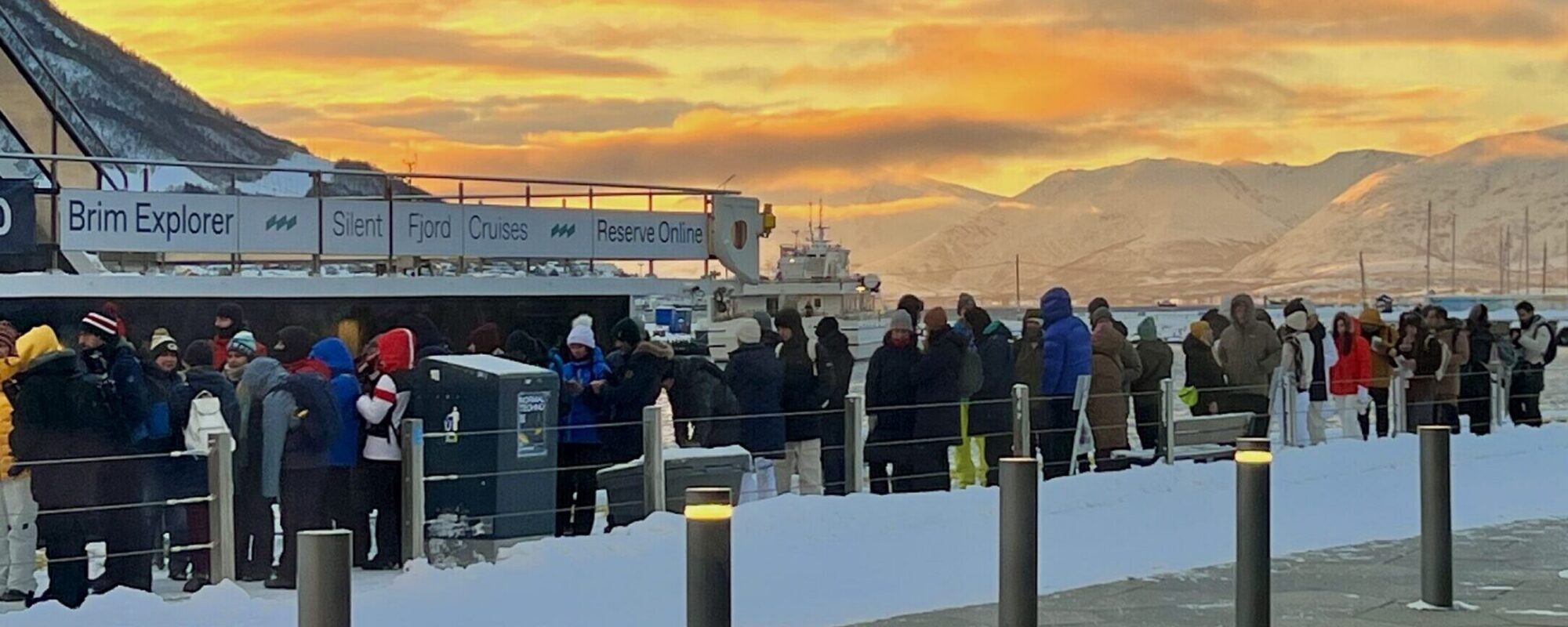
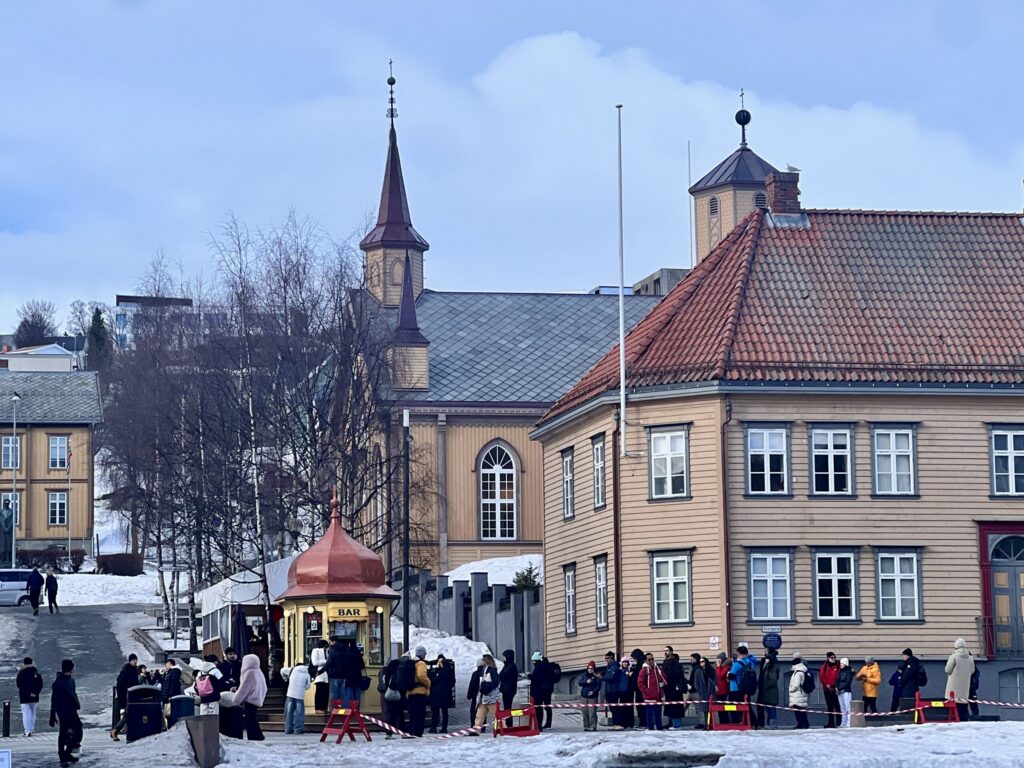
But when entry fees are exorbitant and experiences are “curated” by corporations, this kind of travel begins to resemble an amusement park visit. I notice it in the number of lines that spring up around the city: outside a whale-watching boat, a fleet of northern-lights “safari” buses and, yes, TripAdviser’s top-rated coffee shop, which also happens to be locally owned and loved. It engenders a kind of learned helplessness, I think, an all-inclusive attitude toward an entire city or region. But when you’ve outsourced your entire travel experience and interacted mainly with fellow tourists, where did you really go?
Week after winter week, watching the streams of people churn through nearly identical itineraries, one can’t help but get philosophical about it all. The relentless drive for a predictable set of unforgettable moments feels strangely aligned with the rise of AI chatbots that may have helped plan some of the vacations. They’re both artful facsimiles of someone else’s human experience minus the vulnerability of the unknown. But surely there’s something lost in traveling somewhere new yet leaving so little to chance. And if you’ve based your trip on social media and paid handsomely for your moments, I have to wonder what that does to the sense of, well, wonder. How much dopamine comes from merely the warmth of customer satisfaction or anticipatory thrill of your own future social media share?
Still, despite all the purchased promises, there’s one reliable source of unreliability: This region’s climate is becoming increasingly erratic. No matter how much you might pay for a northern lights tour, no company can guarantee a cloudless sky.

Recently, the tourism season has ebbed. This spring-quieting, I learned last year, is a season of its own: As the sun comes back to us, so does our city. Emptied of most snow and people, the streets feel bigger, and fresh sunlight illuminates the faces of friends who may have avoided town for months. Even local business owners feel a contradictory relief, I’ve learned: The season brings much less income but also much less stress. As Ida, who owns my other favorite café, puts it: “Tromsø is becoming Tromsø again.”
On a recent mild April evening, I met a Norwegian friend named Rebekka at a local bar, where we had no trouble finding a seat. Rebekka has lived here for years but had never worked in hospitality or tourism. This winter, at the height of the tourist season, she had taken a management job at a local hotel. I hadn’t had the chance to ask her about it yet so I arrived full of questions.
It’s been a fascinating glimpse into humanity, she told me. Working the front desk, she said she’s learned that travelers from all over the world still sort into some common types. She’s now an expert at identifying them: the semi-outdoorsy nervous young couples in too-clean hiking boots, the seasoned solo skiers with weather-worn confidence, the aprés-ski-ready TikTok influencers in multicolored outfits.
During a breakfast in February, however, Rebekka saw someone who didn’t fit any type: an elderly woman sitting alone. Looking closer, she realized the woman was openly weeping. A longer look at the table revealed, to Rebekka’s horror, the unmistakable shape of an urn. No one else was acknowledging the woman. So Rebekka picked up a box of tissues, crossed the room, gently offered the box and sat down.
The woman looked up in surprise. “Thank you, darlin’,” she said in a soft Southern drawl and gratefully blew her nose.
“Is anyone with you?” Rebekka asked. The woman shook her head. “Would you like me to sit here for a bit?” she offered carefully. The woman nodded vigorously, and her story soon spilled forth. She and her husband were recent retirees from North Carolina and had bought an Arctic cruise as their Valentine’s Day gift to one another. On the morning of February 14, as their ship traced Norway’s icy northern coastline, her husband simply never woke up.
Tromsø, the closest port, was intended only as an afternoon stop. Instead, it became her husband’s official place of death. The cruise organizers handed her over to local officials to take care of the paperwork, cremation and temporary hotel booking. She would fly back to North Carolina the next morning.
Listening to the woman tell her story, Rebekka felt tears welling in her own eyes. She gave the woman a big hug and, as they sat together, she told her she could cry as much as she needed.
When Rebekka arrived at work the next morning, the woman had already checked out. But she found a handwritten note on the front desk. “I will always remember your kindness,” the woman had written in looping script, her signature punctuated with a heart.
As we sat in the bar, Rebekka pulled out her phone and showed me a picture of the note. She smiled with a mix of pride and fondness.
“You really see people in this job,” she said. “Good and bad, you see them how they are.”
Top photo: A line for a whale watching boat in mid-winter during the rare bright midday hours when wildlife can be spotted