
AMMAN, Jordan — Ten years ago, Batool came to the distressing realization that she was running out of money. She is 43 and lives in Karak, a small city in the south of Jordan that grew up around a 12th-century castle built by crusaders, the imposing hulk of which still towers over the town.
She has worked as a teacher for the past 20 years, and as a government employee, receives a regular salary—more than can be said for many others in the country. But although she and her husband are both employed, by the summer of 2016, their income wasn’t enough to pay for basic needs. She had to cover school fees for her four children as well as pay gas and maintenance costs for her car while the family was trying to build a house, which “costs a lot in this country,” Batool told me in Arabic when we spoke over the phone recently. “So we experienced significant financial pressure.”
The final straw was Batool’s decision to pursue a PhD in teaching at the University of Jordan in the hope of increasing her salary at the school where she taught Islamic studies to 11th and 12th graders. She didn’t want to borrow money from a bank because she knew interest rates would be high and, in any case, Islam forbids paying interest. So she turned to some of her fellow teachers, asking them to participate in what’s known as a lending circle, or in Arabic, jam’iya.
It works like this: A group of people gets together to contribute money to a shared pot, which the person most in need takes to use immediately. Every following month, another member of the circle withdraws cash while the others continue contributing until all have received exactly what they put in. In that way, Batool borrowed 2,000 Jordanian dinars ($2,800) to pay her university fees.
Jam’iya is a very old tradition and not unique to Jordan; it’s also popular in Egypt and Lebanon, while versions of the practice can be found under different names across Africa, Asia and Latin America. In global development parlance, it’s known as a rotating savings and credit association, an informal system that relies on personal networks and trust, an alternative to banks or predatory lenders. Lending circles tend to thrive in times of adversity—and in Jordan, as I’ve repeatedly heard over my first two months here, times are getting harder.
“The salaries we receive aren’t enough to cover the obligations of life,” Batool told me. “Prices are rising. You have to pay the water company, the electricity company, the internet company. You need to buy necessities for the house.” After all that, “there’s nothing left.” That’s a common sentiment across Jordan. In many conversations that inevitably turn to the economy, everyone agrees it’s doing poorly. “Now we have more jam’iya than before,” Lilian, another teacher who has participated in lending circles for years, told me. “Everything is more expensive.”
Such sentiments are borne out by data. Inflation hit 2.7 percent in July, partly due to the economic fallout from the US-Israeli war against Iran. That would not necessarily cause affordability issues by itself (and Jordan’s inflation is actually lower than the global average, thanks to government intervention to stabilize food prices). But the rising costs are following years of stagnant wages, according to Ahmad Awad, director of the Phenix Center for Economic and Informatics Studies, a research center in Amman. The minimum wage in Jordan is 290 dinars, about $400, per month. And that’s for those who can find formal work; Jordan’s unemployment rate is 21 percent, and more than half of all people work in the informal economy as street vendors, taxi drivers, construction workers and in other jobs. They have no formal contracts, wage guarantees or other protections. Poverty is increasing, Awad told me, even if it’s not accurately reflected in official numbers from government ministries and international institutions.
At the same time, Jordan’s overall economy appears to be growing. The World Bank upgraded Jordan in July to upper-middle-income status, a category that also includes Russia and China and is considered a “positive indicator of the country’s economic performance,” according to the state news agency. When I brought it up in conversation, however, Jordanians as well as foreigners who have lived here for years all expressed confusion about what that actually means to anyone on the ground. The official categorization doesn’t match their lived realities.
What explains the dichotomy? Awad believes it’s a matter of creative accounting. Jordan’s GDP—the total value of goods and services produced within the country—grew by about 8.5 percent over the past three years. At the same time, the population declined as thousands of Syrian refugees, who had fled to Jordan after civil war broke out in Syria in 2011, began returning following the fall of the Assad regime. It moved Jordan’s per capita GDP above the $4,636 threshold needed to qualify for the higher World Bank income category.
But just because Jordan is producing more wealth doesn’t mean it’s being equally distributed among citizens. Research has shown that the top 10 percent of earners capture 40 percent of all income in the country—and that was before the Covid-19 pandemic further stratified the income gap. Economists have warned that Jordan is losing its middle class. Meanwhile, international financial institutions have pressured the government to reduce spending on public services and maintain high taxes to pay off foreign debt.
Those conditions have worsened in the six months since the US and Israel began striking Iran, sending oil prices skyrocketing and triggering a global economic crisis. The on-and-off rocket fire—some of which has landed in Jordan—and flight cancellations have affected Jordan’s important tourism industry. Thousands of Jordanians working in construction and other sectors in the Gulf have been forced to return home, depriving their families of income from remittances.
The World Bank designation “doesn’t mean anything,” Awad told me. “The people are still suffering.”
* * *
The history of Jordan’s economic woes goes back to the 1970s, when oil wealth from the Gulf channeled through expat Jordanian workers began pouring into Amman. King Hussein—father of the current monarch—expanded the state bureaucracy, investing in education and literacy and creating thousands of government jobs until nearly half the workforce received a government salary. But the spending was not re-invested in sustainable domestic industries, and much of it also fed Jordan’s rapid military buildup. By the time the income began to dry up in the 1980s, the government decided to finance its spending by taking on foreign debt, and has since received nearly a dozen loans from the International Monetary Fund as well as development aid from the World Bank and USAID.
In return, Jordan agreed to enact a series of neoliberal reforms. National industries such as potash mining were largely privatized by the early 2000s. The government has also raised funds by imposing high taxes on consumer goods, known as an “indirect tax.” Unlike a progressive income tax, which charges higher earners a greater percentage of their earnings, indirect taxes apply to everyone equally, with the cost mostly borne by the poor. Some members of parliament have called for reform, but the IMF won’t allow it, Awad said.
More economic problems followed. Jordan relies on imports for most of its food and energy needs, placing it at the mercy of global commodity price fluctuations. To pay for those products, it needs US dollars, which it receives through aid to the tune of $1.45 billion per year (although some of it was subject to recent cuts by the Trump Administration). That reliance makes Jordan dependent on foreign intervention in its economy. “This is a weapon the US uses to pressure Jordan,” Awad said. If Jordan were to stop implementing reforms demanded by institutions like the IMF, “they would stop financial assistance.”
But there are domestic factors as well. Trade unions are weak and fully controlled by the government. The right to unionize, known as “freedom of association,” is highly restricted, and no new unions have been allowed to form in the last 50 years. That means there are few incentives for employers to pay higher wages or methods through which workers can advocate for better benefits and working conditions.
When I met Ahmad Abu Khalil, a Jordanian journalist who has written extensively about poverty in the country, he told me that class mobility has all but disappeared during his lifetime as the gap between rich and poor has grown. Children from wealthy families are born in private hospitals, educated in private schools and granted access to higher-paying jobs through family connections. The benefits of economic growth have accumulated among banks, businessmen and other members of the capital-owning class, who “got rich at the expense of the working class,” he said. When I asked what others are doing to get by, he told me many try new strategies to adapt, or turn to the practices of their grandparents, such as selling fruit or milk to earn a subsistence income.
Jam’iya provides another solution. People use it to pay for hospital visits, school fees, cars, air conditioners or gold jewelry (which Jordanians view as an investment). Amounts differ, with some seeking thousands of dinars per month while others might ask for as little as 10 or 20 dinars from each participant. It comes with a no-questions-asked policy; although initiators often say why they need money, they don’t have to, and others participate with the understanding they’re showing up for their friends. “We help each other,” Lilian, who is currently participating in two lending circles, told me.
It’s almost always women, and often teachers, who participate; although I couldn’t find any academic research explaining why. When I asked around, people generally agreed that it’s because women have been traditionally tasked with figuring out how to spend household finances on education, food and other everyday purchases for their children. They’re also more prepared to lean on their social networks, even arranging jam’iya parties where groups of women gather at each others’ homes to share a meal and put in their payments for the month. (These days, the contributions are sent digitally through a fintech app called Cliq). Teachers and other government employees have been more likely to participate because they have regular salaries and can be relied on to contribute.

Jam’iya isn’t without its drawbacks. Batool calls it a double-edged sword, there when you need it, but with the potential to cause problems—when group members stop paying, for example. In such cases, if others don’t cover the missing shares, groups can fall apart if the participants decide they no longer want to continue. All the women I asked say they take part in jam’iya only with people they know and trust, which makes it difficult to imagine scaling the system upward. Ultimately, it can provide only temporary solutions to the larger problem of lack of employment and economic opportunity. “We have families with four or five young men, all sitting at home,” Batool told me. “There are no jobs in the country.”
The difficult situation prompts some to consider another option: leave Jordan to seek employment elsewhere. That’s what I heard from Huda, another teacher who’s participated in jam’iya. She was my Arabic teacher when I studied in Jordan during college, in 2018. When I caught up with her on a sunny day at a cafe in Jabal Lweibdeh, a neighborhood in central Amman, she told me that in the eight years since, she has experienced extreme economic precarity as Jordan was buffeted by the coronavirus pandemic followed by on-and-off regional wars. Most recently, she was let go from the language school where she had been teaching for 15 years as students stopped coming to Jordan because of the current conflict. Despite having a doctorate, she is now thinking about leaving the country. “But this will be the last option,” she told me in Arabic.
In the absence of anything resembling a government-led jobs program, I began to examine bottom-up approaches, with people banding together to try to secure livelihoods for themselves and others. For that, I had to travel north.
* * *
On a sunny Saturday morning, I caught a bus to Irbid, Jordan’s second-largest city, about an hour and a half north of Amman. Leaving the outskirts of the capital behind, we traversed rolling hills of yellowed grass before entering a grid of wide streets lined with apartment buildings, cafes and mosques. With a population of 2 million, Irbid is home to the country’s garment manufacturing industry as well as a longstanding agricultural heritage. It’s also an ancient city, having been continuously settled for nearly 5,000 years. Known as Arabella under Roman rule, it became a hub for olive oil production in the Islamic era and was designated an administrative center during the Ottoman period, making it Jordan’s oldest municipality.
Although people here are proud of their rich history, in recent years, it’s become harder to make a living without leaving. That’s what Hussein Ali Abujabal did more than 30 years ago. Born in a village near the Syrian border around 10 kilometers from Irbid, Abujabal studied computer science before moving to Oman in 1994. He spent the next 25 years in the Gulf, until the Covid-19 pandemic brought him back to Jordan. At that time, supply chain disruptions and the global economic downturn led to the closure or downsizing of many of Irbid’s garment factories and other industries. Abujabal noticed that many people, lacking other options, began collecting waste and selling it to recycling companies to survive.
Waste picking, as it’s known, is a pillar of the informal economy, not just in Jordan but many countries around the world with no municipal recycling systems. (Even cities like New York, which does sort and collect recycling, have a thriving underground recycling economy). The plastic, cardboard, metal and glass people throw away here has value, but someone needs to remove the materials from the trash and deliver them to recycling companies that will process and sell them elsewhere. Waste picking generates income for people without formal employment opportunities and saves costs for municipalities that would have to truck the recyclables to a landfill—not to mention the impact on the environment.
But waste pickers have no special legal rights or economic protections in Jordan. Before moving back to Irbid during the pandemic, Abujabal knew nothing about recycling although many of his family members worked in the industry. But he began to see problems stemming from a lack of coordination between the people doing the work.
Waste picking and recycling attracts people with few other options because “you don’t need any capital, any investment,” Abujabal told me when we met at a recycling plant in an industrial area in northern Irbid. “Just your body.” But waste pickers are vulnerable to harassment from the authorities and subject to unfair pricing from buyers. In 2021, as he witnessed more people turning to waste picking to earn an income during the pandemic, Abujabal began working to establish a cooperative of collectors and recyclers, the first in Jordan.
Today, his cooperative has around 40 members, each of whom invests a fixed amount at the beginning of the year for up-front costs. In return, they are issued vests, hats and gloves, which help them stay safe. Police frequently fine or otherwise persecute waste collectors, Abujabal said. But the cooperative has negotiated on their behalf with the municipal government to ensure members are allowed to work, and even issued special ID cards. The cooperative also hosts training, arranges medical visits and pushes for fair prices between recyclers and waste collectors. At the end of the year, profits are equally split between members.
Such cooperatives are part of what the International Labor Organization classifies as the “social and solidarity economy,” or SSE, defined by the goal of increasing social benefits rather than maximizing profit. SSE offers an alternative to traditional free-market capitalism, suggesting that workers can also be owners and profits distributed equally through a democratic decision-making process rather than accumulating at the top. SSE exists in different forms around the world, in both capitalist and state socialist countries. Jordan has 1,455 cooperatives with a total of 130,000 members in fields as diverse as agriculture, tourism, housing and crafts. Although they’re only a tiny portion of the overall economy, the organizations play a disproportionate role in providing economic opportunities for the poorest Jordanians.
Although the idea of eschewing profit in favor of improving general welfare may appear radical, cooperatives have been able to flourish around the world because their structure enables them to operate under various economic systems without directly challenging them. That’s how they’ve built support from the Jordanian government, which even opened a special bank in 1970 for lending to cooperatives at low interest. But the inherent tension between promoting economic growth and the social benefits provided by the cooperatives was exacerbated by economic crisis, and the bank collapsed by the 1990s. The sector stagnated as people saw few benefits in joining, as I learned from a visit to the Jordan Co-operative Corporation, a state agency.
The government set out to assist cooperatives again in recent years, working with the International Labor Organization to spread awareness of the economic model and train people interested in joining. The authorities see cooperatives as a safety net for women, young people, those with disabilities and rural residents. But cooperatives exist in an uncomfortable dichotomy in which the theoretically equitable and socially beneficial organizations operate in an economic system that is stratifying wealth inequality and leading to impoverishment. For those who manage to make it work, like Abujabal, however, cooperatives provide a vision of a future where people can take their economic security into their own hands. Especially in a sector like waste picking, which exists only because of the failure of macroeconomic policy to create an adequate number of well-paying jobs, cooperatives demonstrate that a better life is possible if workers band together.
When I asked Abujabal what motivates him to do this work, he invoked the Islamic concept of ajr, which promises spiritual rewards to those who do good deeds. But he also is propelled by a sense of wanting to help his community, whose struggles he feels are being ignored by decision-makers far removed from the realities of life for everyday Jordanians.
“These are our people,” Abujabal told me. “Maybe some of them are our colleagues, friends, relatives, neighbors. And they need our support.”
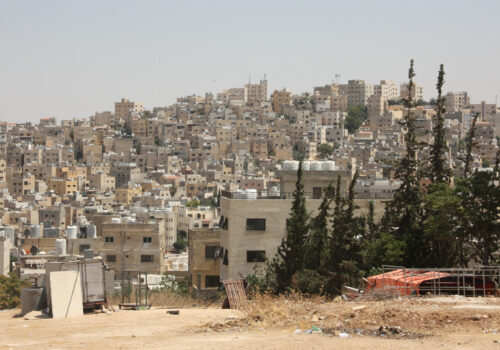
Top photo: Amman, September 2026.