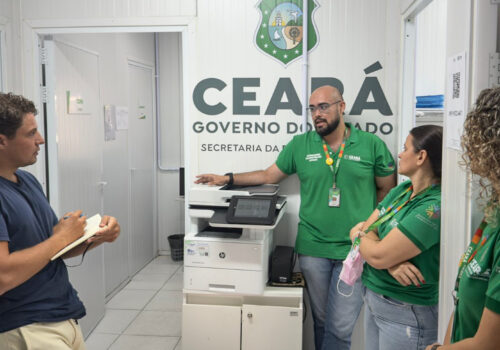
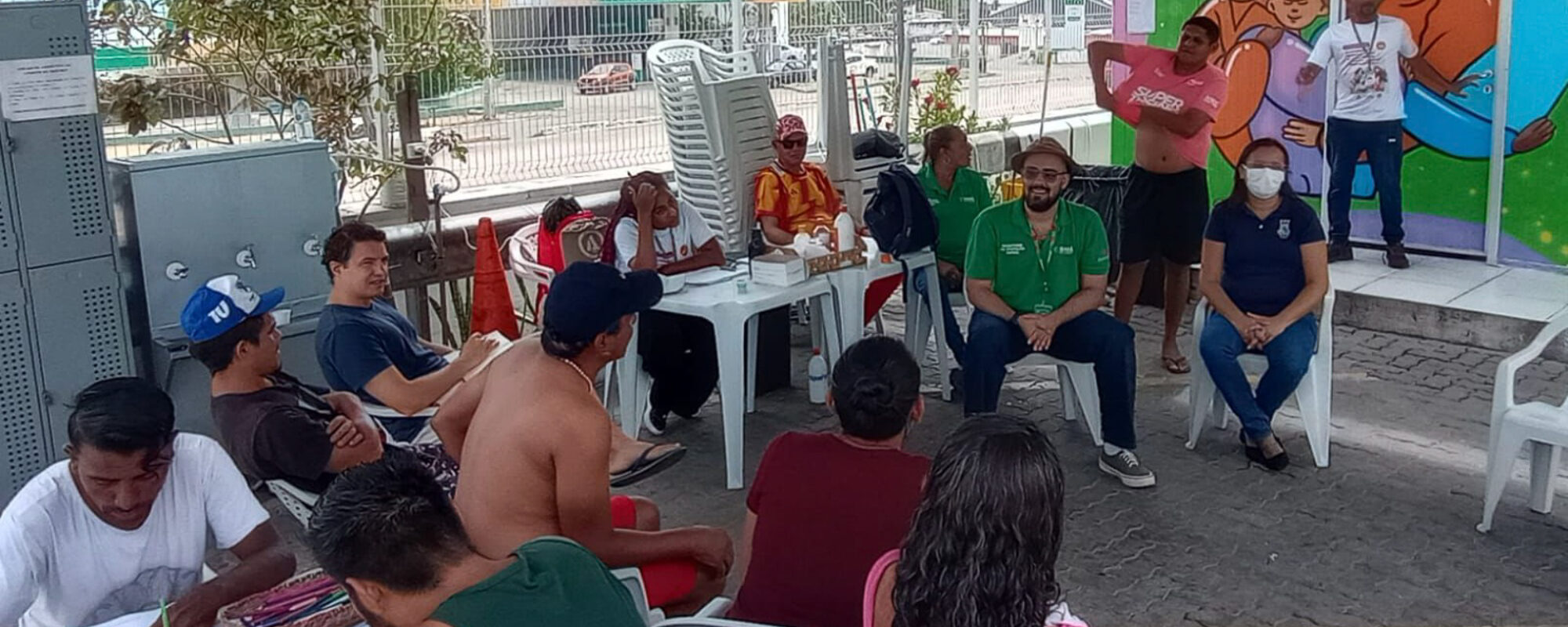
FORTALEZA, Brazil — Marcos Calixto walked out of the homeless welcome center’s office in this northeastern city’s central neighborhood with a big smile on his face. A friendly giant, the team’s psychologist sported jeans and the trademark green polo worn by all state employees working there. He also wore a chapéu de vaquiero, a traditional leather cowboy hat from the region, which framed his rectangular glasses and beard.
The social educator on duty cajoled us into moving plastic picnic chairs into a large circle. We were in a grey-brick courtyard, covered by a large white tarp tent and encircled by a metal fence that delineated the center’s outdoor area. Two dozen or so people had been waiting their turn for a shower. A young woman with dreadlocks wearing a white tee-shirt took down names at a table near the locker room’s entrance on a first-come first serve basis. Throughout the course of the morning, 46 people would use the center to bathe themselves, check in with staff and catch up with friends. While the service was open all day, the busiest time was always first thing in the morning when business opened at 9:00 a.m.
Joining the circle, I’d come here to learn first-hand how the center affected the lives of those it serves in Fortaleza, the capital of the state of Ceará. Run by the state government, it is part of the federal government’s flagship Center for Access to Rights a Social Inclusion (CAIS) initiative. Brazil’s national secretary for drugs, Marta Rodriguez de Assis Machado, explained during a previous interview that the program’s goal is to stand up service hubs to facilitate access to health care and social services for historically disadvantaged communities that have suffered from drug traffickers and police repression. The centers are meant to provide multidisciplinary teams that guarantee an intersectional, “whole person” approach. While people without housing are the main targets, those with housing but living in precarious conditions may also utilize the services.
This welcome center employs 13 staff. The supervisor explained that it receives around 100 clients per day, a mix of returnees and new arrivals. However, she couldn’t provide numbers for how many people in total were registered with the center or how many individual and repeat visits they’d seen in the past year since its opening in October 2024.
Around me, the men wore tee-shirts and shorts while the few women present tended to wear dresses. Most seemed between the ages of 25 and 45. To the side of our circle, another group sat around a table, diligently filling in outlined images with colored pencils. They are a sprinkling of the humans behind the statistics showing that the city of Fortaleza counts the largest number of residents without housing in Brazil’s northeast, with over 10,000 people registered as homeless—although local advocates believe the real number to be much higher.

As Marcos sat down, the group members were in a playful mood, cracking jokes with one another, which increased as Marcos asked his first question: “What does it mean to be mão de vaca (cow handed)?”
The shouts began immediately. “A spendthrift!” someone said. “No, a penny pincher!” another interjected. Marcos confirmed with a hearty laugh that “cow handed” describes a stingy person who’s unwilling to share money or belongings. The energetic back-and-forth continued for 20 or so minutes as Marcos lobbed more terms. It was “Northeast Brazil appreciation day,” and he was quizzing the group on local slang. It also explained his hat.
While those I spoke with came from Fortaleza and its periphery, given some people’s difficulty in answering Marco’s questions, it’s not clear how many were from neighboring states or further afield.
The young woman handling the checklist would intermittently yell out a name and a man would jump up to get his allotment of soap, shampoo and walk through the locker doors. There were three showers in total. Women showered separately in groups of three. The practice helped reduce harassment and other unwanted behavior.
The average temperature year-round in Ceará is 86 degrees Fahrenheit and it’s often humid. Add to that the concrete jungle of Brazil 4th largest city and it’s easy to break a sweat in the shade at 10 a.m. Providing daily showers is a welcome reprieve. Scrubbed and soaped, those walking out of the locker room did so with a new energy in their step. Stopping by a table for a last touch of deodorant, they marched confidently back into the world.
Anastasia, the social educator who had earlier coaxed us into a circle, described how important the simple fact of being clean is. It’s a state of living so seemingly banal for those of us with stable housing and translucent water coming out the faucet that it’s easy to forget how many doors smelling nice opens—and how many smelling bad closes. Doors to a friend or family’s home, social service offices, grocery stores, doctor’s offices, art galleries and countless others. That’s especially true in Brazil, where national culture dictates that one should shower three to five times a day. Shamed by others and shaming themselves for innumerable things, these recipients of invigorating showers are able to start their days fresh.
While offering showers is helpful in itself, the bathing service also provides an initial contact point for the staff to offer additional care. On site, the center offers psychosocial support, assistance with the judicial system, rotating health care services, daily social activities, clothes washing service and referrals to other city and state programs.
As Marcos’ circle ended, I found myself next to a young man. With a gentle demeanor, he couldn’t have been much older than 25. We sat next to each other as the white plastic chairs were rearranged in orderly rows.

Dressed in a green tank-top and shorts, he recounted how he’d been homeless for over six months earlier this year after his family kicked him out of the house because of his drug use. That’s a common reason people end up on the street in Brazil, where inter-generational living situations are the norm. Children often continue living with their parents well into their 30s or 40s, if not longer, especially lower-income Brazilians, many of whom earn less than 1,518 real ($280) per month. I heard of a family of 20 near my home living in a two-bedroom apartment.
The young man discovered the welcome center while homeless. The staff helped facilitate reconciliation with his family, which eventually accepted him back into the house. However, he returns several times a week to see friends and participate in the gardening, music, dance and art activities—all of which were set up with input from those using the center. “It’s become a family,” he told me with a sheepish smile. Before long, he was called over by his friends, who were done showering. With a quick goodbye, they headed onto the streets under a scorching sun.
A woman in her 30s walked through the gate together with a girl no older than seven. Both were wearing red lipstick. Spunky, she entered like a queen visiting her subjects, giving out a hello to one, a hug to another. She was popular among the men gathered in the courtyard, and she relished it. Her round completed, she asked the social educator if she could help secure paperwork for her girl, who didn’t have proper identification. The woman has seven children in total. The center helps keep the documents for her and her children, so they won’t be lost or stolen. Luckily for her, it was Wednesday, and the lawyer could see them both immediately.
As I observed the unfolding scene, a woman sat next to me with a perplexed look. I explained that I was collecting stories, to which she readily offered a soft hand and introduced herself as Leandra. Throughout our conversation, she combed her curly black hair that fell to the middle of her back. Her features were distinctly regional yet undefinable: a Brazilian mix of indigenous, African and European ancestry. She wore a clean, white tight-fitting shirt and pink skirt.
“My mother died when I was 8 years old, so I was raised by my extended family,” she told me calmly. “But nothing replaces the love of a mother.” Her father seems never to have entered the picture. Growing up on the periphery of Fortaleza was not easy. She had been born a boy, and her family didn’t accept her identification as a woman, so she moved to the city center in 2020 during the pandemic to start a new life. I guessed that she must still have been a teenager at the time.
“To afford a kitchenette studio I started working as a prostitute,” she calmly continued recounting. It was not easy work, and she was always busy. Brazil’s laws around prostitution are vague; it’s not explicitly illegal to offer or purchase such services—although underage prostitution certainly is against the law. Sometimes Leandra would find clients through websites but most often she’d have to pick them up on the sidewalk. To offer her services on the designated street corners, she had to pay a daily rate of 50 to 60 real to the local cafetina or cafitão, pimp, who controlled that particular block on days she worked. A hefty fee when you realize that the sum is equivalent to the national minimum wage.
To cover her costs, Leandra worked most days. After a few years, she decided she couldn’t take it anymore. Quitting meant losing her kitchenette and ending up on the street but during our conversation, it seemed, for the moment at least, that she had found peace with her situation.
Thanks to an initiative at the local housing shelter to save 10 beds for LGBTQ+ people, she could sleep inside most nights. Her routine revolved around showering here, living on the street in the search of shade, food and friends, and returning to the shelter at night. “I have more freedom now and can actually enjoy my life,” she told me with a shy smile.
In her view, the most helpful services the government offers are the medical teams from the national health care service—known colloquially as the SUS—which offers free health care to all. Medical services are available Monday through Friday on a rotating basis at designated street outreach points across the city. Leandra said that was important because those living on the street find it hard to access the government-run health clinics, even though they’re nominally available to the whole population, because of shame and stigma on both sides.

The welcome center is one such point of access. It offers health check-ups on Mondays and STD screenings on Wednesdays. A nurse is present daily to care for wounds, and a dentist comes twice a month. The service is lifesaving, especially for those requiring prescription medications, as the health care teams ensure the safekeeping and regular taking of medicine. It’s also critical that the services are offered in multiple locations since many of those living on the street are barred from moving freely between neighborhoods because of territorial gang wars.
Staff and other local advocates reinforced that fact, complaining that Fortaleza’s powerful gangs control access to many of the city’s services, from food banks to housing shelters, complicating an already difficult situation for the homeless and those trying to provide them services—a phenomenon I described in my last dispatch.
After posing for a photograph, Leandra bid me farewell but not before making me promise to share this dispatch with her once it’s published. With that, she, too, passed through the gate into the sweltering heat.
Staff members explained that the number one request from those accessing the center is housing. Unfortunately, the staff were unable to share any data about how many people they had helped refer to housing services or how successful those programs were. On a separate occasion, homeless advocates unaffiliated with the welcome center, and who preferred not to be named, revealed that a recent government initiative that had provided 45 people living on the street with their own apartments ended with only three new people in housing after one year. An unconditional failure with a success rate of 6.67 percent, well under the Netherlands’ 83 percent success rate for a similar initiative.
From the advocates’ descriptions, it seems the project lacked international evidence-based best practices such a wraparound social service and proper coordination between the program, landlords and the people being helped.

Another complicating factor is the length of time people have been living on the street. The welcome center staff estimated that most of the folks they see have been on the street an average of five years, but some have been homeless for 20, even 40 years. Staff described how the longer people have been on the street, the less likely they are to ask for services, and that providing services like housing and employment requires additional attention-intensive support. One of the homeless advocates who had also lived on the street for almost a decade was blunt: “You need to help people get off the street as quickly as possible. You can’t let the street enter their heart.”
The welcome center staff members also described how they refer people to other treatment services—although, again, no data was shared about how many people were helped or the average time between requesting treatment and getting it.
One referral pathway is to the various addiction and mental health care services provided by Brazil’s universal health care system, specialized out-patient clinics known as Centros de Atenção Psicossocial (CAPS). While on paper, they provide important assistance to those in need, the reality is not so rosy.
Recent news investigations found that the system in Fortaleza is overwhelmed. The city’s 16 CAPS clinics—only seven of which are designated for drugs and alcohol—are facilitating 55,000 meetings a month. One article found the system faced the “deterioration or inadequacy of buildings, lack of medications and delays in scheduling appointments.” In just one example, the hospital next to the welcome center recently closed, and with it a dozen beds that helped detox needy patients vanished.

The center can also refer people to so-called therapeutic communities on an ad-hoc basis. Unlike the rehabilitation centers of the same name in Portugal and the Netherlands, however, they are not evidence-based and are run predominantly by religious organizations with funding from the government. Beyond abstinence programming, it’s unclear if Ceará’s therapeutic communities put any effort into assisting people with reintegrating society. The staff confessed skepticism over the effectiveness of the therapeutic communities. Many of those referred there would simply come back to the streets even after attending the program for 6 months or a year.
The homeless advocates also candidly described how many use the therapeutic communities as a vacation from the street, or to escape threats, with no intention of changing their behavior in the long term. It’s important to note that unlike opioid addiction, which in the vast majority of cases requires medication-assisted treatment such as buprenorphine or methadone for opioid-dependent individuals to function day-to-day, most users of crack cocaine—the drug of choice for many here in addition to alcohol—can stop their use for long periods without debilitating physical withdrawals, although they do suffer from psychological withdrawal with symptoms such as depression, insomnia and nightmares that require symptomatic treatment.
Leandra’s departure left me alone with my reflections as men continued to rotate in and out of the locker room. The center cares exceptionally well for those with problems with which it can assist itself, such as legal counsel, basic health assistance, psycho-social support and daily activities. Offering a moment of reprieve from the unforgiving life on the scalding streets may be the most important. I read that in the eyes of those I spoke with and in the step of those I observed.
Without data pointing to the contrary, however, the center doesn’t yet seem to be fulfilling its expected role as a broader launching pad to housing, employment and societal reintegration—health care being the notable exception—because of structural weakness of the social service system and the society in which it operates. It serves only a fraction of those in need. The homeless advocate with experience living on the street may have summed up the situation best: “People living on the street are stuck between disorganized public services, violent gangs that limit their movement and the constant petty violence between one another.”
Top photo: Marcos leading a discussion circle with Rowland