

TROMSO, Norway — “Have you heard Alex Karp has come to town?”
It was a sunny afternoon in April. I was sitting in a café called Tøllefsen with a Sámi politician named Anton Petter Hauan. He was in town for the weekend for an arts festival, and would soon be headed back to Kautokeino, the eastern city close to the Finnish border where he lives, populated mainly by members of the Sámi Indigenous people. We were deep in conversation about high north energy projects when a lanky older man approached our table and patted him on the back. Hauan quickly introduced us; this was Magne Amundsen, head of economic development for Tromsø municipality.
“An American journalist?” Amundsen said, raising his eyebrows. Then he asked the question that opened this piece.
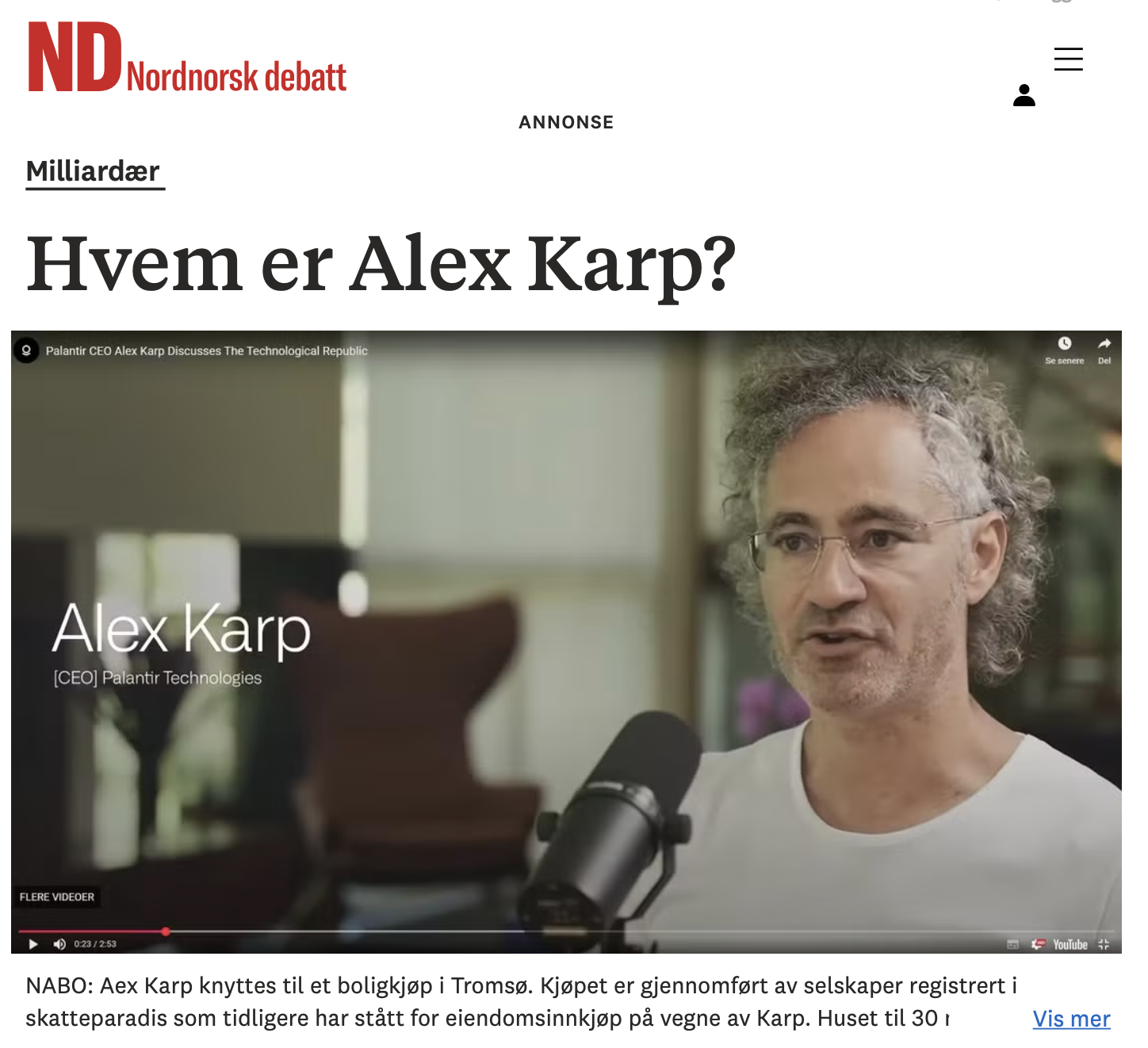
Clocking my alarm, Amundsen quickly supplied the details: Alex Karp, controversial billionaire CEO of the American AI-powered data analytics company Palantir, had bought property in our city. Amundsen pulled out his phone to show me the article in Nordlys, the regional paper. In 2024, a mysterious company called Hohenems AB completed one of the city’s biggest residential sales, paying $3.2 million for a modern five-bedroom home with stunning fjord views. Intrigued by both the scale and secrecy of the sale, the paper had traced the company’s ownership back to Karp.
As it turns out, he has purchased several properties in Norway through Hohehems AB. But, Amundsen told me, he had reason to believe this one was more than a mere real estate investment. One of Amundsen’s friends lives just down the road from the property and this past winter had often spotted Karp’s unmistakable wild graying mane entering or leaving the home. On more than one occasion, an ever-present coterie of super-fit Norwegian security guards had frightened this man’s young child.
Karp is an avid cross-country skier, according to reports, and his rigorous training routine involves splitting time between ski destinations around the world. But for a man outspoken about his commitment to mass surveillance of civilians—one of Palantir’s stocks-in-trade—his sudden interest in these particular ski trails has raised suspicion.
At the center of Tromsø island, seven miles of carefully maintained ski tracks loop around the long north-to-south ridge. One of the most-trafficked loops passes an eerie and unmissable installation: a large field dotted with more than 30 white satellite dishes, many encased in protective domes and some as tall as a telephone pole. It is the global headquarters of Kongsberg Satellite Services (KSAT). The satellite arm of Kongsberg, a joint state-commercial defense company and major weapons manufacturer, it, like Palantir, has considerably profited from US contracts throughout the US-Israel war against Iran.
Palantir has also been rapidly expanding its space footprint, moving beyond defense contracts to building core operating systems for orbital and stratospheric operations. For many in Norway, Karp’s geographical proximity to the state’s satellite operations feels too close for comfort. And well-timed: last year, the European Space Agency announced it would build its new Arctic Space Center in Tromsø.
Nordlys had published an investigation in September 2025 and there was good reason for Amundsen to alert me about it now. On April 18—not long before our cafe introduction—Karp published a 22-point “mini-manifesto” on X outlining his vision for the future of the West. Among other points, he endorsed state mass surveillance of civilians, extolled American military might and called on Silicon Valley to prioritize AI-powered weaponry.
“The question is not whether AI weapons will be built; it is who will build them and for what purpose,” Karp wrote.
* * *
From the United Kingdom to France to Spain, state contracts with Palantir have drawn sharp criticism. In the UK, which has nearly $700 million in AI-powered big-data software contracts spanning the National Health Services, the military and various ministries, Karp’s April manifesto brought the controversy to a head. Thousands of protestors took to the streets and more than 200,000 people signed a petition calling to end the contracts. Parliament members have also raised concerns, according to The Guardian, with one calling the manifesto “the ramblings of a supervillain.”
Norway doesn’t currently employ Palantir. But it tried. The Norwegian state police adopted the company’s Gotham surveillance technology in 2016 until it terminated the contract in 2020, citing, among other concerns, the firm’s non-compliance with Norway’s strict data protection laws. (In December 2025, Switzerland’s armed forces also cancelled a contract after an audit detected data leaks to US intelligence.)

Still, Norway’s sovereign wealth fund remains one of Palantir’s largest European investors. That has attracted criticism at a time the fund has significantly downsized its Israeli defense investments. Palantir has longstanding contracts with the Israeli Defense Forces, providing the predictive systems that supported civilian surveillance and genocide in Gaza as well as operations in the West Bank. An Amnesty International report last year found that Palantir had also contributed to human rights violations by facilitating the US Immigration and Customs Enforcement’s unlawful arrests.
Over my nearly two years living in Tromsø, it’s happened a handful of times: a sudden vertigo-like sensation when my high north small-town bubble seems to suddenly pop. I felt it last year when our port police detained an alleged Russian shadow fleet vessel. I felt it in January, when Thomas Dans, the Trump-appointed chair of US Arctic research, arrived directly from Mar-a-Lago to attend a conference that saw the United States abandon its longstanding interests and partnerships. At a small cocktail reception, he told me, unflinchingly, that US Arctic research would turn its focus from “climate change and Indigenous-peoples-DEI stuff,” to focus on “the economic opportunities of the North.” (I wrote about those conversations for The Atlantic here.)
Any sense of isolation is an illusion, of course. Not just because Tromsø is a growing global tourism hub and geopolitical center. But also because, much like in most of the world, American AI companies are already infiltrating the fabric of many peoples’ personal and professional lives, prompting ethical debates.
The Arctic University in Norway, for example, has a contract with OpenAI to run its own internal, data-protected large language model, ChatUiT. When OpenAI CEO Sam Altman entered an agreement with the US Defense Department in March, it raised alarm. Tromsø is a sister city with Gaza and pro-Palestine activism here is widespread and strong. Many students have expressed outrage that their work is helping train algorithms that are powering the US-Israel defense apparatus.
Among my friends at the university, I’ve heard debates questioning the very existence of an academic “GPT.” It raises all kinds of knotty questions: Whose knowledge was mined and repackaged to produce its answers, often without credit and always without compensation? How are such models trained and how might they be invisibly guiding avenues of critical thinking? What data are we revealing about ourselves from the content and sequence of our own queries?
As word of Karp’s purchase spread, I heard critical conversations among locals as well. There’s another layer of self-questioning behind them: In our countless daily acts of digital permissiveness, what’s the point of being so alarmed by Karp’s mere physical intrusion anyway? Do we need the embodied presence of an easily hate-able figurehead like him to question the inevitability-narrative of power brokers who have everything to gain from our accepting their terms?
* * *
Back at Tøllefsen, Amundsen departed, and my conversation with Hauan, the Sámi politician, turned to his own recent explorations with AI. He’d been talking with Claude, the chatbot created by Anthropic. Founded by former OpenAI employees, that company trained its bot on human rights principles and is considered a moral (and more accurate) alternative to ChatGPT. Lately, Hauan has been teaching Claude to speak northern Sámi. It’s an extremely quick learner, he said.
Hauan didn’t grow up with the Sámi language. He wasn’t raised as a Sámi at all. Thanks to more than a century of successful fornorskning, or Norwegianization, policies, his parents were “fully Norwegian” and didn’t talk about their cultural heritage. Hauan’s ancestors were sea Sámi, coastal fishers whose culture was systemically erased by a state eager to exploit fish-rich northern waters. Hauan has spent much of his adulthood rediscovering their silenced history. Integral to the process was learning northern Sámi.
Could large language models help preserve, and even spread, Indigenous languages? As it happened, that question had come up in another recent conversation. For nearly two years now, I’ve been meeting Risten Turi Aleksandersen, director of language, education and health at the Sámi Parliament, the representative body with which the government must consult on issues concerning Sámi culture and land. She recently told me that the Sámi University of Applied Sciences is developing a large language model of its own.
For the Sámi, language, education and health all go hand in hand, Risten said. Nearly 40 years after Norway ratified the International Labor Organization Tribal and Indigenous Peoples Convention (ILO 169) and abolished its assimilation policies, language revitalization is ongoing work. In many cases, there simply aren’t enough teachers to staff the region’s constellation of small and geographically distant communities. The subsequent language gap isn’t just a cultural loss affecting future generations. It can also magnify health risks for those who are native speakers.
Few doctors in Norway speak Sámi, let alone understand the lifestyle, values and worldviews that should inform consultation and diagnosis. If AI could at the very least help more doctors translate the basics, she told me, it could be transformative.

Risten also sees potential to help level a legal playing field as the state systemically expropriates traditional lands. She cited a landmark 2021 case in which the Supreme Court ruled the state’s permitting of the Fosen wind park unconstitutional because it violated the rights of Sámi reindeer herders. But it took two decades of legal battles to reach that decision. By the time the ruling came down, the park had already been built. Because the damage was done, the state was allowed to keep the windmills and merely pay a fine.
Risten, herself a reindeer herder, has spent a decade fighting a state-permitted wind park in her herding areas just an hour from Tromsø. Much of that fight has also been a sort of linguistic study, as she and her husband attempted to translate cryptic bureaucratic processes and legalese. Theoretically, Sámi-trained AI could help future herders quickly learn permit and approval processes and better defend their lands. Or a tool grounded in Sámi worldviews and trained in international human rights law might in turn be able to communicate those to states and corporations that have historically dismissed Sámi authority.
But even potentially helpful uses must be weighed against one glaring consequence: AI’s devastating environmental costs, and ever-growing demand for energy, water and space. Those, too, are swiftly coming to northern Norway. Just a few hours south of Tromsø lies the fjordside city Narvik, known for the World War II battle that marked Hitler’s first decisive defeat. On its outskirts, Microsoft will soon build a $6.2 billion, 230-megawatt AI data center promising to “deliver sustainable AI infrastructure to all of Europe.” Already, this Narvik center is raising concerns in the local reindeer herding district.
Indeed, northern Norway is quickly emerging as a leader in future European data center infrastructure. Not only is it among Europe’s least-populated regions but the Arctic climate also naturally reduces the energy required to keep the centers cool. Much like the many new energy projects crisscrossing the land, these centers will inevitably encroach on already-fragmented traditional Sámi herding grounds.
On that April afternoon in Tøllefsen, Hauan and I were in agreement: Karp’s arrival was alarming but his technologies had likely long since infiltrated our lives. His presence was merely an uncomfortable reminder of the far-flung, deep-burrowing global influence of a disturbingly small group of American men. Absent larger regulations, civilians now bear the weight of often queasy-making ethics. But rather than restricting those firms’ access to sensitive civilian data, many democratic states are still paying them for the privilege of being mined.
For now, we could hold out hope that Karp is interested in Tromsø only for the quality of its fresh powder. Perhaps, we mused, he may even notice the snow cover’s growing unpredictability, its rapid seasonal changes. Maybe in some future winter, as he wades through gummy slush, he’ll consider his own disproportionate contributions to the high north’s accelerating transformations and have a change of heart.
We laughed at the image of Karp suddenly growing a climate conscience. It felt about as absurd as state leaders expecting that his company, or any powerful technology firm, could be trusted to set its own ethical guardrails, let alone follow them.
Top photo: Tromso in April