BEIRUT — A few blocks from the coast of the Mediterranean Sea, a cluster of discarded shipping containers takes up one corner of an empty lot in Hamra, a bustling commercial neighborhood in the Lebanese capital, flanked by a gas station and a row of concrete apartment buildings. Decorated with murals painted in bright colors, their roofs lined with solar panels, the containers’ original function is barely discernable. Once indispensable to global commerce, these discarded objects have found new life in a country where many can’t afford the products they used to hold.
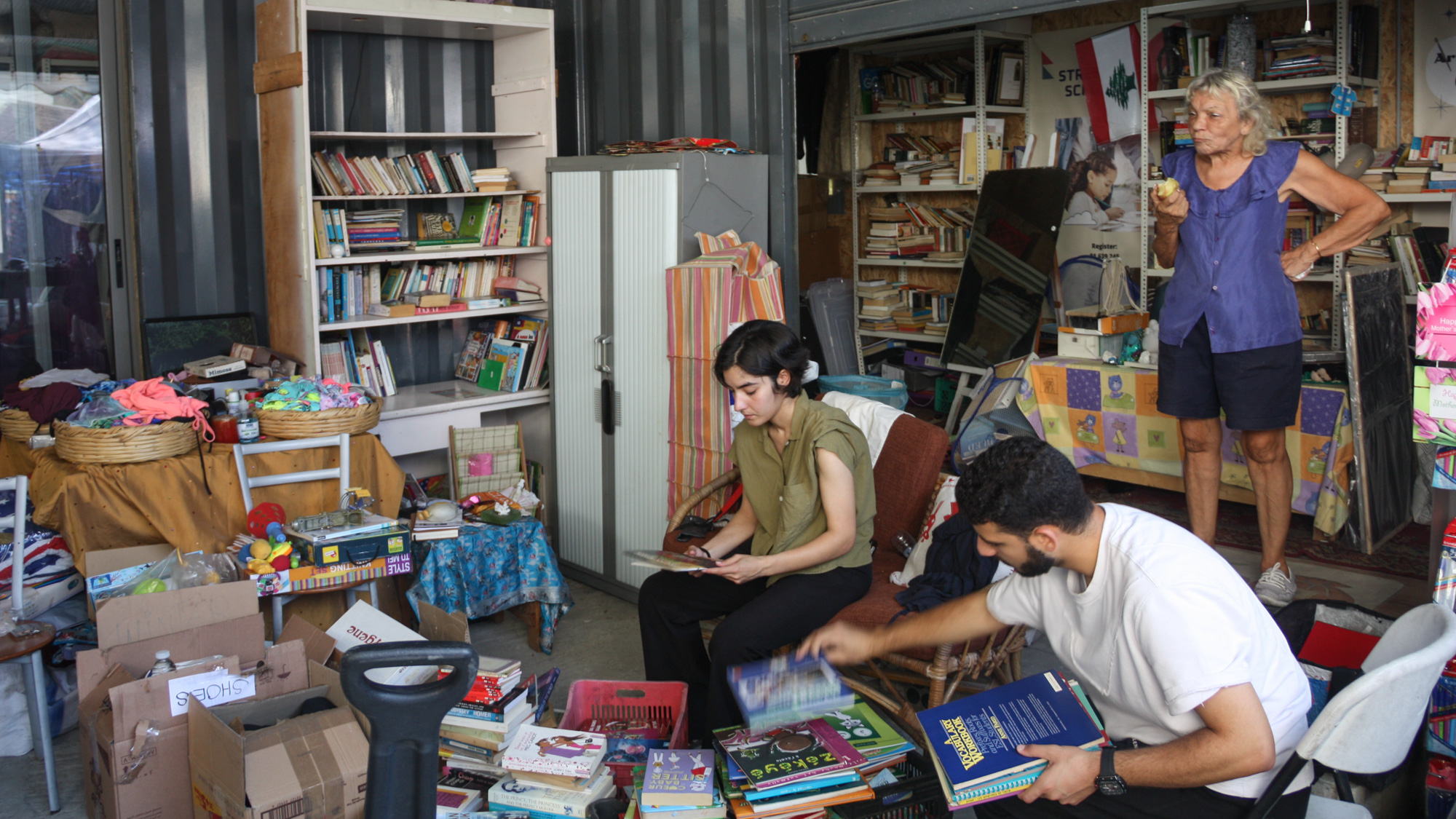
On a warm day in late September, I walked through the lot with Imane Assaf, a stylish Beiruti in her late 50s who is the founder of Ahla Fawda, a community organization that repurposed the containers according to a vision for an alternative economy. Inside one container, volunteers were sorting books people could buy not with cash but plastic, glass, metal and cardboard waste as currency.
Piles of those materials were stacked into bales nearby, waiting to be picked up by recycling companies. More containers held food, clothes, diapers and other essential goods, all for sale to locals bringing in recyclable waste, which would be exchanged for “eco-currency.” The initiative is called EcoHub, aimed at enabling people who can’t afford Lebanon’s skyrocketing prices to obtain products they need without relying on traditional models of charity such as donated food.
“So they are just like any other people, not dependent, not imposed upon with things they don’t need,” Assaf told me. “They have an equal opportunity [to shop] with their trash.”
Ahla Fawda makes up one node in a network of grassroots organizations trying to address successive crises in Lebanon from the ground up. Their footprint is small; although hundreds popped up in the wake of nationwide protests in 2019, only a few have managed to succeed in the difficult work of sustaining their operations as the economic crisis worsens and new emergencies appear.
In the past year, that has meant feeding and housing more than a million people fleeing southern Lebanon, where Israeli forces have flattened hundreds of villages and killed more than 4,000 people in its latest round of conflict with Hezbollah, the Lebanese militant group. During my nine days in Beirut, I met organizers of several of those local initiatives all valiantly struggling to bring relief to an exhausted population while its government struggles to function.
The current war is just the latest stressor on Lebanon’s economy, which has been in free fall since 2019. Triggered by a succession of short-sighted financial decisions by the country’s banking sector, as well as widespread official corruption and the pressures of a globalized economy, the government defaulted on its foreign debt. In the years that followed, the Lebanese pound lost over 98 percent of its value, wiping out the middle class and plunging a vast majority of the population into poverty. People here struggle with electricity cuts and lack of access to basic services while their government is gridlocked by a political system divided along sectarian lines.
Other calamities have exacerbated the economic crisis. Lebanon’s resources were already stressed after the country took in some 1.5 million refugees from neighboring Syria’s civil war between 2011 and 2024. The Covid-19 pandemic in 2020 caused further slowdown. That same year, a devastating warehouse explosion in the port of Beirut caused massive damage to the capital and displaced some 300,000 residents. The city still hasn’t fully recovered.
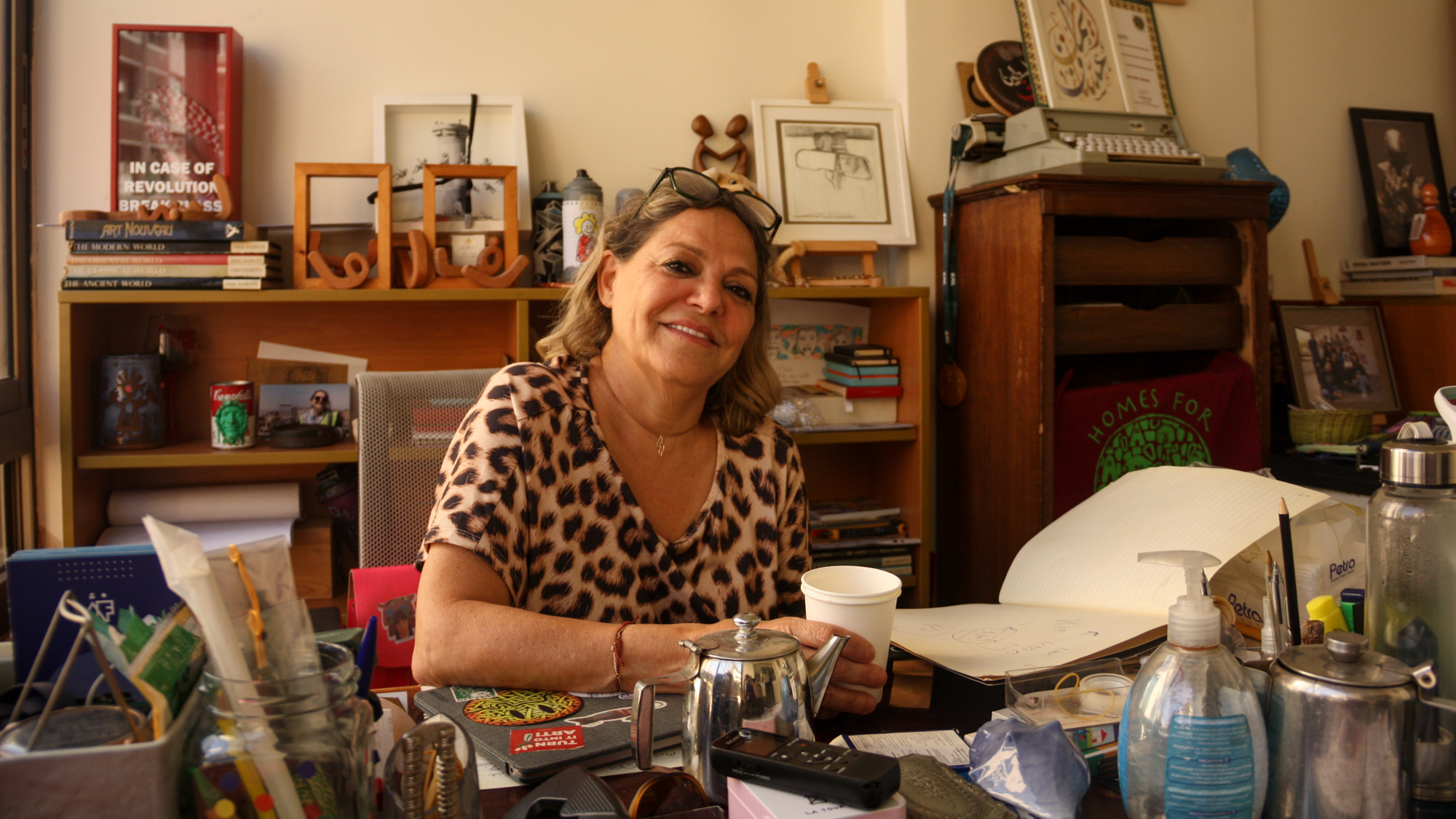
“The situation in Lebanon is really difficult and the government isn’t looking out for us or its people,” said Iman Toubi, who has been displaced from her home city of Nabatieh since it was bombed in December. I met her a few blocks from EcoHub in Ahla Fawda’s office in Hamra, above what used to be a famous cafe for writers and intellectuals. She and other displaced women from the south were decorating a cloth with a painting of an olive tree and other symbols of resistance, part of an art program Ahla Fawda offers for displaced people.
Before participating in the project, Toubi had received financial aid from the organization when she and her husband could not find work after fleeing to Beirut. Where the government fails to step in, “people help each other,” she told me. Her words were echoed by many others I spoke with over the course of my time in the city.
Writing about Lebanon for the nonprofit research organization Synaps, the economic researcher Rosalie Berthier observed that many such forms of assistance are informal. “The owner of a corner shop gives credit to a struggling local family; residents of a building make sure that their neighbor who just lost their job has enough to eat; wealthier families fund extracurricular activities for impoverished students who take part at no cost,” Berthier wrote in 2022.
As if to illustrate her point, in an outdoor area between the Hamra containers, Fouad Georges—a Lebanese entrepreneur and co-founder of the crisis relief campaign One Lebanon—was cooking a meal for hundreds of people living in shelters around Beirut who have also been displaced from the south. Ahla Fawda’s Imane Assaf filmed him with her phone for an Instagram video. “What’s the lunch today?” she asked Georges. (It was kousa bil laban, a Lebanese comfort dish of zucchini in yogurt sauce).
At the same time, more organized networks have developed to meet other rising needs. Much of the effort is organized along sectarian lines, with the country’s varied religious communities offering aid to their own constituents. In particularly acute crises, international charities like Oxfam, Caritas and Save the Children step in, providing what is often lifesaving aid.
What makes an organization like Ahla Fawda different is its goal of not only meeting immediate needs but also building something that may help its community support itself in the future. Its vision for a circular economy—where waste has value and little is truly thrown away—offers an alternative to the consumptive model that drives most contemporary societies, including in Lebanon. In a more practical sense, it seeks to break what Assaf repeatedly referred to as “dependency” on aid, which she believes keeps people locked in cycles of poverty. “So we shifted our approach to give and receive,” she told me. “You want our services, you have to give something back.”
That view is widely shared by social justice activists and critics of traditional aid models. In his book Mutual Aid, the activist and writer Dean Spade describes “solidarity,” in which communities affected by injustice work from the bottom up to meet their needs and solve their own problems, as distinct from “charity,” which offers top-down assistance, often based on the whims of outside donors or individual philanthropists.
Charities have even been criticized for undercutting the work of grassroots movements that might have more explicitly ideological or political goals, such as opposing capitalism or authoritarianism, by offering assistance that is “apolitical.” They also often seek to address immediate crises without addressing the systems that created them or providing an alternative vision.
In the wake of Lebanon’s back-to-back, intertwining crises—including the ongoing Israeli occupation of the south—I wanted to understand the role of groups like Ahla Fawda working to build the society and economy they want to see rather than waiting for it to be granted to them. But I was also aware of the very real challenges such organizations face in keeping their day-to-day operations afloat under increasing pressure.
“Solidarity networks are stretched to the limit,” researcher Berthier wrote. “On the one side, a rising number of people seek ever more help. On the other, a shrinking pool of individuals can spare fewer resources and less time.” Could the grassroots, I wanted to know, deliver on its promises?
* * *
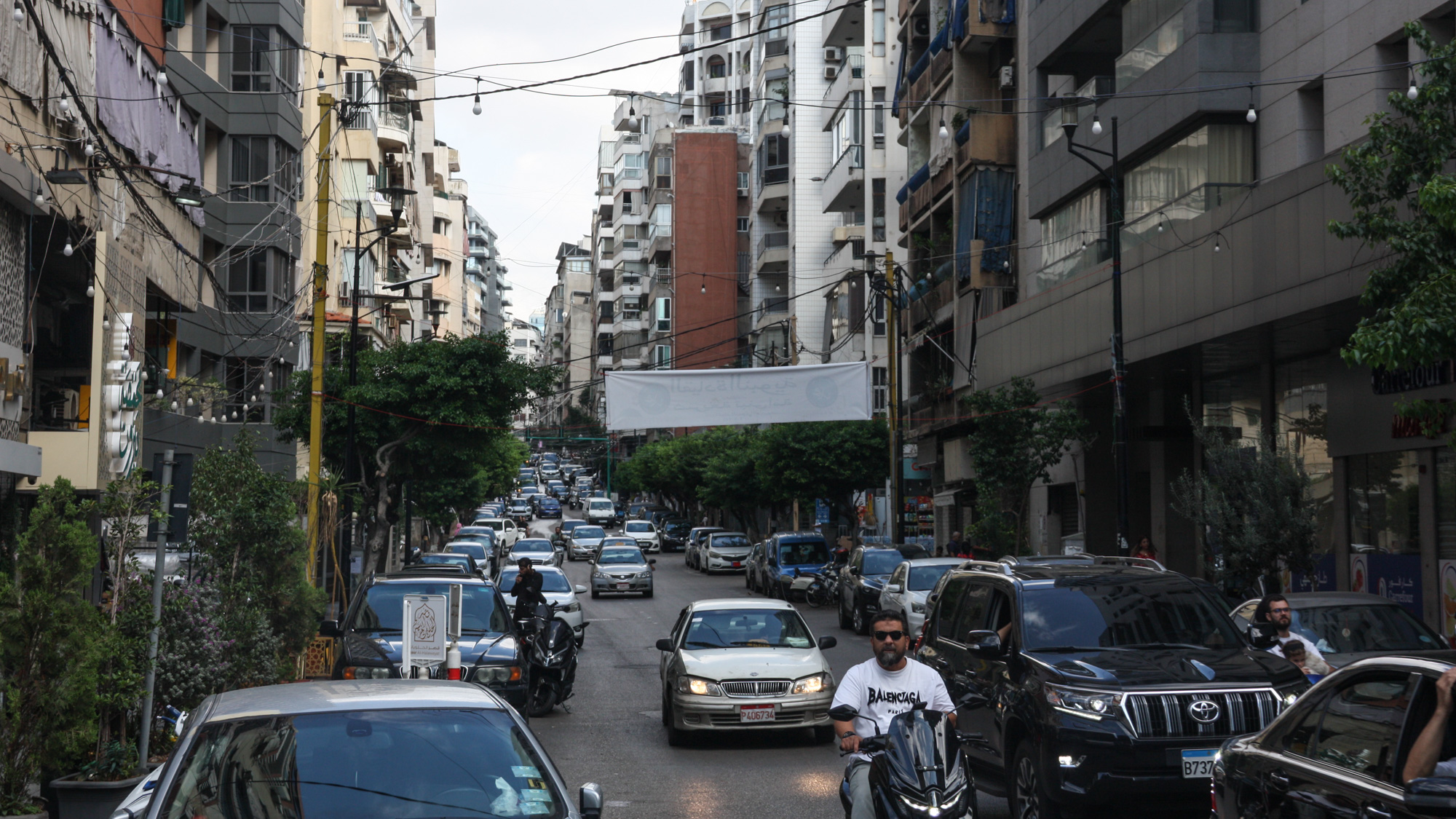
Squint your eyes in Beirut—in some places, you really don’t have to squint very much—and it can be hard to see that an economic crisis exists at all. Restaurants fill with couples and groups enjoying leisurely meals each evening; streets in trendy districts like Gemmayzeh, in the east, are filled with bars, Pilates studios and craft coffee shops selling $10 lattes. Before 2019, Lebanon’s tourism industry was on the upswing as visitors from around the world came to experience its vibrant nightlife, natural beauty and top-notch food.
One of the first indicators that something is wrong, however, might be that most places use US dollars rather than Lebanese pounds. A dollar is equivalent to about 90,000 Lebanese pounds; people often pay in dollars and receive change in local currency.
Lebanon decided to peg its pound to the dollar in 1997, after the country emerged from a brutal 15-year civil war that devastated its economy. The decision was an attempt to tame inflation and stabilize the currency, but because the country had few domestic industries and imported more than it exported, it required a constant inflow of dollars to maintain a stable exchange rate. That encouraged borrowing. The Lebanese central bank offered high interest rates but could not actually pay back its lenders, so it borrowed more to cover its debt in what has been equated to a Ponzi scheme. In 2019, after the government attempted to tax WhatsApp messages to cover its debt, triggering widespread protests, the scheme collapsed.
After the government defaulted on its debt, the Lebanese pound experienced immediate and massive devaluation. Many lost their life savings overnight and news reports were rife with stories of desperate people robbing banks to withdraw their own money. Electricity cuts and medicine shortages have become commonplace.
Since 2020, the government has been in talks with the International Monetary Fund for an emergency loan that would require it to restructure its banking system and meet other conditions. The shift toward dollarization, which is not official policy but has been widely adopted by businesses, offers some stability, but also has the effect of widening inequality for those without access to hard currency.
More than three-quarters of Lebanon’s population doesn’t earn enough to afford basic necessities such as food, clean water, health care, electricity and education, according to the United Nations. More than a million Lebanese citizens work abroad; their remittances sustain family members at home. Here, the lucky ones work for foreign companies or NGOs and earn salaries in US dollars, and it is their income that keeps coffee shops, restaurants and bars humming on a typical Friday night.
The 2019 protests—to which people refer as the thawra, or revolution—became the incubator for a different kind of economic system. The demonstrations, which resulted in the prime minister’s resignation and were notable for cutting across sectarian lines, were an outlet for Lebanese to express their dissatisfaction not only with the WhatsApp tax but the entire political system, and demand accountability for corruption as well as economic, environmental and gender justice. Although the energy of the thawra has not been sustained through the multiple subsequent crises that have rocked Lebanon, it did inspire multiple grassroots groups with alternative visions for their society.
One of them is tucked away on a side street in Mazra’a, a busy, diverse neighborhood in central Beirut. Its name means “farm” in Arabic, harkening back to the days when the area was agricultural land before the encroaching city filled it with multistory apartment buildings. It’s a fitting location for Dikken El Mazraa, a grocery store created in the wake of the 2019 protests to provide Beirutis with access to local produce at affordable prices. I sat down in the store’s office with Karim Hakim, a former teacher who has been managing the operation for five years. As the currency became increasingly devalued, supermarkets raised their prices in anticipation, putting basic groceries out of reach for many people. Dikken El Mazraa’s founders, Hakim said, “wanted to offer an alternative.”
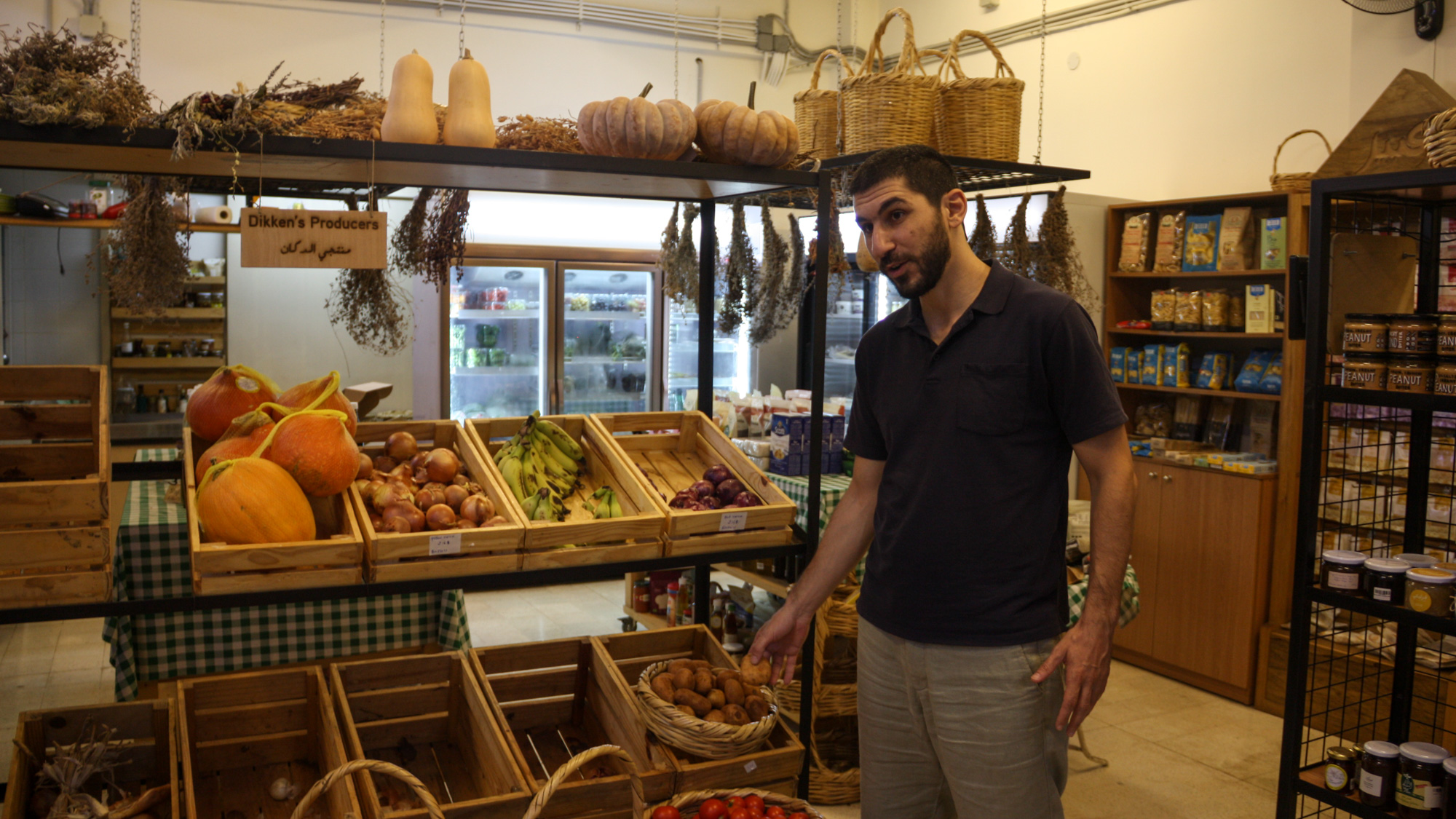
They modeled the store on the Park Slope Food Coop, a grocery store in Brooklyn that offers products at lower prices to members who buy shares in the operation and work at the store in exchange. Dikken El Mazraa had to make some adjustments after realizing that the Lebanese were largely unfamiliar with the coop model. The store’s current membership system offers prices at three different tiers depending on customers’ financial situation. Higher-income members would, in theory, subsidize discounted rates for lower-income members. However, with only 100 members, the store is still finessing its pricing scheme. Without enough members currently paying full price to sustain its discounts, it relies on outside donations.
“We’re introducing a horizontal type of structure where the rich support the poor in an indirect way,” Hakim told me. That kind of structure was popular before Lebanon’s civil war, he said. But after the conflict, some began looking toward more “vertical” solidarity dynamics, such as support from their religious communities. “People are not very familiar with” the coop model, he told me, “and are a bit careful.” But the 2019 demonstrations inspired a new wave of horizontal organizing.
The thawra was also a turning point for Ahla Fawda, which Assaf founded in 2012 as a neighborhood initiative to offer trick-or-treating to children. Its name means “beautiful chaos,” and its ethos evokes the vibrant energy of the street. In 2019, at the height of the anti-government demonstrations, she brought artists together to paint murals on buildings across Beirut, some of which she pointed out to me as we walked through Hamra’s bustling streets, past shuttered cinemas and vendors hawking newspapers. She believed art could amplify the demonstrators’ voices, although she feels less hopeful now about the possibility of real change. “The revolution started with a positive message,” she said. “But the politicians ruined all the principles of the revolution.”
The crises that followed—currency collapse, the Covid-19 pandemic and the Beirut port explosion—forced a pivot, Assaf told me. Ahla Fawda began offering humanitarian relief before coming up with the EcoHub model, which itself has gone through multiple iterations.
Assaf quickly realized that at current market rates for plastic waste, customers would have to bring in mountains of trash to be able to afford the products in her store. So she convinced local businesses to let Ahla Fawda pick up their recyclables, subsidizing the products that could be sold at half-price to people in need. The organization also upcycles trash into clothing, accessories, art pieces and household items, and is working on integrating composting and urban farming into the operation. It pivoted again to assist waves of displaced people from the Israeli attacks on southern Lebanon, as well as parts of Beirut, beginning in 2023.
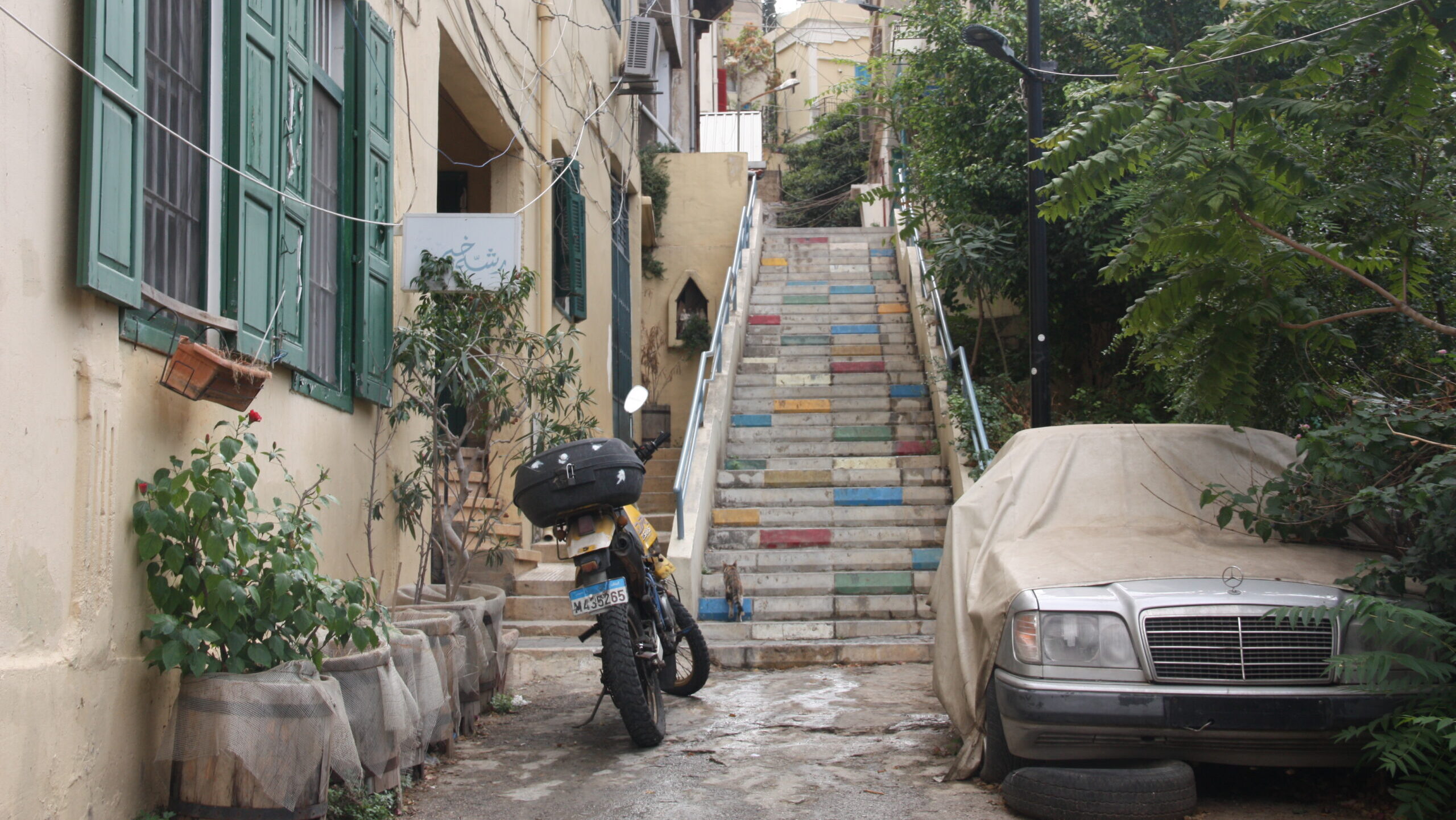
Assaf says her biggest challenge has been responding to those successive crises while maintaining Ahla Fawda’s vision for itself as a self-sustaining community organization rather than a charity. “When we began Ahla Fawda, we never went to donors for support,” she said. But after the start of the economic crisis, “we needed support. It was the first time that we called for help from others. And the bigger the operation, the more we needed to apply for grants or ask for donations. But you can’t sustain it this way.”
The question of funding highlighted a central tension of Ahla Fawda’s model—seeking to meet needs that, in another place or time, many would expect to be addressed by the government. It comes at the expense of the kind of longer-term work the organization initially set out to do.
Assaf says Ahla Fawda has little choice. “We have a saying in Arabic: One hand doesn’t clap, you need two hands to clap,” Assaf told me with a wry smile. “I think we are all responsible. I think it’s our responsibility as Lebanese to do what we can to support one another. You can’t just count on the government to do the job. So if you want to make things happen, you have to work it out yourself.”
* * *
On my last day in Beirut, I walked from my hotel to Nation Station, a community kitchen in the eastern neighborhood of Geitawi. Nation Station sits on a hill overlooking the port of Beirut, where on August 4, 2020, 2,750 tons of ammonium nitrate fertilizer caught fire, triggering one of the most powerful non-nuclear explosions in history. The blast killed 218 people, injured 7,000 and left 300,000 people displaced. The damage has taken many years and billions of dollars to repair, and much of it has never been addressed, leaving scars visible on hundreds of abandoned buildings.
The day after the blast, five friends who lived in the neighborhood decided they needed to do something to help their neighbors. They commandeered an abandoned gas station to use as a hub for collecting food and other supplies, including plastic sheeting Beirutis used to cover their shattered windows. Over time, as broken glass was cleaned from the streets and the immediate emergency waned, the group turned to addressing more longstanding issues including the economic crisis and ongoing Covid-19 pandemic. They wanted to create a self-sustaining community kitchen that would be able to supply discounted food to students, workers and anyone else who could afford it while also feeding people who couldn’t pay anything.
Unlike most political parties and religious charities, Nation Station, like other grassroots organizations I visited, claimed no religious or political affiliation, serving anyone who needed help regardless of their identity markers. That was important for Karim, Nation Station’s head chef. He was born in Syria, in the eastern town of Al Bukamal, and fled to Lebanon after the outbreak of the civil war. Syrian refugees face widespread discrimination in Lebanon, and he was drawn to Nation Station’s universalist ethos.
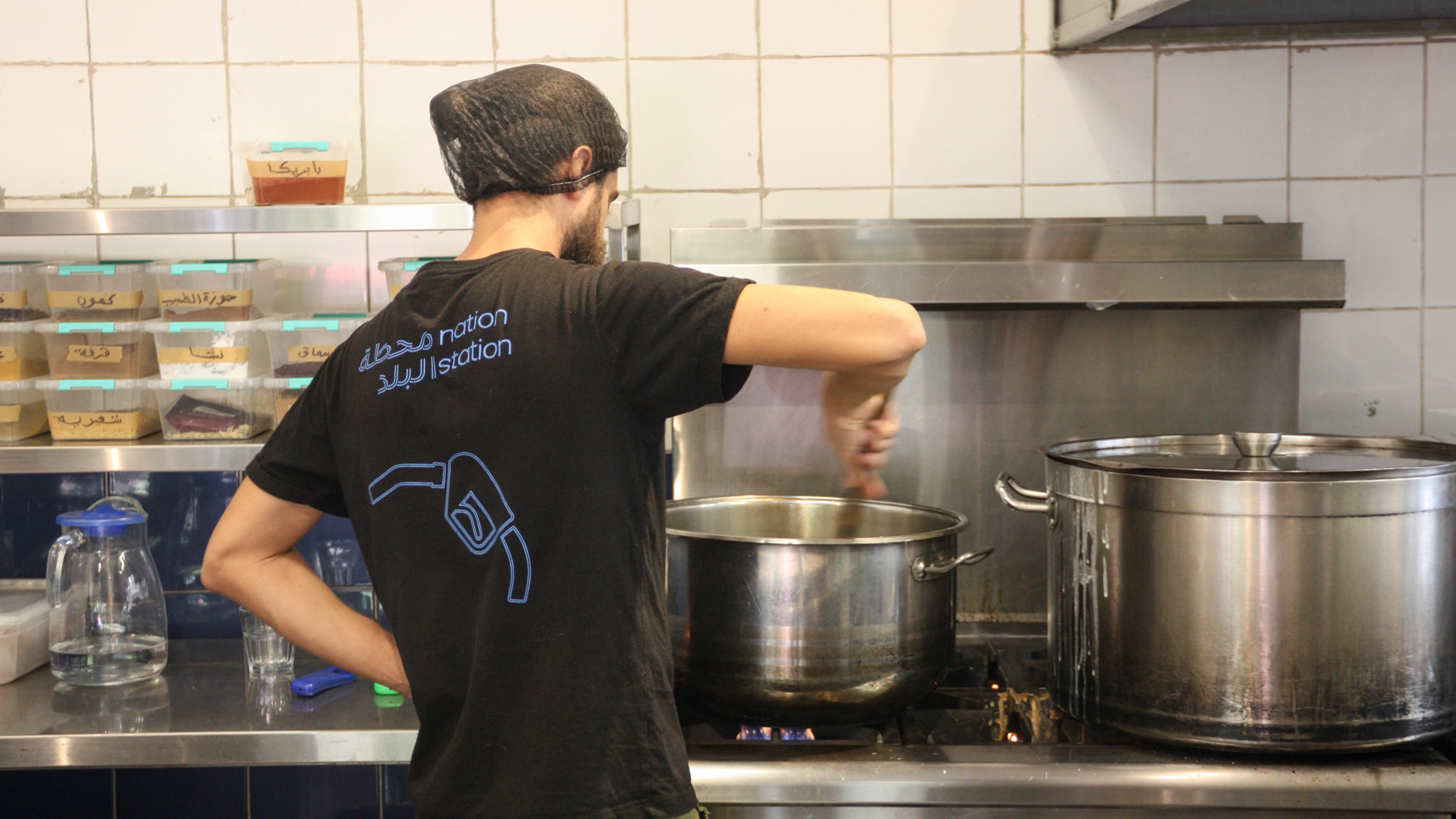
“People trust us [because] we are transparent,” he told me. “We give food to anyone without any racist background or sectarian background.”
Last spring, during the most intense period of Israeli attacks on Beirut’s southern suburbs, Nation Station cooked for some 2,500 displaced people. Although the need has subsided in recent months as many have returned to their homes, the kitchen is prepared to respond if the conflict escalates again.
Recently, it has expanded its work to Tripoli, a city on Lebanon’s northern coast. Meanwhile, the country’s economic situation continues to worsen. On the day I visited Nation Station, two women, sisters from the neighborhood, were volunteering in the kitchen in the hope of finding employment there. I asked if they needed help and quickly found myself putting on a hairnet, snapping on a pair of black latex gloves and steeling myself to cut onions.
Mercifully for my stinging eyes, that task was over quickly, and I moved on to serving those arriving to collect their free meals, which today was pasta with bechamel sauce. They brought their own plastic containers and were allotted a portion based on how many family members they were feeding. I didn’t ask anyone why they were there, but some wanted to chat, including an elderly woman whose eyes brightened when she heard I was from the United States. She seemed eager to share her story. She had worked as a teacher, and her husband was a doctor. The economic crisis, as well as the damage from the blast, took everything from them.
“Life in Lebanon is very hard,” she told me. “We were living like kings and queens before. When the port exploded, we lost everything.”
She asked if we had any vegetables or fruit to share. I had to shake my head no. Nation Station isn’t yet able to fulfill its hope of being self-sustaining. The meals it sells don’t earn enough to cover the cost of the ingredients or the free food it distributes; the organization still relies on donations. The need is too great, and with global attention to the war in Lebanon waning since a recent pause on airstrikes on Beirut and its southern suburbs, there’s not enough aid money coming in to offer more.
Here, as I saw in so many places around Beirut, people are helping each other, and in the process trying to advance an alternative social order, centered on meeting immediate needs rather than generating profit for a few. However, they are brushing up against the harsh realities of a nation reeling from one crisis after another, with barely enough time to catch its breath. Grassroots organizations are struggling to shoulder the burden of a social safety net abandoned by the government, ultimately fulfilling the role of charities helping their communities survive.
In his book Mutual Aid, Dean Spade says neoliberal governance models encourage privatization and the shouldering of services by individuals rather than governments that have traditionally provided them. “In this atmosphere,” he writes, “mutual aid projects have to work hard to remain oppositional to the status quo and cultivate resistance, rather than becoming complementary to privatization.”
Grassroots groups in Lebanon are struggling with the same conflict. I wondered whether the energy of the 2019 protests could continue to sustain those initiatives despite the difficulties they face, or whether it would take another uprising to grow them beyond their current limitations.
At Nation Station, the teacher walked away and I prepared to serve the next person in line.
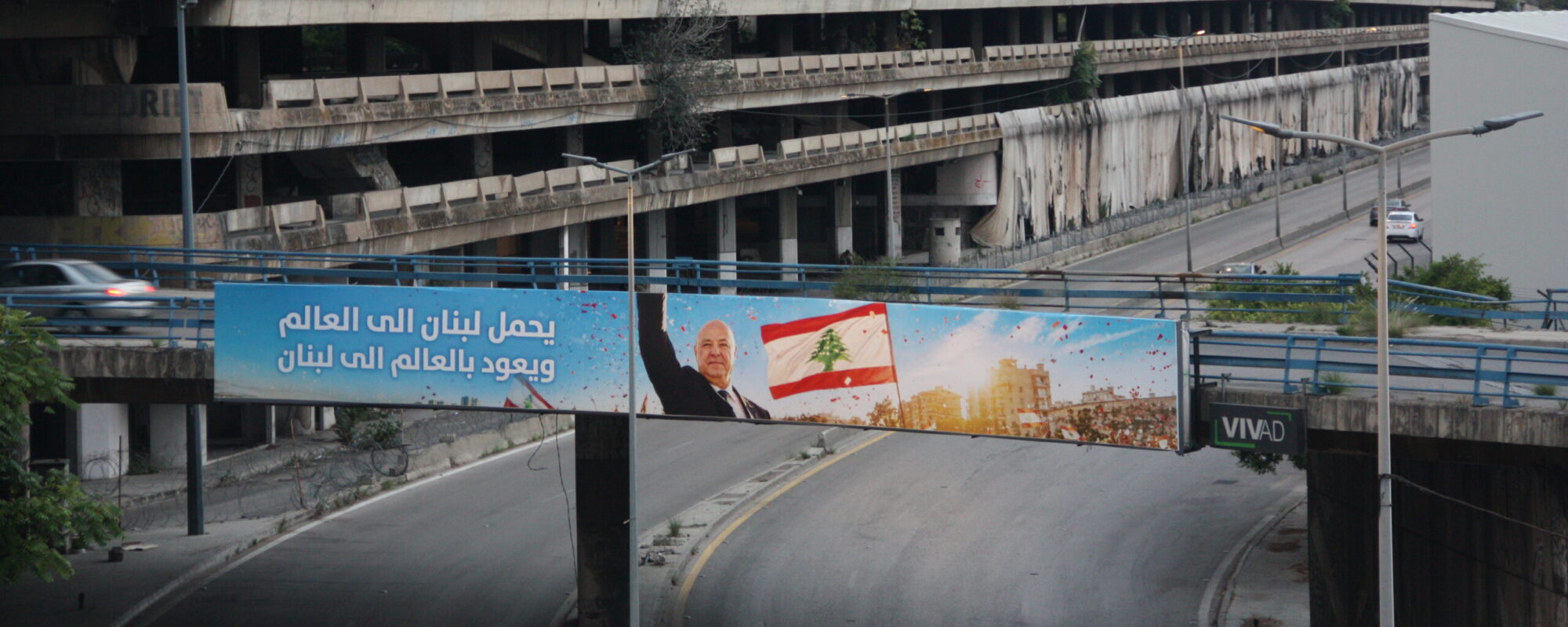
Top photo: Lebanon’s political system is fractured along sectarian lines, a remnant of the country’s 15-year civil war.