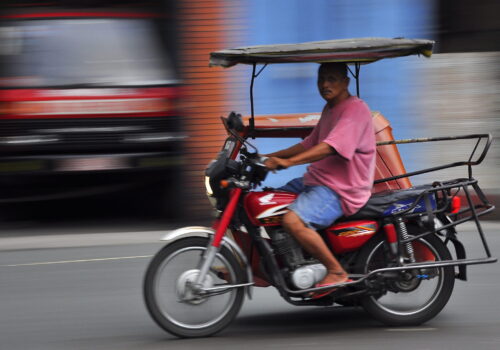
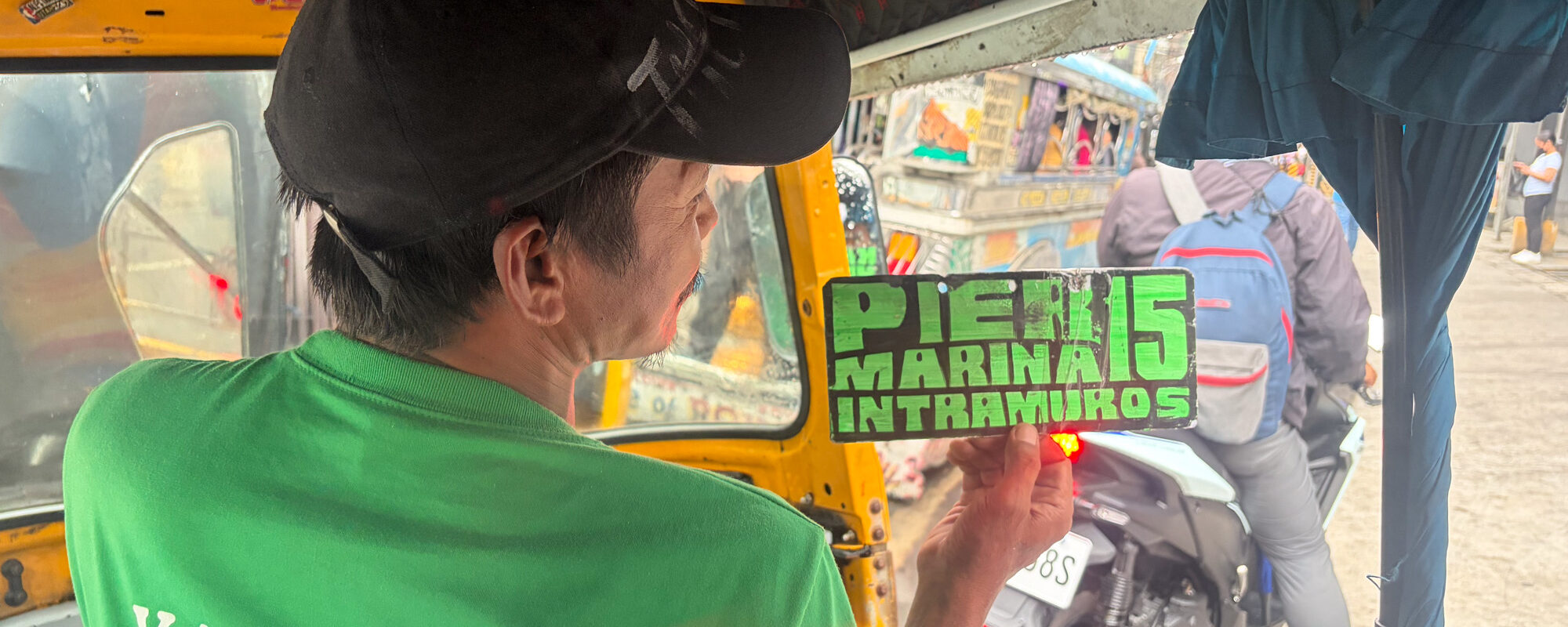
MANILA—Salahuddin earns up to 1,000 pesos a day ($16) as a tricycle driver in Manila. Along his daily 8-kilometer route, he picks up passengers almost continuously during his 12-hour shift. One rainy afternoon I clambered into his tricycle, yellow and white like a mini school bus, and we toured the historic downtown district of Intramuros. I balanced precariously on the tricycle’s plastic bench, bouncing along to each bump in the road as the engine’s rumbling and idling hummed.
Salahuddin has been a driver for 15 years, driving jeepneys, tricycles and taxis: the three vehicles that make up the patchwork public transportation system of the National Capital Region (also called Metropolitan Manila), which includes the capital and 15 other cities. Jeepneys provide the best take-home pay, carrying more passengers than a small tricycle allows along the same popular routes. But a few years ago, a leg injury left him unable to work the jeep’s pedals.
Now the US-Israeli war against Iran has disrupted the fuel supply to the Philippines, a country almost entirely dependent on foreign oil, compromising the livelihoods of thousands of transport workers like Salahuddin. To date, fuel prices in Metro Manila have shot up to 82 pesos per liter (around $5.32 a gallon). Salahuddin uses about 6 liters to fuel his tricycle, filling up twice a day. Since the war started, he’s counted himself lucky if he takes home 400 pesos ($6.50) at the end of the day.
The fuel shortage has had far wider effects, spiking electricity costs and inflation that has raised the costs of basic goods to untenable levels. They have hit remote parts of the 7,000-island archipelago the hardest, where residents rely on food shipped from agricultural hubs in other parts of the country. President Ferdinand Marcos has declared a national energy emergency and appealed to other nations in the Association of Southeast Asian Nations (ASEAN) for collective solutions to the fuel shortages felt throughout the region.
While covering the International Criminal Court’s current prosecution of the Philippines’ former president, Rodrigo Duterte, I’ve often heard the criticism that the proceedings are an illegitimate intrusion into an already contentious Filipino political system. When the Iran war was launched in February and the energy crisis in the Philippines gained strength, I noted parallels between criticism of the conflict and the discourse around the ICC’s actions as a “foreign” court.
With the war triggering a direct shock to the day-to-day lives of millions of Filipinos living in Metro Manila, I wanted to find out more about its impact there and also on far-flung islands and remote provinces. Although the energy crisis is burdening the entire country, I found it is especially exacerbating existing inequities and vulnerabilities in the regions.
* * *
In traffic-heavy Manila, transport workers are some of the most exposed to the downstream consequences of the Philippines’ dependence on foreign oil. Dressed in a bright green shirt designating his membership in the Transport Workers Association (TWA), Salahuddin explained that the organization standardizes and enforces the fares for his routes. Despite the fuel price increases, it has refused to allow even a five peso increase, leaving drivers to cover the rising costs while missing out on paying passengers while waiting in long queues for fuel. Sometimes customers underpay him—giving 15 pesos for a long-distance fare that costs 20 pesos or more—but Salahuddin won’t argue with them, he told me. He’d rather carry on driving and try to pick up more customers.
The psychologist Edwin Decenteno writes about pagdadala, or “burden-bearing,” to describe how Filipinos conceptualize roles for themselves and others in difficult times. It is a daily experience for many, particularly the poor. To fully understand the weight of a burden, Decenteno argues, one must understand that burden-bearers are defined, and their experiences given meaning, by their communities.
Everything Salahuddin earns goes to support his family of nine. What he can’t earn, he borrows in micro-loans from a neighborhood lender. His priority is paying for the education of his oldest, who studies criminology at a local university.
As we turned a corner and passed the whitewashed columns of the National Museum of Art, I grabbed the metal backrest of the tricycle bench to brace myself. My arm brushed against something in the back seat: a pink backpack with Cinnamoroll (a Hello Kitty-like character) on a pocket. I didn’t ask which of Salahuddin’s eight kids had left it, but it painted a picture in my mind of his pagdadala, of the family and community together with which he bears the burden of the fuel crisis.
On a macro-level, the current crisis exacerbates existing tensions between making livelihoods and the increasingly urgent need to address climate change. The transportation sector—which employs an estimated 2 million formal and informal workers—is responsible for a third of the country’s greenhouse-gas emissions, while as a Pacific Island nation, the Philippines is one of the countries most vulnerable to the impact of climate change. In Manila, emissions contribute to urban pollution and rising temperatures. But transitioning to cleaner energy—such as electric jeepneys, tricycles and taxis—would jeopardize transport workers: If the government were to ban or phase out vehicles that run on “dirty energy” or emit high levels of carbon, many would lose their jobs because they wouldn’t be able to buy or rent new fuel-efficient vehicles.
The concept of a “just transition” in international development policy addresses the tension, calling for governments to subsidize renewable energy industries to meet low-carbon targets under international climate agreements and domestic law, and enact supplemental social policies to support workers negatively affected by decarbonization and energy transition. Proponents of just transition in the Philippines have designed programs to provide compensation and requalification training to those who would be negatively impacted by the phase-out of fuel-inefficient vehicles. But the financing remains a distant reality, and the current energy crisis has been sharpened by years of government inaction.
In comparison, my own pagdadala, my experience with the burden of the energy crisis, has been limited. My electricity bill has gone up, as has the cost of booking a ride-share. Stores have shortened their opening hours and some domestic airlines have cancelled flights. Daily conversation with neighbors and friends almost always touches on the latest report about the dwindling oil supply (as of this writing in late May, the Philippines is said to have 45 days of fuel left).
As an air-conditioning addict, I listen to any public service announcements about upcoming blackouts with just a bit of trepidation. But I’m not alarmed: When I visited family in the Dominican Republic as a kid, blackouts were a common occurrence, and as an adult I lived in Sri Lanka during an economic crisis in 2022, when electricity and essential goods were strictly rationed. After weathering an hours-long brownout in Makati, I was forced to question just how badly I needed cool air to sleep; for now, I have a battery-powered fan on hand for emergencies.
Even before the current crisis, Filipinos paid some of the highest electricity rates in Asia relative to household income. That’s due to decades-long privatization of the power industry and mismanagement of aging plants and overburdened grids. As a result, millions of Filipinos also lose power every summer, and officials from the Energy Department have testified before the Senate regarding reports that blackouts are expected to only further worsen.
Outside Manila, many Filipinos must contend with an underdeveloped energy infrastructure that relies on individual diesel plants, making them disproportionately affected by the crisis. The National Capital Region is often referred to as “Imperial Manila” for the over-concentration of political, economic and cultural capital in the region. To learn more about less-resourced provinces, I travelled across forested mountains and white sand islands to speak with residents of some remote parts of the Philippines about their own pagdadala.
* * *
Reachable by a 12-hour overnight bus ride north from Manila, the town of Sagada stands in the mountains of the Cordillera Administrative Region. Its cool, misty forests and surrounding mountainscape are more reminiscent of North America’s Pacific Northwest or the American Rockies than the typical image of the tropical, sunny Philippines. Sagada was a base for American missionaries in the early 1900s who disseminated both Christianity and the seeds of many pine trees now comprising the area’s forests. Stepping off the bus sleep-deprived and a little motion-sick, I felt like I was in a different country rather than just a couple hundred kilometers from the capital.
Home to several Indigenous tribes that retain legal autonomy and practice their own forms of governance across the region, Sagada is known by its native name, Ganduyan, among members of the Igorot group of tribes. As part of a burgeoning tourist industry that attracts both foreigners and non-Igorot Filipinos, Indigenous residents of Ganduyan educate visitors about their cultural traditions. They include distinctive weaving practices for cloth and baskets, terraced irrigation for farming rice and other crops and religious burial rites in which bodies are placed in coffins on local cliffsides (known as “hanging” coffins).

After trekking the town’s famous Marlboro Hills, local rice terraces and ice-cold waterfalls, I stopped by the Ganduyan Museum, which preserves a wide variety of Igorot artifacts and art. The curator is a member of the Applai tribe of Igorot peoples, Lester Aben, whose family has collected artifacts from various Cordilleran groups for generations.
Many of the preserved pieces are weapons, shields and armor. Igorots were feared as warriors (known as “headhunters” who kept their enemies’ heads as trophies) who defended their mountainous home from the Spanish after the rest of the Philippines had been colonized in the 16th century. Aben explained that despite their military prowess, the Igorots’ cultural norms were fervently anti-war. Since the 1980s, the tribes have even maintained a community-led peace zone, banning military exercises on their land in opposition to the Philippine government’s regional operations against the separatist National People’s Army.
Aben expressed unhappiness about the war between the United States and Iran from both a cultural perspective and a practical one. In remote Ganduyan, the agriculture sector has been hard hit by the energy crisis, as fuel and fertilizer prices have spiked. Aben runs a family restaurant reliant on local crops. Many farmers can’t afford to transport their goods to the National Capital Region—their most profitable market—and have had to find ways to prevent food waste such as selling locally at highly discounted prices and distributing free food among those in need in Ganduyan.
Skyrocketing fuel prices have also kept tourists from visiting the remote region, which is accessible only by road. Once they arrive, tourists rely on tricycle drivers to transport them among the trailheads of popular hikes and other natural attractions like remote waterfalls and the Igorots’ cliffside coffins. Just like Salahuddin in Manila, Sagada’s tricycle drivers are bearing the brunt of the higher fuel costs—but here it’s considerably worse. While fuel has increased to 80 pesos per liter in Manila, it has doubled in Sagada, costing drivers 150 to 160 pesos per liter. “That’s simply unaffordable for most people,” Aben told me.
Many other locals—including small-business owners, tour guides and innkeepers—also rely on seasonal tourists to boost their income. The downstream effects of fewer tourists and higher prices for essential goods are creating a vicious cycle that is further stifling the tourist industry in this small mountain town. The fuel crisis has made Sagada residents far more vulnerable than their compatriots in Metro Manila, their pagdadala compounded by underdevelopment and a lack of livelihood options due to the town’s remote geography.
Returning to the capital a few days later, I was immediately hit by a rush of hot air, car exhaust and haze when I stepped off the bus that seemed somehow worse than I remembered. A quick news check revealed that the air quality index was “unhealthy” because a nearby landfill had been burning trash for the last few days, sending a cloud over my neighborhood. Back home in Imperial Manila, I yearned to still be gulping in lungfuls of fresh alpine air.
* * *
In search of an even more remote location, I found myself on a small propeller plane approaching the island of Camiguin in Mindanao, the southernmost region of the country. Nicknamed the “Island of Fire,” it sits atop several active volcanoes, including Mount Hibok-Hibok, which most hikers can scale in about seven hours with a local guide.
After joining a muddy jungle trek up to the misty summit—replete with long-tailed macaques and limatik (forest leeches) that made a snack out of my leg—I visited the beachside Agoho Hotel for a quick respite and a mango shake. Run by local Camigueño Myleen and her Albanian husband, Peter, the Agoho is one of two hotels on the island that mostly runs on solar power.
Most solar power on the island is for residential use. “We regularly have to contend with brownouts,” Myleen said, “so the panels provide a way to preserve some of our essential power for ourselves and the guests.” As we chatted and Myleen pointed out the solar-power setup and rooftop panels, Peter worked with a few local kids to put together a new porch swing for the guests’ patio. Peter, who told me he had worked in the restaurant industry in Milwaukee before moving to the Philippines, installed the solar system himself.
The system is able to support all the hotel’s operations with the exception of the air-conditioning units in the guest rooms, which demand a lot of electricity, and the water heater, which runs on gas. But the start-up costs of adopting solar power in Camiguin were enormous—upwards of 500,000 pesos (about $8,100). In addition, individual pieces, like the inverter that converts sunshine to electricity, can cost the owners tens of thousands of pesos to replace when they wear out.

When the war started and gas prices began to rise, the couple decided to reduce consumption, shutting off the water heater. “We wanted to hold off on raising our room rates, but more and more guests began to complain about the lack of hot water,” she said. Meanwhile, the Agoho (and Camiguin as a whole) have seen many fewer foreign and Filipino visitors compared to last year.
As in Sagada, rising prices are stifling the tourism industry of Camiguin, affecting the fuel for flights, ferries and local transportation by tricycle. Meanwhile, basic goods have become more expensive for residents, who already pay some of the highest electricity costs in the country due to difficulties connecting to Mindanao’s power supply. “Everything, including essentials, has to be shipped into Camiguin from mainland Mindanao,” Myleen told me. Despite the increasing use of solar power, the pagdadala of the fuel crisis on Camiguin is still driven by reliance on fossil fuels and the need to ship in goods.
Camiguin is tiny—its circuit can be travelled in just two hours—and as I rode in a tricycle around its most scenic spots, I noticed solar panels at various locations. In the entryway of some old Spanish church ruins on the west side of the island, the tourism office had a small solar setup that maintains internet access and powers the site’s security cameras. At Katibawasan Falls, the highest waterfall on Camiguin, there are solar panels atop a picnic area to power similar services. Along the main thoroughfare, I noticed solar-powered streetlights that absorbed the renewable energy of the tropical island’s 12-hour days. As I walked back to my hotel late one night, I felt grateful for the endless supply of sunshine that powered the lights guiding my way.
* * *
A few days after my return from the Island of Fire, all hell broke loose in Manila.
The House of Representatives impeached Vice President Sara Duterte in a second attempt after the Supreme Court blocked a 2025 vote on reasonable constitutional grounds. Soon after, Senate President Vicente Sotto was ousted by a pro-Duterte bloc to install Senator Alan Cayetano, a Duterte ally, to preside over the vice president’s eventual Senate impeachment.
During this vote, Senator Ronald “Bato” dela Rosa appeared in the Senate after a six-month absence—an unprecedented disappearance triggered by rumors that the ICC had issued a warrant for his arrest in connection with crimes against humanity committed when he was chief of the Philippine National Police during Duterte’s drug war. Soon after dela Rosa’s appearance, former Senator Antonio Trillanes visited the Senate with claims that he possessed the rumored warrant, which he would personally serve to dela Rosa.
Within a few hours, gunfire broke out in the Senate, the ICC officially published the arrest warrant from The Hague and dela Rosa was taken into protective custody by allied senators looking to shield him from arrest. Meanwhile, armed marines entered the Senate building and pro-Duterte protesters attempted to tear down the barricades around the complex in an episode reminiscent of the January 6, 2021 US Capitol attack. In the chaos, dela Rosa slipped out of the premises and back into hiding.
While those developments were unexpected, I couldn’t help but see parallels to the energy crisis. Just as the fuel shortages were conditioned by a reliance on imports and then ignited by a foreign war, the Senate chaos was enabled by longstanding feuds and then ignited by the political spark of the ICC investigation. The two parallel events showcase an aspect of outside influences that could affect Filipino perceptions of the legitimacy of international institutions like the ICC.
According to recent polling, nearly 60 percent of Filipinos want Duterte to face trial for the alleged crimes committed during his administration. But whether he should be tried in the Philippines or at the ICC is a more divisive question partly because of the Philippines’ 2019 withdrawal from the court.
Michael Tiu, an associate professor leading the international criminal law program at the University of the Philippines, agrees the trial encapsulates the tension between domestic turmoil and international affairs. “On one hand, the Pre-Trial Chamber’s confirmation of charges is uncontroversial, because the evidence to convict Duterte at the ICC is overwhelming,” he told me about the preliminary proceedings in The Hague earlier this year. “When you lived in the Philippines during that period, there were reports of killings every day, with the government reinforcing the narrative that these killings were justified.”

To expect that same government to impartially prosecute these killings, then, seems unreasonable to much of the Filipino public. Instead, prosecuting the alleged crimes of the drug war through an international tribunal with foreign judges would avoid the baggage of the recent administration and any allegations of undue influence over the trial process.
A more recent Appeals Chamber decision upholding the ICC’s jurisdiction over Duterte’s case, on the other hand, presents a trickier problem for the court’s legitimacy in the eyes of Filipinos. “The Appeals judges could have ruled either way, since the previous decision upholding jurisdiction was only decided by a narrow 3-2 margin,” Tiu said. Given that the court hears so few cases already, he added, it was in the court’s institutional and existential interest to rule that it could prosecute Duterte. But many here believe the court’s jurisdiction is an overreach and affront to national sovereignty because Duterte withdrew the Philippines from membership in the court in response to its investigation into the drug war. State consent, the principle underpinning the legitimacy of the court and international law as a whole, is missing.
Still, engagement with international law and multilateralism have always been central to the Philippines, partly due to its colonial history with Spain, Japan and the United States. The country’s need to maintain alliances with other states in the region eventually played a role in the 1967 creation of ASEAN, of which the Philippines was a founding member. Tiu characterized Philippine foreign policy as generally prioritizing coordination with regional and international institutions, although some political groups have criticized such organizations as part of a postcolonial attempt to subjugate Filipino interests to those of powerful states.
“The 1987 constitution illustrates this careful balance,” Tiu said. Implemented after the removal of dictator Ferdinand Marcos the previous year, the document formally phased out the US military bases in the Philippines, while leaving a legal framework for the two countries to negotiate the temporary visitation of foreign forces and military training for the Philippines Army.
The 1987 constitution also included a clause that incorporates international law into the domestic “law of the land.” The Philippines has since acted on that commitment by ratifying eight of the nine core United Nations treaties. Even before the Philippines joined the ICC in 2011, the legislature passed a law enabling the domestic prosecution of international crimes, crimes against humanity and war crimes; despite the Philippines’ recent withdrawal from the treaty underlying the ICC, the domestic law remains on the books. In theory, it provides an avenue for prosecuting the same crimes over which the ICC also has jurisdiction.
Ultimately, the current controversy over dela Rosa’s potential surrender—specifically the lack of political will to arrest him while he was physically in the Senate—shows that the withdrawal debate still undermines the court’s status enough to affect its operations in the Philippines. Without the cooperation of key players in Filipino politics, the court as an international institution lacks the power to enforce its own arrest warrants on the territory of the Philippines. And it is unclear whether that cooperation will be forthcoming.
“In the eyes of Duterte supporters and allies, dela Rosa is like a proxy for Duterte,” Tiu said. “It would be disenfranchising for those supporters who have voted for him to see a sitting senator hauled to The Hague.”
* * *
As of this writing, dela Rosa is still at large. Despite piecemeal imports from nearby allies, the Philippines is still running out of fuel. The US-Israeli military conflict with Iran is now in its fourth month with no effective resolution from peace talks in sight.
The June start of the typhoon season over the Pacific is looming. With it will come widespread flooding and the need for costly relief measures that, in previous years, have prompted uproars over the government’s corrupt and ineffective responses to the increase of climate-related disasters.
That is just a snapshot of the pagdadala borne daily by the Filipino people: a nation vulnerable to climate change, its citizens reliant on privatized energy infrastructure and contending with pervasive political corruption. My hope is that whatever international news breaks next, they will weather the storm.
Top photo: Salahuddin with a sign designating his Manila route: from the historic Intramuros district west to Pier 15 on Manila Bay