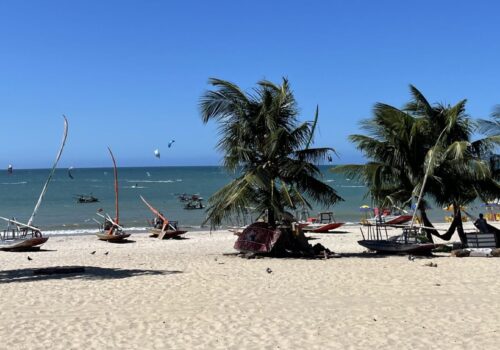
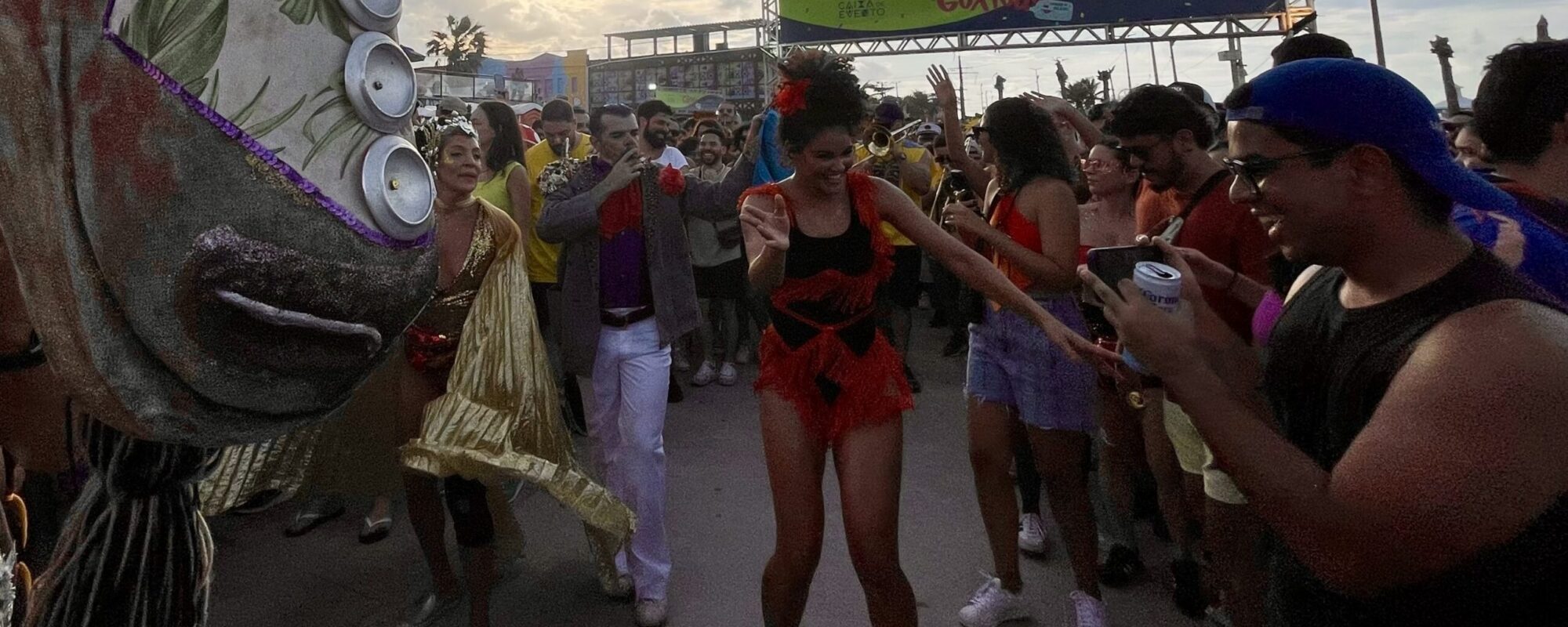
FORTALEZA, Brazil — The line already stretched to dozens of people on a Saturday morning when my friends and I arrived at 9:20 a.m. Glitter was the accessory of choice and served as the primary costume for many. Most had done their best to wear as little as possible. Men wore fishnets and tutus, women sported bikini tops and sheer leggings. Teens giggled with their phones out as parents entertained their costumed children with crayons. By the time the doors opened an hour later, the line had grown to around 200.
This eclectic crowd had gathered to see an 11-person band named Por Quem Gosta É Bom, “For Those Who Like It, It’s Good,” a popular local Carnival group. Although the official Carnival weekend was still several weeks away, on February 17, pre-Carnival had begun as early as December. Many foreigners may be familiar with Rio de Janeiro’s opulent parade, but Brazil’s Carnival is more accurately described as a three-month season that’s celebrated differently across the country.
Beyond highlighting regional cultures and predilections, the festivities are a big economic driver. In this northeastern city of 2.7 million people, the 2026 Carnival cycle was expected to create approximately 67,000 jobs and generate more than 1.15 billion reais ($200 million) with an influx of around 230,000 tourists.
A tradition that predates Roman colosseums, Carnival also serves as a visible platform for politicians to appeal to a population that often feels disconnected from the government. The mayor and other political appointees appeared onstage at several events, a not-so-subtle message to ensure everyone knew whom they should thank for the party.
The municipality of Fortaleza invested more than 2.4 million reais in 96 projects spread out across the city. In addition to large percussion parades, there were 48 blocos—as organized street parties affiliated with Carnival are known—36 of which were for adults and 12 for children. The latter were designed as family-friendly spaces to incentivize the transmission of the tradition to a new generation. This year, the city contracted 122 artists, up from 91 last year.
As we waited in the scorching sun for our public spectacle, a boy who appeared no older than 14 ran up and down the line selling bottled water, competing with older vendors selling ice cream, popsicles and colorful assortments of Carnival paraphernalia such as masks, garlands and hats. One seller evidently with access to more capital arrived with two large coolers and quickly began running out of ice-cold beer.
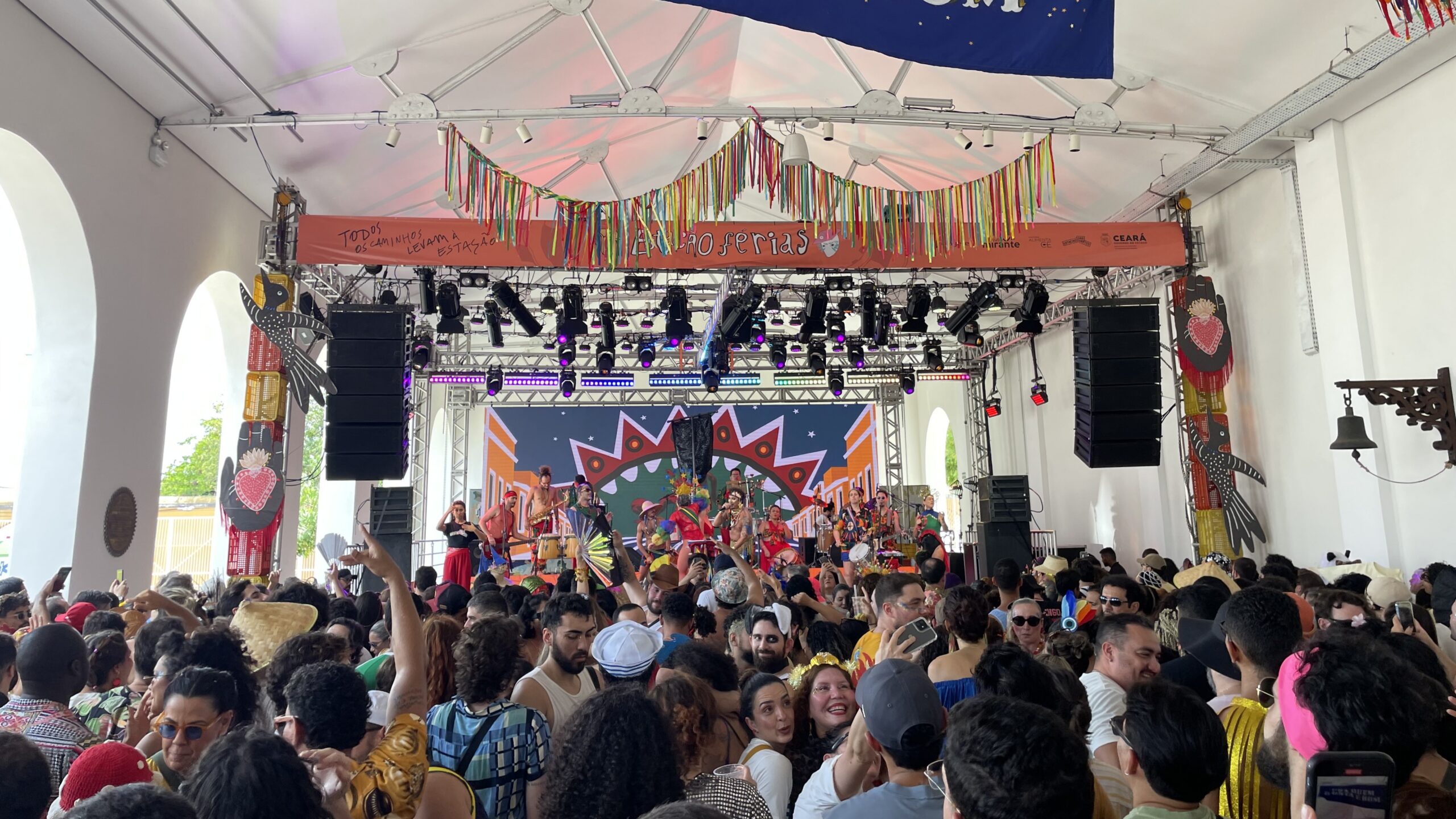
Inside the Complexo Cultural Estação das Artes, a recently renovated state-sponsored cultural center located within the city’s old railway station, the mood was electric. The band began earlier than scheduled—a rare occurrence in Brazil’s perennially tardy culture—as a goodwill gesture to its dedicated fans. The crowd jumped and swayed to the rhythm of the drums as the band played a mix of popular Carnival anthems and original songs.
Blocos can take on many forms. Por Quem Gosta É Bom describes itself as a “resistance” bloco, reflecting its openly left-leaning political stance. Stickers were given out with phrases such as sem anistia, “no amnesty,” a reference to the prison sentences being served by the far-right former President Jair Bolsonarro, his cadre of coup plotters and those who had stormed Brazil’s National Congress, Presidential Palace and Federal Supreme Court in January 2023 in an attempt to overturn election of Luiz Inácio Lula da Silva, who had entered office the week before.
Another popular sticker was não é não, “no is no,” reminding partygoers, particularly men, of the importance of consent in a country with some of the world’s highest rates of rape and femicide. In 2023, Brazil recorded a rape every 6 minutes, totaling roughly 84,000 incidents, or 41.4 incidents per 100,000 people—over 75 percent of which involved minors. Those numbers are similar to those of the US but three times those of the Netherlands and 20 times more than Portugal’s.
No less shocking, official national studies reveal that there were 1,470 femicides in Brazil in 2025, a rate of 3.9 per 100,000 women, according to the World Bank. That is more than the US rate of 2.6 and roughly eight times higher than in the Netherlands and Portugal, which come to 0.5 and 0.4 per 100,000 women, respectively. Across countries, in cases of both femicide or rape, the perpetrator is most often someone known to the victim.
Contrary to media portrayals that depict Carnival as a hedonistic wellspring of sinful chaos, what I observed in Fortaleza is more accurately described as a collection of people who love the opportunity to listen to live music in public places dressed however they like.
Por Quem Gosta É Bom and other resistance blocos I attended attracted many members of the LGBTQ+ community. They marked their presence by rhythmically clapping and snapping handheld fans whenever a favorite song played. Their large public presence was especially noteworthy given that much of Brazil continues to be hostile toward LGBTQ+ people. The country registered 257 violent deaths, including over 200 homicides, in 2025. A big portion happen in this northeastern part of the country. That number is several times higher than in the United States in absolute terms even as the US has 100 million more people than Brazil. The blocos offered a rare space for joy for traditionally marginalized communities enjoying themselves publicly without fear.
The pro-consent and pro-LGBTQ+ signs were part of the global left-wing symbols present at resistance blocos I attended. And just as it is impossible to avoid President Donald Trump in the news, so too was his presence felt at Brazilian Carnival. The lead singer of the Pro Quem Gosta É Bom paused his show to say that Brazil must be run by the street, by the people, and not by the North Americans.
He decried Washington’s heavy-handed meddling in South American politics, in reference to the politically motivated US tariffs on Brazil, threats to Colombia’s president and kidnapping of Venezuela’s former authoritarian leader Nicolas Maduro. A few placards and tee-shirts featured slogans such as “We are nobody’s backyard!” a refrain used by critics of the Trump Administration’s recent focus on its influence in the Western Hemisphere after remarks by Defense Secretary Pete Hegseth last year that the United States must “take our backyard back.”
Those sentiments reached their apex a few weeks later after Bad Bunny’s Super Bowl performance on the Sunday of Carnival. Following the show, many Brazilians, including those who had never before heard of the Puerto Rican singer, began playing his songs on repeat in the street and at blocos in a public display of Latino solidarity.
That is not to suggest the existence of a coordinated global left akin to the international network of far-right activists and politicians associated with the US Conservative Political Action Conference. Such an alignment has not emerged partly because local left-wing activists tend to view the US economic and military role abroad in negative terms, while most US Democrats support the country’s role for good in the world.
Through this negative lens, left-wing activists here tend to undervalue America’s once-leading role in promoting LGBTQ+ and women’s rights worldwide. They also ignore the large amount of local job creation through American investment in Brazil and Brazilian exports to the United States. However, given the Democratic Party’s challenges communicating an inspiring vision at home, it is perhaps unsurprising that they have trouble finding adherents abroad.

However, most blocos do not complicate their partying with political symbolism or pronouncements. Back at the Por Quem Gosta É Bom performance, before the band finished its set, we took an Uber to Teresa & Jorge, a restaurant and samba bar in front of which another bloco was forming. The street was blocked off to traffic and filled with hawker stands selling meat skewers, popcorn, beer, cocktails, soda, corn on the cob and churros. The city had set up a temporary podium from which a DJ played the season’s hit songs. As I discovered, each Carnival features a collection of tracks, each with its own accompanying dance routine, played on repeat throughout the festivities.
After fighting to get on the waitlist, we furtively sat next to some locals with extra room at their table for Feijoada, a hearty Brazilian stew made with black beans and smoked pork cuts served with white rice, farofa (toasted cassava flour) and orange slices. As the food arrived, a samba band began playing national favorites. Patrons stood to dance and sing along.
Unlike the mayhem outside, the atmosphere within the Rio de Janeiro-style restaurant was lively but organized. Behind a wooden bar, waitstaff struggled to keep up with the endless drinks and plates. Two television screens were showing soccer games from the Saudi Pro League while team flags of Rio de Janeiro’s Vasco De Gama, Flamengo, Botafogo and Fluminense hung on the walls next to photographs of famous Brazilian musicians.
Before we could finish our meal, the percussion band that had formed outside became so loud that the samba group had to temporarily pause. Most people dressed more conservatively than during our morning bloco but they were no less rowdy. With every drumroll, the hundreds-strong crowd let out a roaring cheer. As the band made its way down the street, we cautiously adventured outside.
As we walked home under the setting sun, we passed a public square where workers were beginning to set up a bloco geared toward an older crowd. Bar owners arranged rows of plastic tables and chairs while city-hired workers organized the stage for a live band scheduled to play later. It was hard not to be impressed by the logistical operation behind these various government-organized events that allowed people of all ages and social classes to take part in the free festivities.

The events’ management was not lost on the city’s voters. Local friends said this year’s festivities were more secure and better organized than before, praising the work of the new mayor. A heavy police presence was visible at all the blocos and was especially large during the mainstage concerts held on the city’s esplanade and at Iracema Beach where tens of thousands of people came together. Crowd control barriers set up at the various entrances were ubiquitous as officials looked to discourage robberies. A small army of tax compliance officers were also deployed to ensure street hawkers were properly vetted.
When the weekend ended, the Ceará state’s government, which is primarily responsible for law enforcement, boasted that the four-day 2026 celebration had been the safest in the region’s modern history. Violent deaths were down 33 percent from the previous year, robberies were also down almost 60 percent, thefts 40 percent and transit deaths 65 percent. Over 12,000 cellphones had been returned to their owners. Whether those numbers can be solely attributed to the government’s actions or whether the new dominance of a single armed criminal faction played a decisive role will be the topic of my next dispatch.
By the time I returned home nine hours after setting out that Saturday morning, I was exhausted. When Carnival came around a few weeks later, I could muster enough energy for only one of its four days, relying on water and Coca-Cola to help me keep pace with the crowd. By the time the events were over, I was relieved to not have blocos reverberating through my neighborhood until 1 a.m. every weekend.
With their irreverent and undiminishable source of energy, however, Brazilians have already begun sending out countdown clocks for next year’s celebration. For many locals, Carnival is about forgetting your sorrows, health complications, financial strains, and simply having fun. As the Pra Quem Gosta É Bomband leader exclaimed during his show, “We party not because life is easy but because life is hard!”
Top photo: Pre-Carnival street festivities in Fortaleza