
I once read that the most powerful word in the English language is “my.” The possessive determiner that elicits defense and desire. But is it compatible with what is arguably the opposite, and may be the greatest desire of human beings, which is to belong—be it to a place, person or group?
Throughout my life, and across this fellowship, I have encountered a bewildering array of forms of belonging. Yet for all the many ways to belong, I’ve met many who feel they do not belong anywhere. From well-off expats to locals living on the street. It is curious that it can be so hard to find belonging among a species so in need of others to survive and thrive.
Although I moved around extensively throughout my life, relocating every eight months on average to a new city, state or country between graduating from high school in 2012 and moving to Washington DC in 2021, the moves to and through my fellowship have felt different.
That’s because while in Washington, I successfully surrounded myself with diverse and overlapping circles of belonging, perhaps for the first time. There was my group with whom I danced bachata and salsa most evenings, my professional community working in Maine Senator Angus King’s office, my former colleagues from the Elizabeth Warren presidential campaign in Iowa and old friends from my high school days.
As the common refrain goes, I didn’t know what I had until I’d lost it. Or at least, having so often ridden life’s rugged road alone, I thought another two years traveling wouldn’t make such a difference. I was wrong, as it quickly turned out. But before judging myself too quickly, I must admit the reality is that even in Washington, with all the coinciding communities, I felt that I still belonged out on the trail in the world. Had it not been an ICWA fellowship, it would have almost certainly been something else that took me away.

I can’t speak for those who were born and stayed into adulthood in the places they grew up, whose families have lived on the same land for successive generations and who fit into the traditional framework of their cultures. But for those of us who have been pulled willingly or unwillingly to unfamiliar lands with different peoples and customs, or those who’ve come to believe differently than we were taught, the feeling of belonging can be elusive.
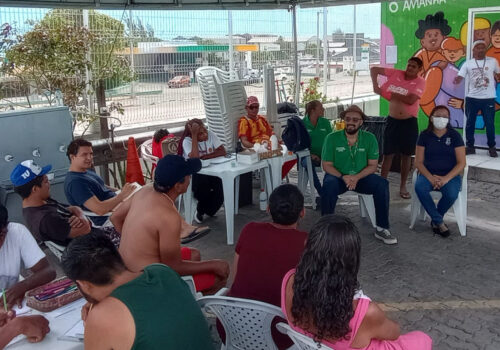
I’ve come to sympathize with the small percentage of those living on the street who, having made it their home for 10, 15, 20 years, initially resist moving into housing when it becomes available. And why Housing First projects, if they are to be successful, need proper supportive social services to create new daily routines and forms of belonging.
Because for all their violence and discomfort, the streets, with their characters and rhythms, can be familiar. The unhoused may feel they belong to the streets and that the streets belong to them. Those human bonds and familiar surroundings are so important that some are willing to forego a roof—a lesson about the importance of human relationships, routine and sense of place, which take time to establish.
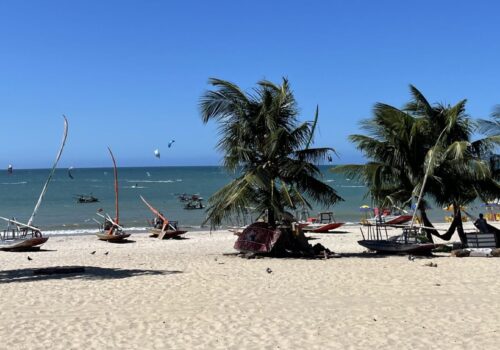
While my peripatetic life crisscrossing 33 countries and just as many US states prepared me better than most for this nomadic life, it’s been a dizzying adventure. During my fellowship, I lived six months in Amsterdam, three-and-a-half months in Lisbon and the nearby coastal town of Cascais, three-and-a-half months in Porto, a month in Brazil’s central Fortaleza, followed by six months in the beach town of Cumbuco (in Fortaleza’s metro area). I plan to spend another two months back in central Fortaleza before heading out on a two-month road-trip across northern and central Brazil. “Home” has been 10 apartments.

Along the way, I learned that I need at least four months to begin reaping the familiarity that precedes belonging. Only in Amsterdam and Cumbuco did I really get a taste of that feeling. In those places, in addition to having more time, I routinely took part in partner dancing, kite surfing and yoga.
I believe participating in activities is critical for adults partly because the collegiality of school no longer fosters social encounters. Around most of the world, drinking alcohol counts among the most common communal activities that bring friends and strangers together. However, as someone who has not drunk in 7 years except for special events and does not enjoy being around inebriated people past 9:00 p.m., that avenue is largely barred to me. Consequently, other activities have been anchors, instilling routine and delivering opportunities for social contact that, over time, have led to meaningful bonds.
Simultaneously, it’s become clear that belonging also encompasses much more than a handful of sincere relationships rooted in vulnerability. That it is, just as importantly, built on small, habitual moments of recognition. Someone acknowledging you, you acknowledging them.
In the hope of mitigating some of the expected loss of my friendships, I created an Instagram account only to discover most people now use the app to follow celebrities rather than catch up with one another. Furthermore, I was too easily sucked into the logic of Instagram’s own universe: Social media has a way of rendering moments beautiful contingent on the number of likes on a post. I held onto the account but came to visit it only once every few weeks for an hour before deleting it. While it’s great to have friends all over the world, it’s even better to have them in your own neighborhood.
One of the biggest surprises of my fellowship has been that I haven’t felt most at home in warm countries by the beach—my preferred climate. Culture has played a much stronger role than expected.
Portugal is the perfect example, with its mild weather and surfable waves. I arrived with high expectations, and it was a deeply enriching professional experience. However, perhaps due to my itinerant and secluded lifestyle, I was never able to connect with the places or people in a meaningful way.
Brazil, after eight months in country, continues to be an intriguing enigma. Its sounds, sights and tastes, from African drums to sugarcane drinks, with its scorching sun and heavy rains, remind me of my childhood in Reunion Island in the Indian Ocean. It is also similar to the United States where I grew into adulthood, with its disproportionate class system and self-centeredness. Brazil is too big and still too overwhelming to call home, but that doesn’t diminish my continued interest in the country.
I’m surprised that it is Amsterdam, where one needs a sweater in peak summer, that continues to pull at my heartstrings. Like Washington, it is a national capital with fewer than a million inhabitants that attracts educated young go-getters from around the world. These dislodged adventurers, whose sense of home is about more than one place, seem more eager to build novel communities than those still tightly knit with middle school classmates. Crisscrossing The Netherlands from north to south, east to west—not difficult in a territory half the size of Maine—I came to enjoy the blunt but amicable manner of the Dutch.

But what of the “my” with which I started this rambling monologue? “My” seems to me the basis for that which dutiful parents and working society ask of us: to own enough to be secure, be it money, property or professional success.
In our troubled and fast-changing world, “my” still evokes a steadfast certainty promising unconditionality and control. Yet there is nothing more conditional than ownership—even with everyday items. A house is often more controlled by a bank than the nominal owner. Even in the most fundamental family relationships with parents and siblings, to whom we instinctively refer as “my,” the best we can hope to do is influence others’ actions. And when we pass through life’s final door, we bring nothing with us and leave mainly how we made others feel.
Owning is often a solitary act. If something is fully mine, it can’t be yours. I have shed many of my belongings over the fellowship. What I have left now fits in a suitcase. Because while “my” may be the most powerful word in the English language, we can belong only to things that we can’t call “mine.”
Individualism, particularly of the nomadic kind, falsely promised possession of myself, my time and my future. Belonging offers no such illusory comforts. It invites us to be part of conglomerations outside our control—much like life itself—in the innumerable combinations of people, preferences and places that kindle attachment and purpose. In belonging, we can learn to find solace in participation rather than ownership.
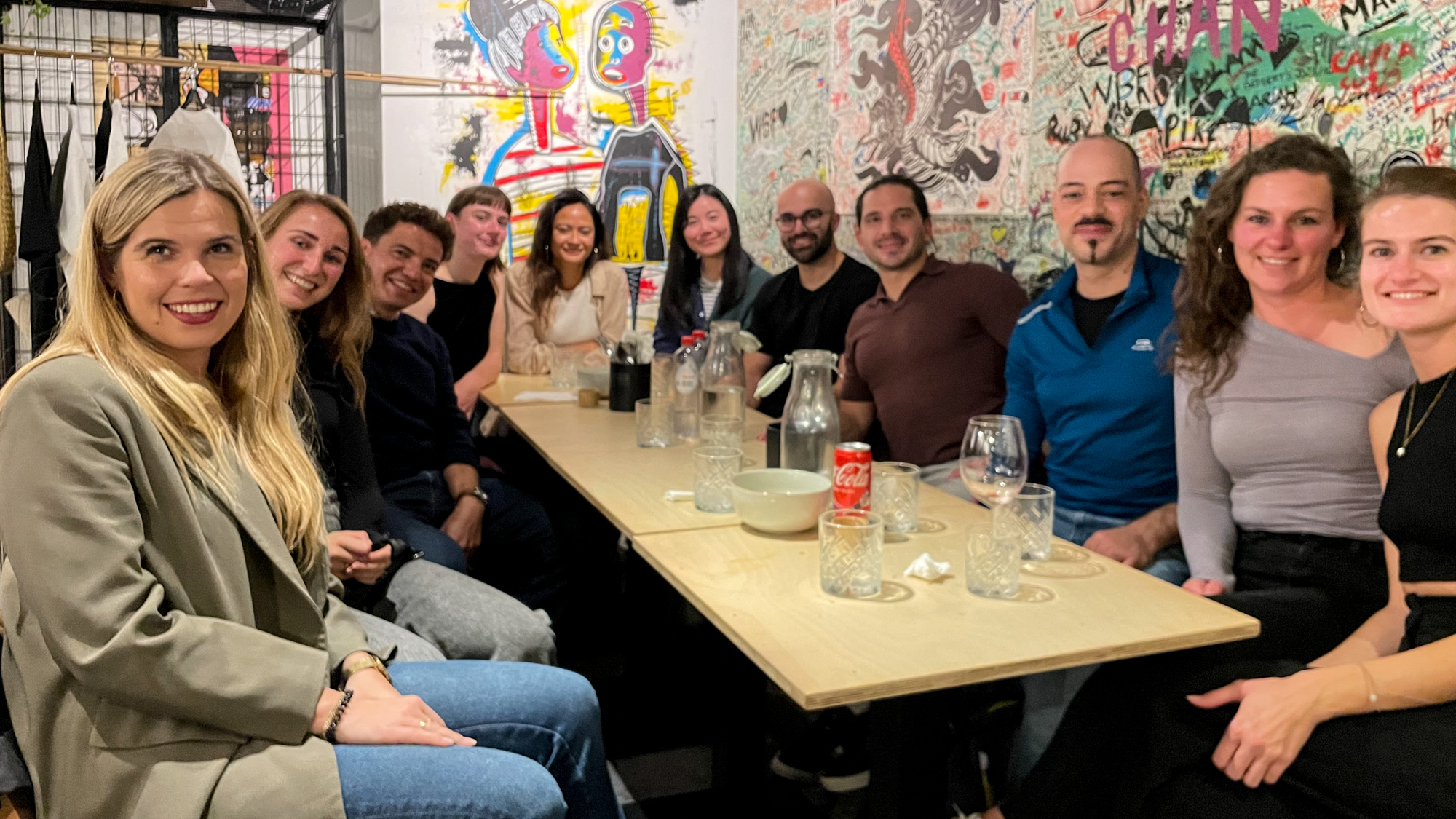
Top photo: Rowland with friends at his going-away party in Washington, DC