FORTALEZA, Brazil — Time passes with the rhythm of the wind. After gaining speed from August through November, it is now decreasing again as locals prepare for the rainy season. It has been 85 degrees Fahrenheit and sunny for the past seven months. Last week, for first time since I arrived in the northern state of Ceará, scattered raindrops dampened the sand before the sun burned through the clouds once more. The waters of March, as a famous Brazilian song goes, are slowly making their arrival.
Since July, the wind has literally brought innumerous waves of gringos—a term locals use for any outsiders regardless of origin. First came the Argentinians, Chileans and Uruguayans with lisped accents and suave swagger. While Spanish and Portuguese are sister languages, particularly in their written forms, verbal communication is not smooth when both sides attempt an elusive “Portingnol” that mixes enough of both languages to navigate ordering a cold beer and a hot meal, but often not much more.
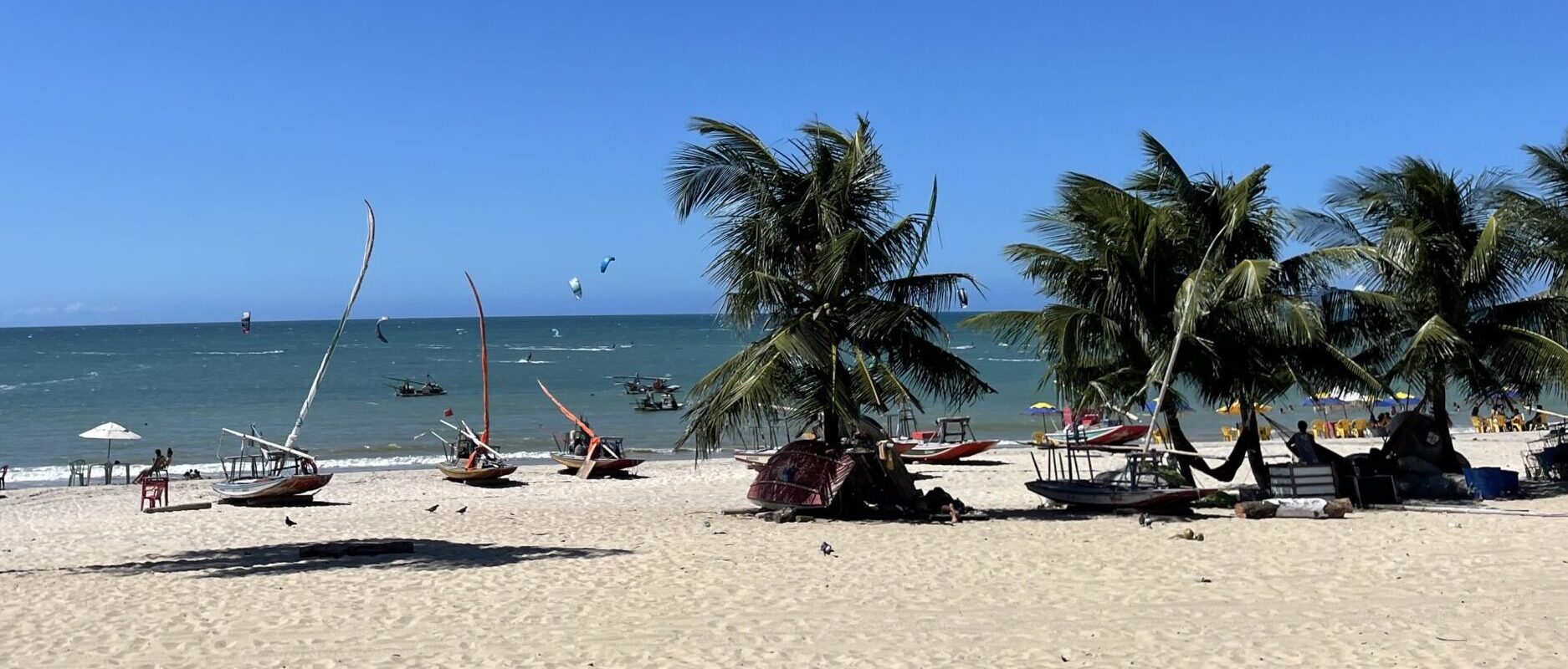
They are here to kitesurf, a sport that has increased in popularity in the past decade thanks to cinematic YouTube videos and advances in equipment that has made it beginner-friendly for anyone 10 to 70 years old. Strapped to a kite by four 75-foot lines attached to a harness, kitesurfers turn themselves into sailboats, gliding above the water on a diverse assortment of twin-tip, directional and foil boards.
The southern neighbors were followed by many Europeans beginning in earnest in October and lasting through early December. Americans are rare, there are only two direct flights to the US mainland, to Miami and Orlando, but their availability is inconsistent. In total, over 350,000 adrenaline-seeking foreign tourists visited Ceará in 2025, generating $250 million in revenues—a 21 percent increase since last year alone. Not an insignificant sum when the average monthly household income is $223.
Tourists generate a great deal of money for the local economy, but locals don’t necessarily benefit the most. Alex, a kite instructor who preferred to use an alias, was one of the first Argentinians to move full-time to Cumbuco 20 years ago. At the time, the little-known kitesurfing town was connected to the regional capital Fortaleza by a dirt road accessible only to off-road vehicles. He opened a hostel by the beach that has since been one of the most popular in town.
I often hear his kind of story. The reality is that many if not most of the popular hotels, bed-and-breakfasts and restaurants foreign tourists frequent outside Fortaleza are run by gringos, not locals. Alex says that’s partly because Brazil doesn’t have a strong middle class that can bring the necessary capital and customer service required to attract foreign tourists. The country’s immense wealth gap consistently ranks among the world’s five largest, meaning services locals provide tend to be either luxurious or rudimentary.
Thanks to the advantageous exchange rate and relatively cheap land prices—at least until recently—gringos with a little capital and customer-service-oriented work ethic have thrived in an industry that anyway hasn’t particularly appealed to most locals with access to the necessary funds. “Rich Brazilians respect being a doctor, engineer or lawyer,” Alex said. “The idea of waiting on others is seen as beneath them, even if they could make a lot of money.”
Another limiting factor for locals is that less than 5 percent of Brazilians speak some form of English and less than 3 percent speak some form of Spanish. Those proficiency numbers are even lower in rural Ceará.
At the same time, the kitesurfing tourism boom is generating thousands of low-wage jobs for the working classes as cleaners, cooks, taxi drivers, gardeners, waiters and kitesurf instructors—providing unimaginable opportunities in previously neglected rural areas. However, it seems that it’s mainly the gringos, together with a few well-connected wealthy Brazilians, who own and manage the properties, and collect the largest share of the profit in a circular gringo-oriented economy.
But the impact kitesurfing has had on these communities goes beyond just economic: It’s become a popular afterschool activity along Ceará’s coast. Benefitting from one of the longest wind seasons in the world, many Cearenses have gone on to win national and international competitions. Some have returned to start programs for kids. In an environment in which criminal organizations tend to recruit middle school children, those initiatives, although small, still make meaningful differences.
A 13-year-old I spoke with said he was left lonely after his best friend was forced to leave town with his mom after his dad was killed by gang members for unpaid debts. Kiting helped keep him focused while him providing a community and some solace, he told me.

While its windy coast is becoming overrun by gringos, Fortaleza itself still stands as a bastion of, for and by Brazilians. It is a sprawling seaside city with 2.5 million residents spread across 121 square miles. The crowning jewel is a curving esplanade on its northern shore, recently renovated, that starts at the city’s municipal fish market and makes its way three miles northwest to the Bridge of the English. Along the way, it hugs four beaches, each more inviting than the last.
The esplanade, called Beira Mar, is at its liveliest early in the morning between 5 a.m. and 8 a.m. and again after 4:30 p.m. Brazilians’ proclivity for tattoos becomes jarringly apparent at those times. Shirtless men and athletically, and skimpily, dressed women run from one end to the other, when it’s impossible to miss the tattoos covering entire arms, backs, chests and necks. Religious symbolism is the most popular theme, stylized women’s faces on shoulders are a close second.
During the day, the Beira Mar is barren as locals hide from the scorching sun. It only takes 30 minutes around noon to become thoroughly sunburned. Courageous tourists, determined to make the most of their holidays, brave the heat at their risk. Staking claim to a parasol, they’ll call over the moço (waiter) from the nearest beach barraca for their preferred refreshment.
Barracas are cultural institutions. They typically consist of a couple large coolers surrounded by wooden planks to form makeshift walls and roofs and are run by two or three men who cover themselves from head to toe in UV protective clothing. They spend their shifts hailing potential customers and ferrying an endless array of ice-cold beers, caipirinha cocktails and fresh coconuts across the burning sand.
No less intrinsic to Brazilian beach culture than the barracas are the wandering salespeople. The sheer variety of items they sell is beyond impressive: grilled cheese sticks, peanuts, lemonade, brownies, small music speakers, sunglasses, grilled shrimp, brigadeiros (sweet, chocolaty truffles), grilled lobsters, hammocks, ice cream, earrings, bracelets, popsicles, iced tea, puffed biscuits, candy, handcrafted boats… the list goes on. Thanks to the hard work of those walking hawkers, tourists can attend to all their epicurean needs without having to move from their beach chairs.
Rounding out the ambiance, self-appointed DJs play music from large speakers for their groups’ enjoyment—and anyone else within earshot.

Brazilians love the beach, but they do not necessarily like entering the ocean—far from it. Women, many of whom arrive in full makeup, appear more interested in taking pictures of each other with feet lapped by retreating foam. That made more sense after I learned that only 55 percent of Brazilians can swim, according to the Organization for Economic Cooperation and Development.
The Beira Mar comes alive again around sunset. Because of its proximity to the equator, the sun sets around 5:30 p.m. year-round. Those who don’t wake up early enough to exercise before work do so now. They are joined by everyone else who wants to celebrate the ending of another day and cooler temperatures.
The esplanade becomes full of hawkers and food vendors. My personal favorite are the popcorn sellers, spread out every 50 yards, who cook on gas stoves attached to wheeled carts. They offer a choice of sweet or savory popcorn, served with salt, butter or condensed milk. All for under $2!
My second favorite is the fruit seller strategically located by the “Espigão Nautical”—a breakwater known as the best place to watch the sunset. For $3, you can get a cup of fresh papaya, pineapple, banana, apple and avocado cut to order. Add to that your choice of granola, condensed milk or crushed cashews. This delicious assortment is best enjoyed at dusk watching amateur fishermen try their luck in the dimming light.
Acarajé fritter sellers, usually women, recognizable by their colorful traditional dresses and headscarves, are popular with locals. The food and clothing come from the state of Bahia, also in Brazil’s northeast, inspired by deep cultural ties to West Africa. Salvador, the regional capital, was once Brazil’s second-largest port of entry for enslaved Africans.
To make acarajé, the women mash together black-eyed peas, onions and shrimp, and fry the dough in large oil-filled pans. Once the fritters are golden, they’re taken out and split open with an effortless slash of a knife and filled with spicy shrimp, tomato salsa and vatapá—a savory paste of shrimp, coconut milk, palm oil (dendê) and cashews that’s thickened with cassava flour.
Other vendors fight for attention selling dindin (popsicles), açai, tapioca (cassava flour crepes), corn, hamburgers, triple-layered cakes, meat skewers and the traditional pratinho—a small plate overflowing with rice, beans, salad and grilled meat that will never leave you hungry.
For those who would rather not walk, double bench quadracycles, bikes, rollerblades and electric scooters can be rented. Kids have options, too, including sitting behind the wheel of toy SUVs, watching passing strangers, vacillating between astonishment and indifference while their parents operate the buzzing vehicles by remote control.
Along the boardwalk, the city has set up points for various groups to gather. Volleyball and footvolley enthusiasts play late into the evening. A group of visually impaired folks provide 20-minutes massages that leave you blissful. Capoeira schools set up in the open teach students a uniquely Brazilian blend of dancing and martial arts while those on the sides sing to the beat of local instruments.
Fortaleza’s tourist police, in neon green long-sleeve tee-shirts, watch the crowd. Occasionally, a squad of mounted police officers trots by. While not often, they do not hesitate to rough up petty thieves when they get the opportunity.
This bustling microcosm runs on PIX: the Central Bank of Brazil’s instantaneous money transfer service that connects any Brazilian bank account to another. Launched in late 2020, it is now used by 80 percent of the population. In October of 2025 alone, the PIX system counted 7 billion transactions with a volume of 3 trillion reais ($540 billion). The service is free when transferring money from one personal account to another. For commercial transactions, fees amount to around 0.22 percent, making it significantly cheaper for businesses than the 1 percent to 2.2 percent fees charged by credit card companies.
The low cost helps explain why in the span of four years, PIX came to account for some 47 percent of all non-cash commercial transactions, dwarfing credit and debit card payments. The revolutionary system is a threat to the business models of companies like VISA and Mastercard. It also derailed Mark Zuckerberg’s planned roll-out of a payment method through Meta’s ubiquitous messaging service WhatsApp in 2022. The Trump Administration has complained that PIX undercuts US companies, and it does, but it also keeps Brazilians’ financial data secure and puts more money in their pockets rather than sending it to Silicon Valley or New York City.
The street vendors of the Beira Mar seem satisfied. New flights to and from Europe and other Brazilian cities have already been announced for 2026 that will further fuel the tourism economy. Meanwhile, recently built and soon-to-be completed luxury apartment buildings dot the waterfront, encouraging more of those who visit to stay. With the wind at its back, Ceará and its capital seem ready for their moment.
Top photo: Cumbuco Beach with kite surfers, traditional fishing boats and tourist parasols