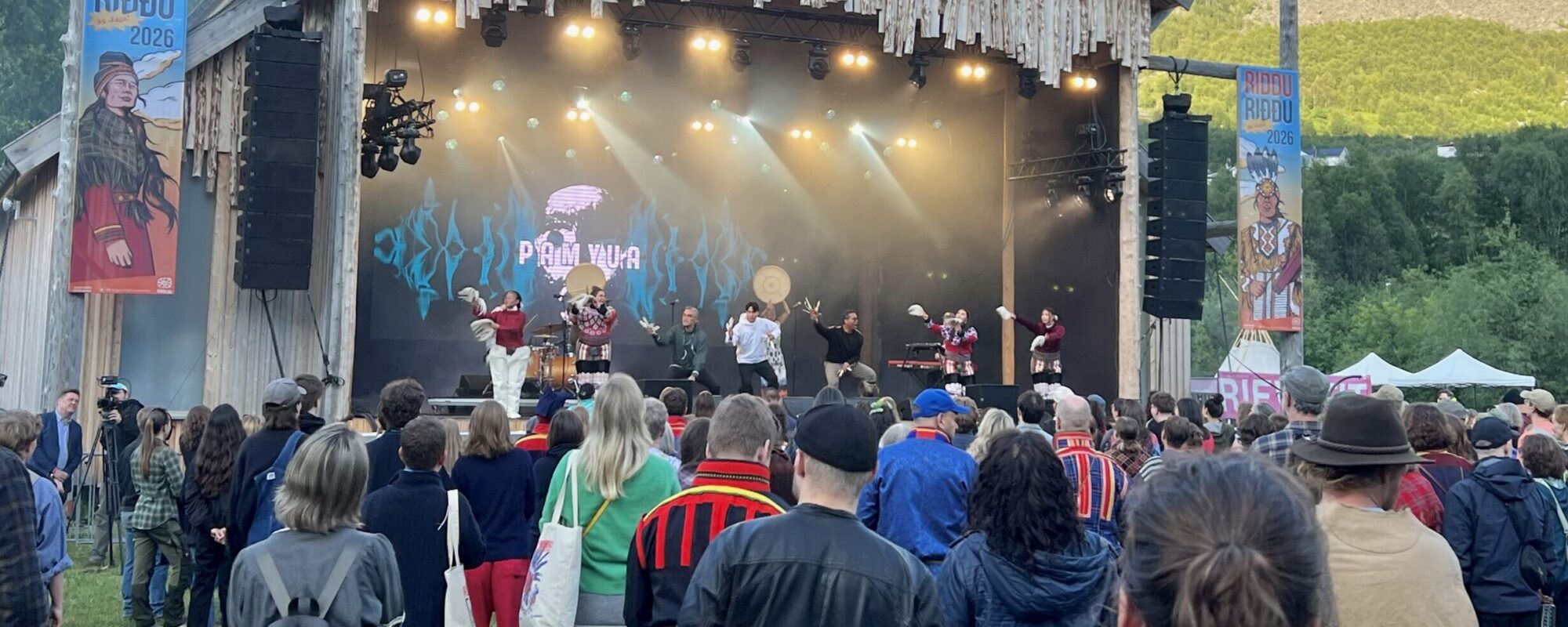
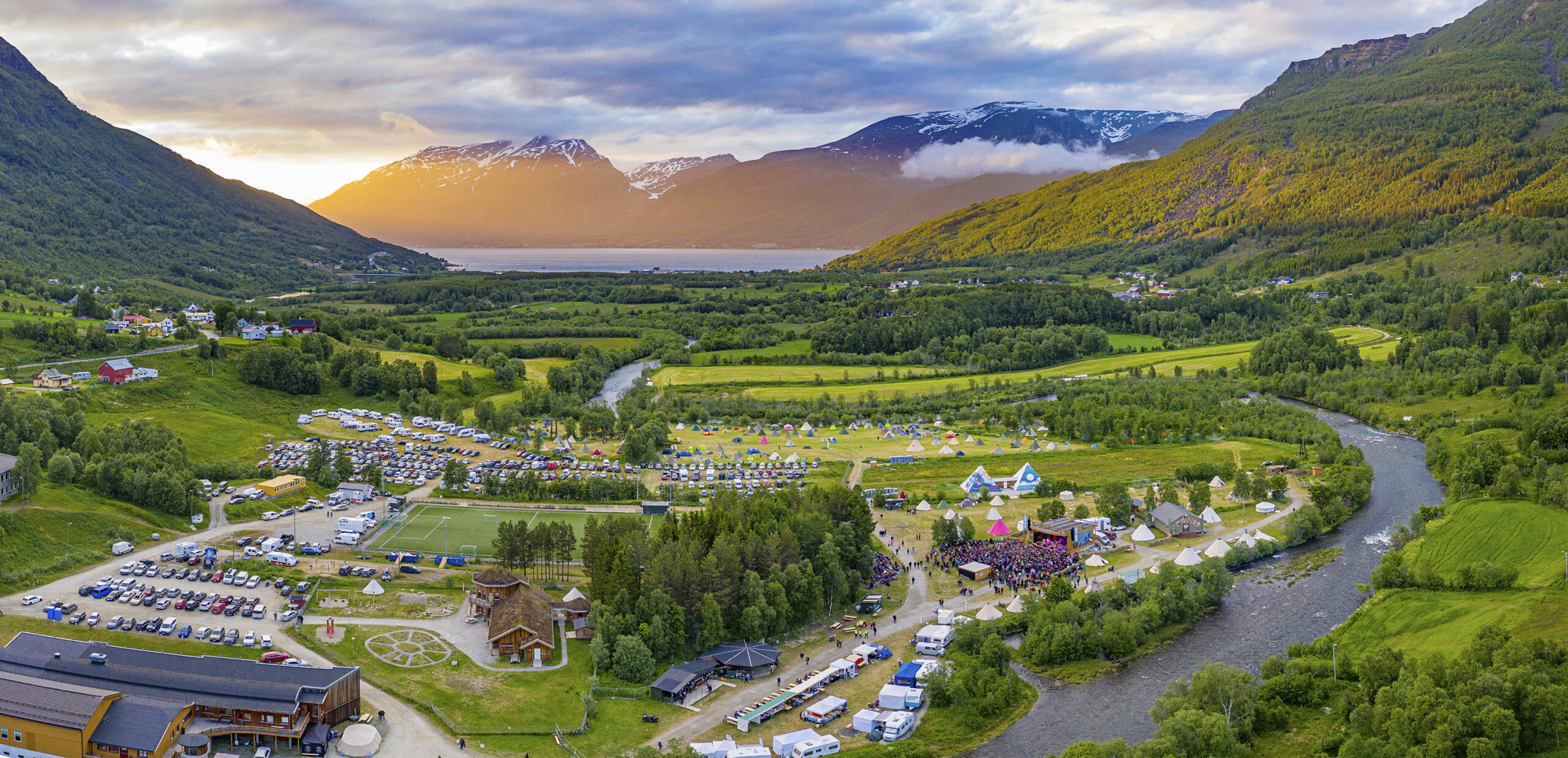
KÅFJORD, Norway — A voice echoed through the green valley, sounding against barrel-shaped slopes and up toward the cloud-tangled sky. Songbirds lit from pine branches. The river rumbled with midsummer snowmelt. As the haunting tune reached a full-throated cry, a cloud shifted, washing evening sun over the grassy clearing where, standing on a timber-roofed stage, a young Sámi woman was yoiking.
For thousands of years, Sámi yoiks rang from these mountains, and nearly every person, place and animal had its own distinct melody. Then, in the 16th century, the Norwegian-Danish king banned the ancient singing practice as witchcraft punishable by death. In the mid-1800s, Norway rolled back the death penalty but kept the ban under its forced assimilation, or fornorskning, policies. For the next century-and-a-half, yoiks were suppressed along with Sámi language, clothing and countless traditional practices. It wasn’t until 1989, after a decade of youth-led protests sparked a cultural revival movement, that Norway legally recognized Sámi peoples, language and culture.
Centuries of oppression don’t reverse overnight, however. In subsequent years, anti-Sámi prejudice persisted while many Sámi who learned about their heritage preferred to leave the past buried. That was the story for many in this fjordside valley of Gáivuotha (Sámi)/Kåfjord (Norwegian). But a group of local young people questioned the lingering legacies of silence. In 1991, they formed a youth union to both reclaim their coastal Sámi identities and rebuild cultural cohesion throughout Sámi society. Together, they schemed a radical idea: to counter shame with a public display of pride and celebration. They decided to throw a festival.
That summer, this valley held its first-ever “Coastal Sámi Cultural Days,” a mix of music, art exhibitions, theater performances and political discussions. Four years later, it was dubbed Riddu Riđđu, a sea Sámi phrase meaning “small storm on the coast.” And from the beginning, the festival did cause a storm. Locals complained about the noise and crowds. It became a target for discrimination; Sámi-language road signs were riddled with bullet holes and locals in passing cars slung spit and beer at young volunteers. But year after year, as its size and reputation grew, the event became an unstoppable cultural force.
Thirty-five years later, Riddu Riđđu has grown to a nationally recognized and globally renowned Indigenous music and cultural festival with a diversity of representation unparalleled anywhere else in the world. Every July, its Sámi-led organizers host a global selection of artists, intellectuals and cultural practitioners for four days of craft workshops, literary talks, theater and dance performances, film screenings, seminars and genre-dissolving music that bridge the traditional and the modern. Plenty of non-Indigenous people attend, too, traveling far to camp, eat, dance and learn in a space where Indigenous peoples come first.
On this evening in 2026, the yoiker onstage was Sámi-Norwegian artist Elle Maija. As her voice lifted, she tossed her dark hair behind her and grasped the microphone in both hands, leaving her white-and-black electric guitar dangling from her neck. Her band watched and waited behind her. In front, the crowd was a colorful collage of flannel shirts and hiking boots, Sámi traditional gakti tunics and point-tipped reindeer hide shoes. They stood, rapt and silent, as the last haunting notes of her naked voice carried toward the mountains. Then her drummer dropped a beat, Maija strummed her guitar with a reverberating twang and the dancing began.
* * *
I first attended Riddu Riđđu last year almost by accident. One Thursday morning in July in my base of Tromsø, I was sitting with a friend in Tøllefsen, a local cafe. As we chatted over coffee, one of her friends arrived and approached us with a greeting and an offer: Active in Sámi cultural events, she had access to discounted festival tickets. Did we want them? In a few hours, we had bought the tickets, borrowed a tent and found a ride with friends leaving the same afternoon.
I wish I could say that I felt only buoyed by uncomplicated spontaneity. But it wasn’t long into the two-and-a-half hour drive east to Kåfjord that trepidation began creeping in. Simply put, I’m not a fan of music festivals. On the few occasions I’ve attended, I felt claustrophobic and overstimulated, constantly in search of quiet spaces. Maybe it’s an American-trained sense of danger in large crowds, but I can’t stop looking for an exit. So as we turned onto a narrow road up a farm-patched valley toward a forest, I quietly steeled myself for a weekend of prioritizing cultural experience over personal ease.
As we pulled into a wildflower-springing meadow, however, I started to sense that this was no typical music festival. As soon as I opened the car door, my lungs filled with a nervous-system-soothing draught of saltwater, river grass and the piney-cold expansiveness one finds near mountains. It was a coastal-forest flavor profile unique to northern Norway—thanks to the extreme length of the deep-slicing fjord whose shore forms its western border, Kåfjord is one of only a handful of coastal Norwegian towns that’s also far inland enough to border Finland. (Because that eastern border halves the Halti mountain just 200 meters short of its summit, the peak of Finland’s tallest mountain is technically in Norway.)

I stepped out to a view dominated by a vast and multi-prismed sky: layered cloud banks that variously split and shifted, tracking sunbeams over the semicircle of round-topped ridges like spotlights over a stage. I could hear rushing water, birds trilling, scattered laughter and, more distantly, steady drumbeats. The smell of smoke drew my eye to an adjacent meadow, where curlicues were rising from between the white-canvas tips of Sámi lavvo tents scattered between multicolored nylon tents. Weaving between them, we saw members of a young family, all wearing gakti in the distinct colors and patterns of their home region. They were headed toward the source of drumbeats on the other side of the festival fence. We dropped our tents in an empty patch of grass and followed.
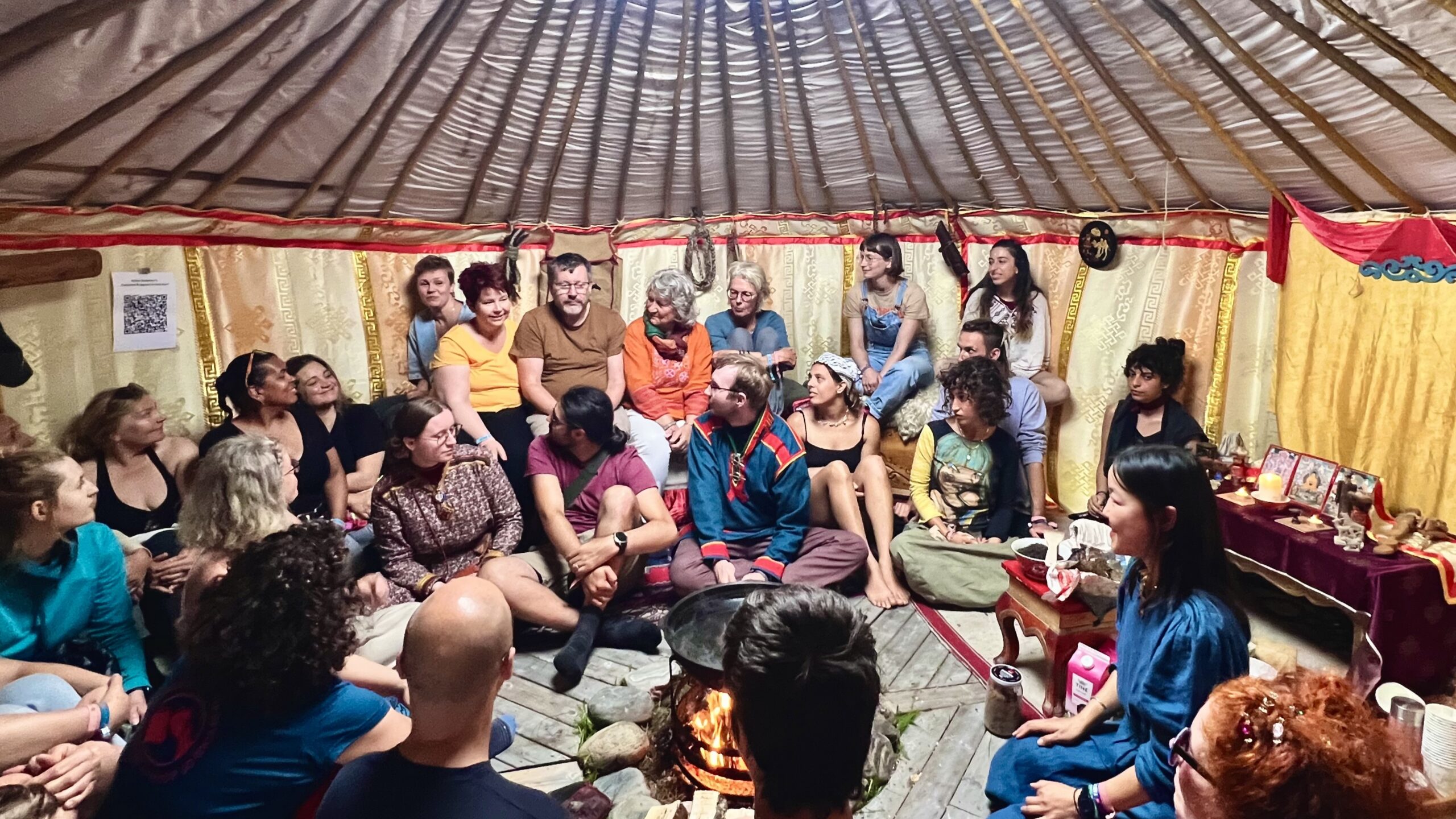
Crossing the fence felt like entering an alternate universe. Suddenly, we were plunged into a buzzing Sámi market, its lines of stalls selling all kinds of traditional handicraft (duodji) made of reindeer bone, leather and wood, gleaming silver jewelry, and countless cuts of dried reindeer meat. At the end of the stalls, children played on wooden structures and practiced lassoing mounted reindeer antlers. Following a dirt path along the curve of the river, a line of lavvos hosted seminars and workshops teaching beading, fish skin tanning, hat and bag sewing, and other traditional practices. A timber longhouse embossed with fierce red-painted animals—a gift from the Nisga’a peoples of Canada—screened a program of Indigenous films. Inside a squat yurt with a tiny red wooden door, a Mongolian woman hosted a daily tea ceremony, kneeling in front of a steaming pot with a long ladle in hand, telling stories as she stirred the sour-sweet milky tea for the closely packed floor-sitters around her.
All the venues circled the festival’s only stage. There, over three nights of concerts, we heard music that blended the traditional and modern, evoking feelings of joy to rage to radical solidarity. The program highlighted both well-known yoikers and contemporary Sámi artists, Greenlandic reggae, Mayan-Kaqchikel folk rock, Palestinian rap, Taiwanese pop and much more. During the day, we watched films by Sámi and Māori filmmakers, attended a Greenlandic mask dance and sat in the yurt sipping black tea with yak milk. As we lunched on reindeer kebabs, we visited a Sámi friend learning to sew her own Gobbagahpir, the characteristic tall hat traditionally worn by sea Sámi women. (The workshops fill fast and Sámi people get first priority.) On the final afternoon, we joined a powwow hosted by the nēhiyawak (Cree Nation). We whooped as a young hoop dancer in tasseled boots tossed hoops high in the air, leapt through them, then strung them over her arms and beat them like eagle wings, face turned to the sky.
At the time, I knew almost nothing about the festival’s history. But I understood the term “music festival” couldn’t begin to describe it. It was at once artistic, political and intellectual, radically open and often emotional. At the same time, it was both family-friendly and simply friendly. Walking up and down the single-track dirt path along the river, I realized I was getting more eye contact and smiles from strangers that weekend than I’d received over my entire time in Norway.
Still, I keenly felt that though I was welcomed, it was not a space created with people like me in mind. There was much to enjoy in that, too.
This year, I could only stay one night. But I knew it was worth it—no two Riddus are the same. One year later, the familiarity of the valley-entrance and that first deep draught of air didn’t make either any less extraordinary. We arrived in the early evening and pitched our tent to the sounds of a concert just beginning. After a quick campsite dinner, we hurried past the market stalls toward the stage.
We were just in time to see Pamyua, Alaska’s most famous Inuit band. Its official genre, “Inuit soul,” only partly captures the unique sound, which blends Yup’ik/Cup’ik fish camp chants with influences as varied as South African vocals, African-American R&B and gospel, and Russian Orthodox Church chants. The three men and woman onstage, most of whom were graying, had last performed at Riddu Riđđu 25 years earlier. Their ease together was palpable and their playfulness infectious. During one song, a humorous reggae ode to the woes and joys of the Alaskan air-taxi culture, an Alaskan friend of mine couldn’t stop laughing. She pointed to the lead singer, holding feathers between his knuckles and beating his arms like wings. Then she pointed to the baseball cap on her head, embossed with the word ALASKA.
“He commented on my hat earlier and we talked for a long time,” she said, then grinned sheepishly as she shook her head. “I had no idea who he was, and he didn’t mention it at all.”
At midnight, the sun came out for the headliner, Tarrak, a 27-year-old Greenlandic hip-hop artist. As he bounded onstage, his mane of long dark hair springing behind him, the crowd roared. Tarrak, who raps exclusively in his native language of Kalaallisut, is on a meteoric rise in Europe. In 2023, he became the first Greenlandic rapper to perform at Denmark’s Roskilde, northern Europe’s largest music festival. Like many others in the crowd, I had already seen him perform—he came to Tromsø for a cultural festival in late April. That night was both joyful and jam-packed, and the bar-backroom venue quickly began turning people away at the door.
On this night, Tarrak took advantage of the bigger stage. As he cued a soft but urgent beat on his mixer, he told us in English that he had grown up with Danish images of Greenland, of untouched wildness, remote and empty landscapes. “Tonight, I brought you our Greenland, Kallalit Nunavut,” he called out. Behind him, his banner-name dissolved into a slideshow of home photographs: a young woman in a hoodie flashing peace signs, young men walking among rusted military detritus, an old woman smiling over a steaming pot.
Tarrak paced across the stage, spitting out quick and fluid verses, then guided the crowd to bounce a raised arm along with the beat. At one point, as hundreds of arms moved in unison, he called up to a line of uniformed officers standing near the fence: “Now, the police!” We all turned to see them unfold their arms and bounce along with us. Tarrak whooped and yipped. Later, someone standing close to the stage handed him a banner, which he held up for all to see: Greenland is Not for Sale. The crowd went wild.
* * *
Survivance: This portmanteau of “survival and “resistance,” coined by the North American Anishinaabe cultural scholar Gerald Vizenor, offers an alternate vision of the Indigenous experience. In his 1993 book Manifest Manners: Narratives on Postindian Survivance, he rejects victimization narratives about colonialism, arguing that bringing culture forward through oppression takes active resistance that mere “survival” doesn’t capture. Vizenor’s survivance doesn’t happen only in the past tense; it exerts a living imaginative force through modern life.
How does any culture survive through decades or centuries of violence and forced suppression? How does it continue under threat of punishment and even mass death? The yoik offers one example of survivance in practice. Over the centuries, many yoiks that had been handed down through generations were lost. But the practice of yoiking survived. Through small acts of resistance, the songs continued, taught to children or remembered by grandparents.
“We don’t sing ‘about,’” the renowned yoiker and activist Mari Boine has said. “We sing into being—a person, landscape, animal, situation.” Last summer, while I was covering protests against the Nussir copper mine on a fjord called Repparfjord, I watched an activist named Sara Marielle Guap block the mine while yoiking into a megaphone. Even as the police removed her, she continued to yoik. When I interviewed her about the Repparfjord yoik, she told me that it had been lost long ago. But she didn’t “compose” this particular song. A yoiker learns how to listen closely and “catch” the song on the wind. From this perspective, even a forgotten yoik can still be reclaimed.
On the last day of this year’s festival, Lávre, a well-known Sámi artist, performed. Between songs, he told us his origin story. When he was growing up, his family wasn’t particularly musical. One day when he was a teenager, however, he received a surprising email from his grandfather. It contained an audio file of the old man’s voice yoiking. It was the first time anyone in his family had heard him sing. Lávre held up his phone to the microphone and the tinny but haunting voice carried over the audience. Then his accompanist struck a few gentle keyboard notes and Lávre put his phone away to pick up where his grandfather had left off.
Like the yoik that sings rivers into being, survivance of Indigenous culture can’t be separated from the ecology in which it’s rooted. This festival was a space to reify and celebrate that connection. But it also became a place to share experiences of deep ecological grief.
This year’s powwow was hosted by the High Water Drum Group, a family-based drum circle from the Lower Similkameen Indian Band of the Syilx/Okanagan Nation in British Columbia. On that final afternoon, after a lively drum and dance performance, two women approached the microphone and thanked the Sámi people who brought them here.
“Since we arrived in your home, we have been amazed by how blessed you are to have so much water,” one woman said, gesturing around her as the river roared audibly. “Back home, our community is facing droughts and a water crisis. Climate change has brought wildfires that we have never seen before.”
They would sing a song, they said, about Big Water.
As the two began a commanding melody, the screen behind them projected images of burning and charred fields, blackened bare trees and cracked riverbeds. Then it switched to people: in traditional dress, sharing food and sitting in drum circles. The images were overlaid with words like “CEREMONY” and “SURVIVAL.”
As the women’s liquid voices alternately wove together and spilled apart, it struck me that the river’s own voice was eddying and coursing around theirs, joining in the buoyant chorus. While their last notes rang out, its unbroken surge seemed to briefly sustain their song. Then the echo diminished skyward, to be absorbed by low clouds pregnant with the promise of rain.
Top photo: The Riddu Riđđu festival stage