MANILA — Atencio-Libuano Hall is a sanctuary on the forested campus of the University of the Philippines. With white-washed, Spanish-inspired architecture and a sparkling reflecting pool, it resembles a church or a wedding venue more than your run-of-the-mill conference space. Last April, Atencio-Libuano’s grand ballroom was filled with around 100 people attending a forum. The topic? Advocating for the legalization of cannabis for medical use in the Philippines.
Beneath crystal chandeliers, legal scholars mingled with patient advocates, representatives from Congress, health care providers and other civil society activists. The presenters included doctors discussing evidence-based medical uses of cannabis, advocates sharing their personal experiences using the drug despite its current criminalization and a sitting congressperson explaining his plan to garner support for regulation in the legislature.
The discussion would have been utterly unthinkable just a few years ago. Under the presidency of Rodrigo Duterte and his 2016-2022 “war on drugs,” challenging drug prohibitions was met with legal sanctions, public vilification including by Duterte himself and even violence. Now, in 2026, audience members and speakers across the political spectrum talked freely.
The existing law criminalizing cannabis, which undergirded Duterte’s drug war, is called Republic Act (R.A.) 9165, the so-called Dangerous Drugs Act. It authorized the formation of the Dangerous Drugs Board (DDB) to be a policymaking agency and Philippine Drug Enforcement Agency (PDEA) as its implementing arm.
Although the law has been on the books since 2002, Duterte’s war on drugs saw the harshest and most widespread implementation of its penalties, leading with life imprisonment for the sale of “any dangerous drug” listed and 12 years to life for possession. An estimated 400,000 people were arrested over the course of the drug war. Thousands are still incarcerated today in pretrial detention while the congested court system struggles to process the lasting influx of cases.
But as Duterte faces an International Criminal Court trial for crimes against humanity, current President Ferdinand Marcos, Jr., has adopted a less bloody anti-drug approach that includes rehabilitation as one of its central objectives. That gives civil society a bit more maneuvering room to advocate for reform.
Still, health providers and decriminalization advocates told me progress is being stymied by a fragmentation of the reform movement as groups split over approaches to decriminalization and regulation, medical and recreational drug use and more. Moreover, despite widespread condemnation of Duterte’s approach, stigma, classism and lasting prejudices continue to pervade the public’s views about drug policy as a tool for social control. The war on drugs may be over but the battle for hearts and minds continues.
While Duterte’s public approach was violent and bloody—he frequently called on police and the public to kill drug “addicts” and “pushers”—the government’s actions were actually more multifaceted. Soon after the launch of the drug war, the drug enforcement agency established a large treatment and rehabilitation center right outside Manila, built to accommodate 10,000 people. By 2022, 55 such centers were operating across the country.
Compared to Duterte’s calls for violence, the facilities provided an alternative that would seem at first glance to be health-focused and more in line with international human rights standards. In practice, however, the government created a false dichotomy between extrajudicial killings and rehabilitation: accept treatment or be killed in the street. The country is still struggling to find alternatives.
In fact, the rehabilitation centers have functioned as de facto places of detention, Amnesty International reported in 2024, where drug suspects were coerced into treatment, held against their will and subjected to mandatory drug testing, solitary confinement and other abusive practices. After their release, patients were required to regularly report to the authorities and undergo unannounced drug testing. If they relapsed, they were liable to be re-arrested and incarcerated or re-admitted to a center. Under the drug law, rehabilitation is considered a penalty for drug use.
The policy of compulsory intervention against the backdrop of widespread extrajudicial violence has generated little criticism from the public, finding widespread support beyond the hardline, tough-on-crime politicians and advocates one would expect. It exploited longstanding perceptions that people who use drugs are violent by definition, liable to commit rape, murder and other crimes. In the eyes of society as well as under the law, those who use drugs are either criminals or patients.
That perception is hardly unique to the Philippines. Global policies to criminalize and eradicate drugs have been in place since the 1970s and ’80s, including under US presidents Richard Nixon and Ronald Reagan during their own wars on drugs, which drove massive spikes in incarcerations in the 1980s and 90s. As the writer and civil rights activist Michelle Alexander writes in The New Jim Crow, “Nothing has contributed more to the systematic mass incarceration of people of color in the United States than the War on Drugs.”
In response to the effects of such policies, international organizations like the World Health Organization and various UN agencies have subsequently issued guidelines for addressing substance dependence through evidence-based and voluntary forms of treatment rather than compulsory treatment and forced rehabilitation. A growing international consensus over the wider social factors that influence drug use has been central to their approach to drugs. People use drugs for a variety of reasons, many of which are directly influenced by the realities of their socioeconomic status. For previous dispatches, I’ve spoken with people who use drugs to help carry out manual labor, work long hours as taxi drivers or perform other predominantly informal or low-income work. “In an economy where your capital is your physical labor, you might rely on performance-enhancing drugs to put basic food on the table for your family,” Lee Yarcia of the Institute for Law and Government Reform in Manila told me in an interview on the University of the Philippines campus.
That context does not erase the problems or real harm related to substance use, he clarified. “Drug dependency and addiction or the transmission of HIV/AIDS and other infectious diseases through the lack of sterile supplies are well-recognized and documented problems,” he said. “But these are best addressed by the public health system, not by putting people behind bars.”
That principle is the basis of what many reformers in the Philippines have labelled both a public health-focused and a human rights-based approach. “As medical providers, we cannot deliver health services to people who use drugs if they are afraid of facing criminal penalties for disclosing drug use or accessing those services,” Yarcia said. “Human rights-based approaches to drug policies solve this by redesigning policies to effectively address real harms of drug dependency without wielding incarceration as a ‘stick’ to the ‘carrot’ of treatment.”

As we chatted in his pristine, sunlit office at the UP Institute, Yarcia was soft-spoken but crisp and clear in his explanations of abstract legal and medical concepts, belying his extensive experience talking about these issues with people outside the Philippines and the general public. He has been working with other scholars at the University of the Philippines Law Center on a broader drug policy reform project focused on defanging the Dangerous Drugs Act and its punitive approaches. The center’s April cannabis forum stemmed from this wider advocacy agenda, which aims to learn lessons from the drug war.
In 2025, the university’s Institute of Human Rights drafted its own “Public Health and Rights-Based Drug Policy Act,” a proposed bill that would essentially disarm the current law by making rehabilitation and treatment the government’s central response to drug offenses. The reform would require police officers, on arresting suspects, to direct them to community-based health and social support programs—effectively decriminalizing drug use by removing the threat of criminal sanctions.
As of this writing, the legislation is still being debated in the House of Representatives. But it has been overshadowed by controversies surrounding the pending impeachment trial of Vice President Sara Duterte, among other scandals that have consumed immense political capital.
For now, it seems the momentum to address the drug law’s flaws has been lost. “Realistically, no new law to repeal or amend R.A. 9165 will be passed in this administration before the next election in 2028,” Yarcia told me matter-of-factly. “But I’m hopeful these attempts at reform and ongoing conversations will carry us forward, brick by brick, until we can create something grand.”
* * *
The reform effort is benefitting from international guidance. Back in 2019, in response to increasing reports of drug war killings, the United Nations Human Rights Council passed a resolution ordering its Office of the High Commissioner on Human Rights to investigate the campaign and provide recommendations. That effort led to the formation of the Joint Program for Human Rights between the UN and the Philippine government in 2021. It would facilitate the provision of technical assistance by the UN Office of Drugs and Crime and other agencies in developing human rights-based approaches to drug policy.
The UN’s move was partly diplomatic, Yarcia told me. “It’s an alternative to providing accountability, which means acknowledging that the Philippines has committed widespread human rights violations through its drug policy and the drug war,” he said. “Proposing technical assistance instead couches the problems of criminalizing drugs in the language of expertise-based fields like ‘health’ and ‘human rights.’”
The program concluded after three years when President Marcos declared that the government had formally ended its war on drugs and would instead conduct a “campaign” focusing on education, prevention and rehabilitation. But critics say there are reasons to be skeptical about the efficacy and reasoning behind the shift, saying it was a superficial effort on Marcos’s part to rehabilitate his father’s dictatorial legacy and win a rotating seat on the UN Security Council (the seat went to Kyrgyzstan over the Philippines in June).
Before the program’s inception, the Dangerous Drugs Board approached drug policy solely through demand- and supply-reduction efforts—primarily law enforcement against sellers and education in schools about drugs and users’ criminal outcomes. Despite its prejudicial name, the board has since incorporated recommendations from the program on top of Marcos’s policy shift, and, more recently, a third focus of “health and social development.”
Still, it’s unclear whether the DDB has the requisite expertise or evidence-based policies in place to address drug dependency as a public health issue, given its primary law enforcement focus. The community-based health programs appear to be implemented in parallel to their barangay (neighborhood) drug-clearing programs.

Those kinds of operations were central to Duterte’s design of the drug war, known as Operation Tokhang, where police officers were directed to go door-to-door to suspected drug users or sellers and urge them to seek rehabilitation. Many of the “knock and plead” encounters resulted in nanlaban—reports of drug suspects fighting back against police, which I discussed in my first dispatch. Over six years, the drug-clearing programs resulted in thousands of deaths, and their design is central to the ICC Prosecution’s case against Duterte as evidence of a nationwide policy to kill suspected drug users.
Now, the DDB’s community-based health programs utilize many of the methods of a policy called tokhang: identifying people who use drugs and maintaining a centralized list of names (without much oversight, data protection or verification), using police to visit those people in their homes and conducting other forms of surveillance, including mandatory drug testing.
The same people previously subjected to the criminal application of drug policy are now being monitored under this treatment-based paradigm. To retain their eligibility, often under threat of incarceration, participants must abstain from using drugs and complete the treatment program in its entirety.
* * *
“But if drug use is part of a person’s life, then making them be ‘drug-free’ as a condition for the program renders the entire intervention pointless,” Inez Feria of NoBox Philippines, a drug policy reform NGO, told me. “It’s as if a patient goes in for treatment of bronchitis and the doctor tells the patient to stop coughing!”
We met in her high-rise apartment, where Feria, short and sprightly in her horn-rimmed glasses, greeted me with the warmth and fervor of a longtime colleague or friend. A medical anthropologist, Feria has led NoBox in advocating for harm-reduction principles in all aspects of drug law reform since 2013, just prior to the drug war. NoBox’s research focuses on fighting narratives within Filipino society that perpetuate the punitive and prohibitionist approach to drugs, often through collecting and sharing the stories of people who use drugs.
“Within a broader narrative ecosystem, we look at how we can bring the lived realities of people who use drugs into everyday conversation,” Feria said. “We have to supplement existing discourse to show that this is not just a criminal or health issue.”
Buy-in and effective engagement from communities where people use drugs are central to Feria’s approach. NoBox partners with other organizations across the Philippines like IDUCARE, a peer-led organization based in Cebu City, 350 miles south of Manila in central Philippines, where organizers conduct outreach among people who inject drugs, and provide health services and legal aid.
“When you create a space for people to share their insights and answer questions about their experiences without fear of being arrested, confined or killed, they will connect and view these harm-reduction spaces as relevant to their lives,” Feria said, “They’re so used to interacting with drug policy in a way where they have no control over their life, where they feel like pawns within a system. They will say ‘Maliit lang kami’ (We are just small people).”
In its discussions with government agencies and local authorities, NoBox doesn’t present its harm-reduction approach as an alternative to the drug war’s lethal approach but rather a “compassionate pragmatism” to guide drug policy, focusing on understanding the risks and harm surrounding drug use to provide effective and relevant support measures to those who use drugs.
“To adopt a harm-reduction approach, you have to acknowledge that drug use may continue,” Feria said. “You have to think outside this reductive persona of the ‘victim’ of drug ‘addiction’ who is being fixed by treatment-focused drug policies.”

Feria is a proponent of the “set and setting model” as a starting point for policymaking: Outline the experiences of drug use, including people’s circumstances (setting) and expectations (set), and then notice where there are problems or risks. “People’s stories don’t start with drugs,” she said. “But there’s a tendency to use drugs as a starting point. Instead, we locate the role of drugs in their life, the conditions and systems which shape them, to better tailor policy solutions.”
Even within the drug reform campaign, approaches to supporting people who use drugs conflict partly because of pervasive stigma and antipathy that causes groups to differentiate their calls for reform among substance type (shabu, or methamphetamine, versus cannabis) or substance use (medical versus recreational) and so on. As we talked in her apartment, Feria explained that various moralisms present one of the biggest challenges to unifying advocates to present a clear, actionable message.
Behind her desk, whiteboards, diagrams and sticky notes plastered the wall: preparations for an upcoming forum NoBox will hold to launch its report about the practices of communities living with drugs. When I mentioned my surprise at how much strategy work there seemed to be behind the scenes of just one forum, Feria smiled, crinkling her eyes behind her glasses.
“It looks like a lot but in the Philippines, we have this culture of selling and buying products tingi-tingi, in small sachets or individual portions,” she said. “Our work is like that. If change happens, it will be tingi-tingi.”
* * *
“I’ve been an activist since I was 17,” Lea Fullon told me as we sipped coffees in a restaurant in Quezon City, just northeast of Manila.
At 37, she has a resume that spans advocacy for Indigenous rights and land rights as well as working in Congress as a legislative staffer for Bayan Muna, one of the oldest progressive parties. Today, she’s the executive director of the Haraya Policy Center, a group formed to advocate for legalizing cannabis for medical use.
The origins of Fullon’s advocacy are deeply personal. In 2014, her cousin developed a germinoma, a tumor in the pineal gland of his brain. Doctors told her family it was completely inoperable and her cousin began to lose his vision and hearing. After his diagnosis, doctors estimated he had about five months to live. He was nine years old.
“I couldn’t accept that,” Fullon told me, tears glistening in her eyes. Looking for a solution, she connected with a small patients-rights group she encountered during congressional canvassing made up of mothers advocating for the legalization of medical cannabis for children with serious medical conditions. With their help and further research, Fullon secured the necessary medicine to start her cousin on cannabis therapy for the nausea and pain resulting from his chemotherapy at Philippines General Hospital.
“We had to sneak his medication into the hospital, starting with a bottle of cannabis oil just this high,” Fullon said, motioning with her thumb and forefinger to indicate a few inches. Of the multiple doctors treating her cousin, only one was willing to take the risk of helping the family administer the oil.
In the children’s ward, Fullon’s cousin was surrounded by 15 to 20 kids, some as young as four or five years old, slowly dying in their too-large hospital beds. “My cousin was the only one doing well, able to sit up, eat and sleep,” Fullon told me. “The cannabis supported his healing, and I think that was truly how he survived those months in the hospital.”
While further research is needed to fully understand the effects of cannabis as a therapeutic substance, clinical trials have provided conclusive evidence of its anti-emetic (anti-nausea) effects in cancer patients undergoing chemotherapy.
Eventually, Fullon’s cousin completed the treatment and became cancer free, going on to graduate from college. But at the time, her family members were quiet in their celebration and didn’t share much with the extended family about exactly how they had managed the illness. By 2016, Duterte had launched his drug war; Fullon’s family lived in one of the hotspots for killings in Quezon City.

“We would see people dead in the street, lying outside our neighborhood 7-Eleven,” Fullon said. “This was a normal Monday or Tuesday.” In her barangay, or neighborhood, 17 people were killed in anti-drug operations in one week in 2017. Many more were arrested. “As our supplies for my cousin were dwindling, we struggled to find quality medicine,” she explained. “And there was a constant fear of being found by police.”
Their fears were realized. In 2018, Fullon’s partner was arrested at a roadside checkpoint in possession of cannabis leaves. “I thank God it wasn’t oil; the charges against him would have been much higher under R.A. 9165’s penalties,” Fullon told me, motioning once more with her hands to illustrate the small size of the leaves her partner was carrying. “Just 14 milliliters of cannabis oil and he could have been sentenced to a lifetime in prison.”
Her partner was jailed for a month, an experience Fullon described as deeply traumatic. “He and I have been jailed after rallies; we have friends who were political prisoners,” Fullon explained. “But this was different.”
Her previous activism had exposed her to “red-tagging,” a practice used to harass and threaten advocates by associating them with communism and the separatist New People’s Army. But stigma and moral judgements about drugs are much stronger. “Previously, when my partner was jailed on political charges, the other detainees would treat him with respect. ‘You’re an activist, here, have this space or special privilege,’” Fullon said. “As soon as they learned he was jailed on a drug charge, he was considered one of the ‘bad ones’ and relegated to the bottom of the hierarchy.”
Eventually, her partner was acquitted and the charges dismissed. “We weren’t softies; we were seasoned activists. And yet I’m just happy he’s alive,” she said.
Her experience fueled the formation of the Haraya Policy Center in 2021, built on Fullon’s work with the wider cannabis legalization movement in the Philippines and growing momentum within Congress over the issue. Across the last three congressional terms—including during Duterte’s administration—various legislators have repeatedly sponsored bills to decriminalize cannabis for medical use in different fashions.
But the bills have relied heavily on a prohibitionist foundation, without much basis in public health or the principles of harm reduction. “Essentially, these bills have been simply adapting R.A. 9165 and carving out a small space for cannabis for medical use.” Fullon said. “If you get caught with cannabis without a prescription, R.A. 9165 still mandates that you can be labeled a ‘user’ and spend a lifetime in jail.”
Haraya is currently developing what Fullon calls an “advocate version” of existing medical cannabis bills. “It won’t be profit-oriented, and it won’t retain the penal provisions of the previous bills that passed the House, but rather it will center on harm-reduction principles and be a building block for more widespread decriminalization,” she said.
From my discussions with Fullon, Feria, Yarcia and others, it seems cannabis is at the top of the “acceptability” hierarchy in the Philippines and much less alarming than descheduling shabu or injectable drugs. It is inoffensive enough to have been repeatedly deliberated by Congress over the last decade. Still, the constant deliberation without actually passing a law indicates that there remains significant skepticism, moral panic and general fear around drugs—an underlying barrier to acceptance that even the images of sick or dying kids can’t breach.
“My cousin survived, but of those working in our movement on behalf of their kids, roughly half the children have died over the course of these 12 years,” Fullon said with a sigh. Her eyes lost focus for a few seconds, somewhere over my shoulder. “If we get this bill passed, I hope to name it after some of them.”
* * *
Each year on June 12, the Philippines celebrates Araw ng Kalayaan (Day of Freedom), to mark the country’s independence from Spain. Immediately after the Spanish exit, the United States took control of the Philippines as a colony under the 1898 Treaty of Paris. After a period of occupation by Japan during World War II, the Philippines was granted independence from the United States on July 4, 1946. For the next 16 years, the Philippines commemorated its independence day on July 4, aligned with the American recognition of its sovereignty. It was only in 1962 that Araw ng Kalayaan was moved back to June 12.
So the answer to the question of how long the Philippines has been independent is more complicated than simple arithmetic. Your intrinsic beliefs about self-determination and national identity come to the fore when you choose between saying the Philippines achieved its independence 128 years ago or that it has been free from colonial rule for only the last 80 years.
Calls for the reform of R.A. 9165 remain widespread and ongoing, from the halls of Congress to the University of the Philippines. But the responses have been complicated and varied, just like the shifting dates of Philippine independence. How you answer reveals your understanding about drugs, the people who use them, their role in informal economies and the urban poor communities associated with them.
The 10th anniversary of the start of Duterte’s war on drugs was July 1, 2026. An entire decade has passed since the former president launched his campaign of extrajudicial killings under the policy of eradicating illegal drugs. Thousands are dead, yet the drugs remain.
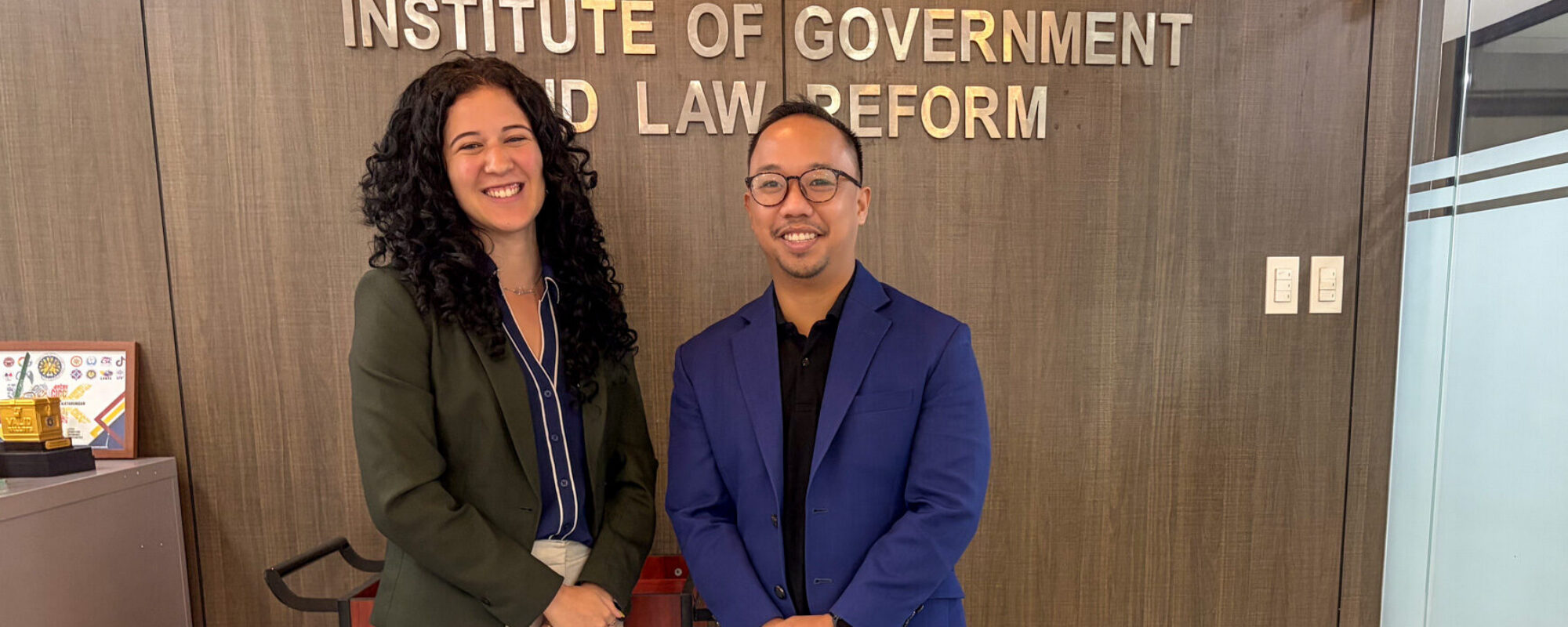
Top photo: With Lee Yarcia of the University of the Philippines Institute of Government and Law Reform