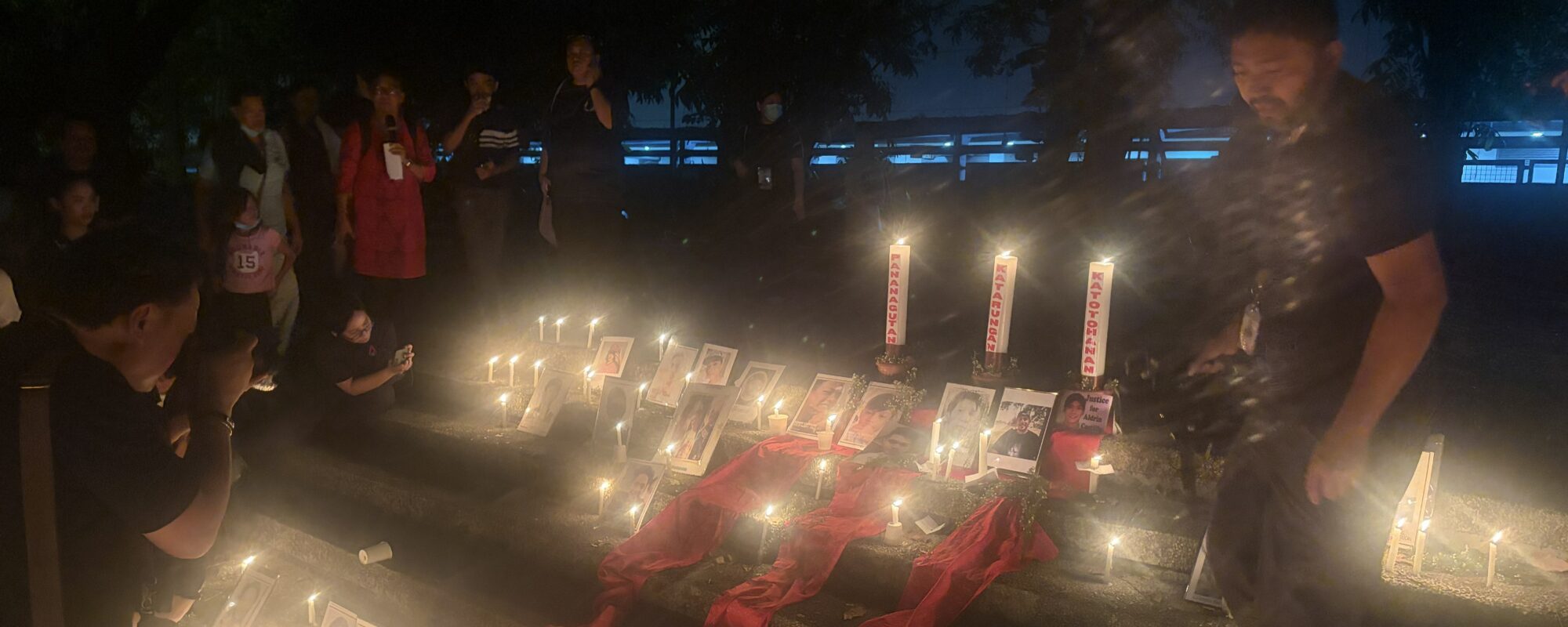
MANILA — Three thick, waxy candles stood atop several skeins of fine red fabric, which tumbled like waterfalls of silk down jutting stone steps. Each candle was labelled with a bold, red Tagalog word in all caps: PANANAGUTAN, KATARUNGAN, KATOTOHANAN. Accountability, justice, truth.
It was July 1, the ten-year anniversary of the 2016 launch of the “war on drugs,” officially implemented on former President Rodrigo Duterte’s first day in office. Now in 2026, organized groups of drug war victims and their advocates were holding a memorial event to commemorate the occasion.
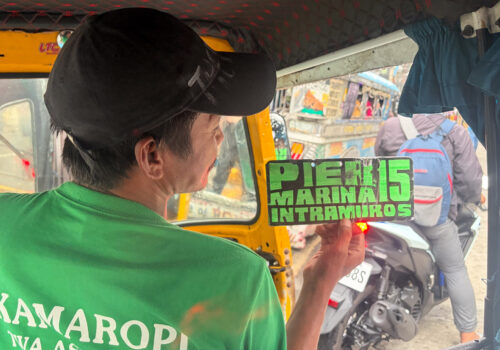
I hopped on the Manila Metro and rode the only rail line to its final stop in Quezon City, just northeast of the capital. Sweating inside the packed elevated rail car, I looked down along Manila’s main highway where a massive protest had shut down several northbound lanes, vindicating my decision to squeeze onto the crowded train.
Organized by a strict apocalyptic religious group, Iglesia ni Cristo, the rally was triggered by the filing of corruption charges against Senator Rondante Marcoleta, a Church member. The protest was unannounced and by the time I was travelling to Quezon City, thousands of protestors had been camped out for two days. Like many Filipinos whose morning commutes to work or school were disrupted by the rally, I scanned news headlines and social media posts to understand the scope and trajectory of the protests: Would the estimated 100,000 protestors continue to show up until the charges were withdrawn? Were there clashes between police and protestors? How would the protestors fare if a typhoon swept over Manila?
Among a number of updates, think-pieces and interviews, I saw several viral posts flagged as fake news: AI-generated videos of protestors, rumors that President Ferdinand Marcos, Jr. had fled the Philippines in response to the rally and claims that millions had attended the rallies (the final count was close to 15,000).
The content reflected a turbulent climate of fake news and disinformation that’s central to daily life in the Philippines. Journalists are in the eye of the storm: During the drug war, they were publicly vilified and targeted by Duterte himself, and killed by vigilante gunmen for reporting about extrajudicial killings. Today, they’re organizing to ensure the Philippines’ recent history isn’t forgotten, and to react to rising tides of new disinformation surrounding the drug war, its victims and the ongoing International Criminal Court’s trial of Duterte.
The memorial was one such initiative, and I wanted to find out how exactly such interventions are leveraging creativity, digital activism and hope-based messaging to defend the truth and crystallize collective memory as the Filipino nation tries to heal the scars of the past.
* * *
The memorial’s full title was Dekada ng Sama-Samang Pag-Alala, Pagkakaisa, Para Sa Hustisya, “a decade of collective remembrance and unity for justice.” Those attending referred to it simply as Dekada, with no explanation needed for which decade it referred to.
Attended by over 350 people, the event featured speeches from advocacy groups, journalists, prominent religious leaders and the families of extrajudicial killing victims. One victim group, Respond and Break the Silence against the Killings (RESBAK) performed an interpretive dance to commemorate its losses and ongoing struggle to secure justice for loved ones. As the emcees introduced each new speaker or group, they performed a call and response with the audience, shouting “Isang dekada na” (One decade already), to which the attendees responded “Lalaban tayo!” (We will keep fighting!)
The gathering was held at the central Bantayog ng mga Bayani (Monument to the Heroes) memorializing those who died under the regime of Marcos’s father, former President Ferdinand Marcos, Sr. from 1972 to 1986. The choice was highly symbolic, holding a drug war commemoration event at a national monument already commemorating another dark chapter of Philippine history. In the organizers’ eyes, it followed a broader Filipino tradition of commemorating Marcos Sr.’s notorious martial law and the protests against it.
“This is the ‘martial law’ of our time,” Raffy Lerma told me as we reflected on the Dekada memorial in the outdoor smoking section of a Quezon City cafe the following week.

I’d first met Raffy in The Hague, in the cold February air outside the International Criminal Court. One of the confirmation of charges hearings in Duterte’s trial had recently concluded, when the prosecution had shown the court a photo Raffy had published during the drug war. Taken in 2016, it depicts a barefoot woman cradling an extrajudicial killing victim, her common-law partner. The image went viral in 2016 for its straightforward depiction of the drug war’s consequences and the fact that the pair’s posture evoked the Pietà, the Catholic image of Mary holding the dead Christ. It’s an image that’s hard to look at but hard to forget: the woman’s anguish clear on her face while her dead partner lies unnaturally bent before her.
“I never even captioned it as such,” Raffy told me when I asked about the story behind the picture. “But Filipinos recognized it as this depiction of suffering and pain because we’re familiar with the Pietà icon.”
Back in The Netherlands, Raffy and I had boarded a bus headed from Scheveningen, the court’s neighborhood, to downtown The Hague. Settled in my seat, I realized we were surrounded by Filipinos all wearing green, the self-identifying color for “Diehard Duterte Supporters.” As I smiled politely at a cheery, chartreuse-clad grandmother, I wondered how Raffy felt on this crowded bus. A common practice among Filipinos abroad, on overhearing someone speak Tagalog, is to ask “Pinoy ka ba?” (Are you Filipino, too?) But Raffy was silent—surrounded by his countrymen but alienated from their separate politics.
A photojournalist when the drug war started, he left his 12-year post with the Philippine Daily Inquirer to cover the killings full-time as a freelancer. Raffy was often present with camera in hand moments after someone was shot, a body was dumped on the street or a victim found by passers-by.
“The first crime scene I visited in July 2016, there were three people killed,” he told me. “Ten minutes after I arrived, the bodies were being carried to a car to be taken to a funeral home, and I remember onlookers feasting on the bodies [taking photographs] and shouting or cursing. ‘Tangina mo, hayap ka (‘You son of a bitch, you’re an animal’), you deserve to die!” After 12 years in journalism, it was the first time he’d heard such a reaction to a scene of dead bodies.
Now, 10 years later, he’s working as one of the main organizers of the Dekada campaign, which includes exhibitions of art, photography, film and other forms of memorialization and archive work across Manila. He’s still in touch with many of the families of the victims whose murders he documented and carries their memories with him when visiting the ICC trial in The Hague.
“Dekada is important because public interest in accountability has gone down tremendously since the start of the drug war,” Raffy told me. “Of course, there are many different current events happening in the Philippines, but we [a group of photojournalists] have decided to continue documenting the stories of victims and their families, to remember and commemorate this sad, brutal history of our country.”
Having grown up learning about the violence of the martial law period, Raffy said, living through Duterte’s drug war felt like living through history itself. “The challenge to all of us who grew up in the shadow of martial law is what do you do when this repression happens again in your own era?”
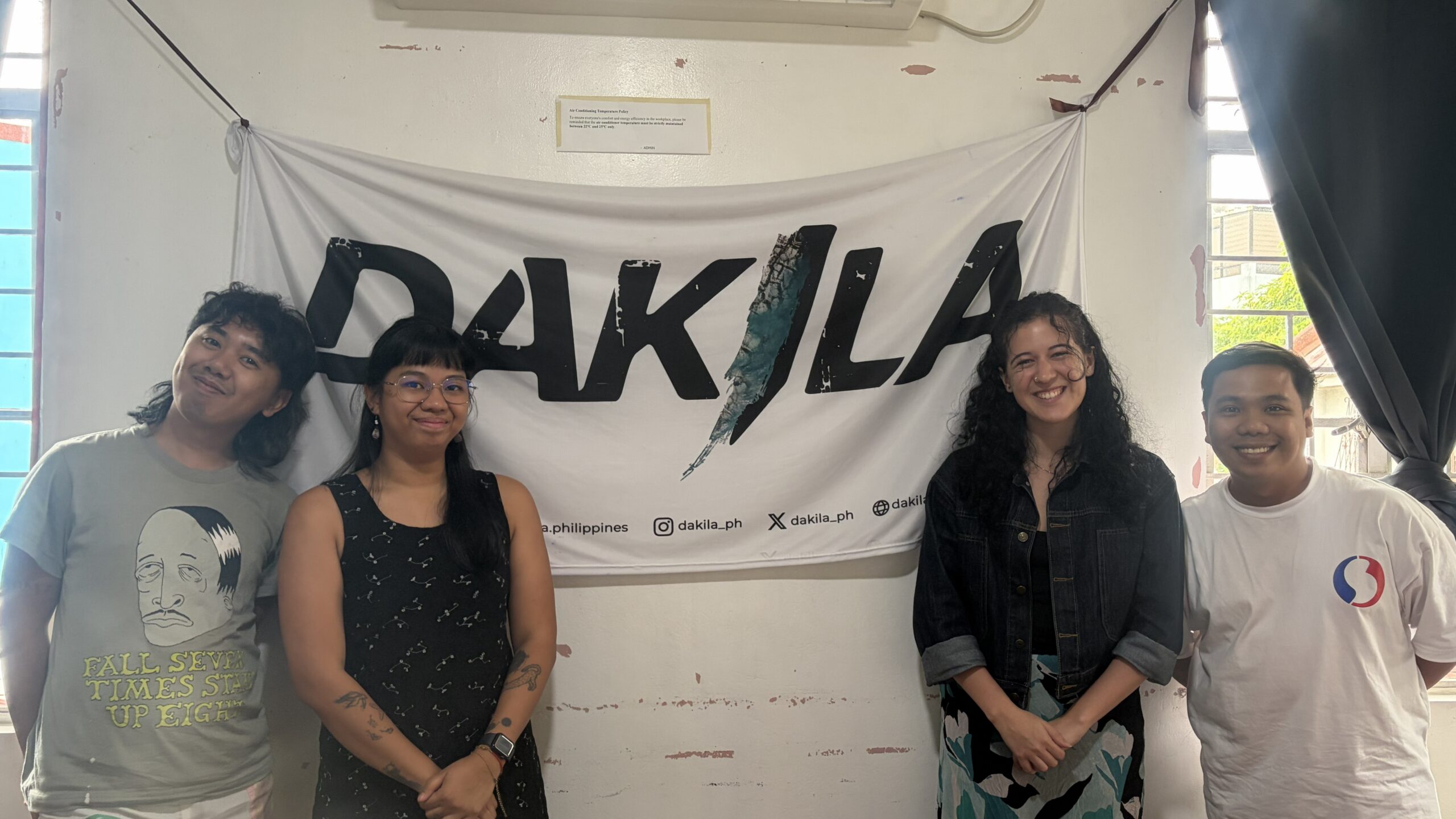
Dekada was organized by a broad coalition of 21 organizations, including an artist-activist collective named Dakila, which launched digital museums about both the martial law era and more recent drug war. I met the managing director Tin Alvarez, creative director Elvin Macanlalay and communications manager Kenneth Gadian in their office in Quezon City.
The Philippines are following the same template as under martial law, Kenneth said. “There was a clear pattern of violence, it was justified by the government using disinformation strategies to distort facts, then people forget what actually happened and the stories of victims ultimately lose their humanity.”
To help preserve stories, Dakila will produce Dekada events until December. Its campaign will include organized exhibits throughout the country, including a human rights festival, film screenings, podcasts, legal information sessions about the ICC trial, the publication of a comic series and jam sessions with musicians to create music about the drug war—just some of the projects.
“We’re not afraid to play around and experiment with new kinds of advocacy, it’s in our DNA,” Elvin said with a chuckle. Across the various advocacy groups in the Philippines, Dakila is unique because of its artistic focus that helps make issues accessible to the more apolitical public, offering different ways for Filipinos to engage with the political messaging underlying the art and music.
The creative approach to art and protest against the drug war actually grew from the Duterte administration’s efforts to attack its critics, Elvin said. In 2020, the then-president signed the Anti-Terrorism Act, which broadly defines terrorism and support for terrorism, and approves warrantless detention for those suspected of crimes under the act or designated as terrorists by the government’s Anti-Terrorism Council.
“While it had a chilling effect on artists critical of the government, there was also an emergence of new forms of digital art and more creative expressions of dissent,” Elvin told me. Adapting to the new reality of “creative resistance,” Dakila’s campaigns began promoting an online avatar comic that went viral. Titled Tumindig (Stand Up), the protest art featured a simple human fist—the symbol of strongman Duterte and his supporters—rising from a crowd of horizontal fists to stand tall in a gesture of defiance.
Launching Dekada, the trio viewed Dakila’s role as “cultural workers” challenging the narratives that have helped normalize the drug war’s violence for the last ten years. Through eight regional chapters across the Philippines, with over 2,000 members, Dakila will help produce Dekada “micro-sites,” providing local perspectives to memorialize communities’ own experiences and, no less important, envision a more hopeful future.
“We want to change the political and cultural landscape of the Philippines through programs like Dekada,” Kenneth said. “Each event we host is meant to challenge dominant narratives that legitimize violence, fight disinformation and train other advocates to conduct digital activism.”
For Raffy Lerma, the photographer, creating images is also his own form of activism against state violence. In her book The Civil Contract of Photography, the Palestinian photographer Ariella Azoulay argues that photos form a sort of borderless citizenry, a bonded group of an image’s subjects, the photographers themselves and its viewers. When documenting atrocities like crimes against humanity, she writes, “photography marks the beginning of a demand to become citizens, even when that demand is hidden behind a demand for the protection of human rights.”
When he reviews his body of work over the last decade, Raffy says, what becomes clear is not just the scale of the violence but also the tirelessness of the calls for accountability from journalists, lawyers, artists and concerned citizens. “What we also have to highlight with Dekada are the efforts of many people along the way,” he said. “The stories of people who fought for human rights, who were the underdogs, the pockets of resistance, in a population widely supportive of Duterte and the drug war.”
“Dead is a good word for a journalist in the age of Duterte,” the journalist and filmmaker Pat Evangelista writes in her memoir Some People Need Killing, a vivid account of her experiences covering extrajudicial killings during the drug war.
But it wasn’t unique to Duterte’s time. Before the 2023 conflict in Gaza, the deadliest single recorded attack on press workers in the world happened on the Philippine island of Mindanao in 2009 after a challenger to the gubernatorial seat of Maguindanao province, Esmael Mangudadatu, sent his wife and sister-in-law to file his certificate of candidacy. The governorship had long been held by the Ampatuan family, the local political dynasty. Journalists followed the convoy to document the unprecedented challenge. On the way, men in several vans armed with automatic rifles ambushed the group. There were no survivors. Thirty-two of the 58 people killed were journalists.
The National Union of Journalists of the Philippines recorded 23 killings of journalists in media-related incidents during Duterte’s presidency. They took place during his public encouragement to kill “corrupt” press workers and his administration’s legal attacks on news outlets that covered or published criticism of the drug war. The longtime broadcaster ABS-CBN shut down after a Duterte-allied Congress refused to renew its franchise license, while the crusading investigative outlet Rappler was temporarily shut down over allegations it was accepting foreign funding, its reporters were banned from the Malacañang presidential palace and its CEO Maria Ressa was prosecuted for cyber libel in a case widely regarded as politically motivated.
It’s dangerous to be a journalist in the Philippines because a free press is a threat to those in power. The country’s most famous highway—Epifanio de los Santos Avenue, or EDSA—is named after a journalist who advocated for Philippine independence from Spain. Filipino journalists have been key to informing the country’s public for centuries, influencing advocacy and politics.
“Journalists usually work as individuals, but during the drug war, we banded together and were labelled the ‘Nightcrawlers,’” Raffy told me, laughing in reference to the 2014 American neo-noir movie “Nightcrawler,” a thriller about a crime photographer pulled into the pursuit of the perfect shot.
“I’m not a fan of the movie, but it’s true that we built a network of journalists trying to expose the drug war, and ended up achieving even more by connecting victims’ families with lawyers and churches who could further help them.”
Exposure doesn’t always amount to accountability, of course. Raffy was one of several journalists who discovered a secret detention cell in a Manila police station in 2017. Hidden behind a bookcase in the main station, a tiny cell was filled with 12 people charged with drug offenses. “There were no lights and there was one toilet but it didn’t work,” he told me, the shock from the scene clearly reflected on his face. “We uncovered it despite the fact that the police chief had repeatedly denied to us that the cell even existed. So I went to him and asked angrily ‘How would you feel if you were the one inside?’”
Several previous detainees described being released after officers extorted 50,000 to 100,000 pesos ($800-$1,600); for some, it was their second or third time in the secret cell, subject to a freedom-for-pay police-run enterprise of arrest, release and re-arrest. Even after Raffy and his colleagues published the story, none of the station’s police were prosecuted. The Supreme Court ruled with finality in 2025 that there was insufficient evidence to file a criminal case.
* * *
“The public sphere is constituted in part by what can appear,” the philosopher Judith Butler writes in their book Precarious Life: The Powers of Mourning and Violence. “The regulation of the sphere of appearance is one way to establish what will count as reality, and what will not.”
They wrote it in 2003, in response to the false claims used to justify America’s invasion of Iraq. It rings true today amid the growing specter of disinformation and its distortion of public debate, undeniable influence on elections and erosion of trust in institutions.
In the Philippines, as around the world, disinformation is also very much a commercial enterprise, creating huge profits from influence operations that employ standard advertising and PR strategies to disperse misleading information on behalf of paying politicians.
Many operations are produced by narrative “architects” who pay influencers to produce content that helps shape political outcomes in their home countries, as the Sigla Research Center has documented. In the Philippines, economic precarity makes participating in the disinformation economy, through employment in troll farms for instance, attractive for many. The global industry generates billions of dollars a year.
Disinformation has surrounded discourse about Duterte since 2016 like a stubborn cloud. His party, the PDP-Laban, hired fake account operators who formed “click armies” on Facebook and Twitter, sharing fake news and amplifying hate speech against his critics during his election campaign and presidency.
The cloud has followed him to The Hague, with disinformation messaging about the ICC’s trial ranging from merely absurd to harmful. An AI-generated image that went viral after the February hearings depicted some of the victims’ families wearing designer clothes, claiming they were paid to testify. After Duterte hired a new defense team in May, viral posts claimed his lawyers were fictional characters from the TV show “Suits” and “How to Get Away with Murder”; in one widely shared post, the author claimed the American singer Lana del Rey was Duterte’s new counsel. Despite the fact that such posts strain credulity, they’re effective because they prey on Duterte supporters’ desires and normative beliefs that the former president should, and will, soon be freed.
Even the ICC’s judges haven’t been spared, with AI-generated photos, videos and fake quotations proliferating after each news cycle about the court. During the latest trial conference, the presiding judge, Joanna Korner, warned all participating counsel about giving any media interviews for fear of feeding into fake news and misleading reporting about the court’s legal rulings.

Working within this shifting information ecosystem, Filipino journalists covering the drug war and its aftermath have had to stay on top of the various narratives being presented to the public by the disinformation industry, and the misleading information used to both legitimize the state’s violence under Duterte and delegitimize the ICC.
Journalists’ role in the Philippines is no longer limited to reporting facts and, say, detangling the ICC’s complicated legal processes for the public back home. For Raffy and others, it also requires more engagement in social affairs, straying from the traditional standard of neutral observer. It has created a duty to act and react: Journalists must report in a way that distinguishes them from disseminators of disinformation and defend against claims they’re the ones actually spreading disinformation.
Take the Pietà. Its enduring circulation over the last decade since it went viral in 2016 could be explained by how simply it illustrated the drug war’s inhumanity by centering the humanity of the victims, forcing viewers to witness the suffering the policy inflicted. Since the ICC’s prosecution displayed the photo in court in February, Raffy has seen a resurgence of claims it was staged with hired actors—a claim Duterte himself originally made in his 2016 state of the nation address two days after the Pietà was published.
“I used to think an image could speak for itself,” Raffy told me. “Now, in the age of fake news, you constantly have to be ready to defend your images. You constantly have to be ready to defend the truth.”
* * *
At Dekada’s memorial at the Monument to the Heroes, I watched the setting sun color the sky purple as fruit bats began flitting between tree branches and mosquitos whined around my feet. Dekada was ending and hundreds of attendees gathered to conduct a closing candle-lighting vigil in remembrance of drug war victims. Some offered the lit tapered ends of their candles to others to light their own as we joined a procession toward Pananagutan, Katarungan and Katotohanan, the three main candles I mentioned at the beginning.
Families of those killed placed photos of their loved ones along the stone steps and atop the red fabric flowing down from the makeshift memorial, framing their pictures with sprigs of small white flowers. The crowd formed a semicircle around the ongoing tribute as smaller groups stepped forward to place their candles around the various pictures, the flickering light reflecting off their laminated faces. As night finally fell, the solemn group sang Pananagutan, a Filipino choral hymn performed at Catholic Mass.
Walang sinuman ang nabubuhay para sa sarili lamang
Walang sinuman ang namamatay para sa sarili lamang
(No one lives for himself alone, No one dies for himself alone)
Tayong lahat ay may pananagutan sa isa’t-isa
Tayong lahat ay tinipon ng Diyos na kapiling nya
(We are all responsible for one another, God has gathered us all to himself)
I watched as the tall, thin candles suffused the memorial with an orange glow. Turning toward the crowd, I saw young and old singing hand-in-hand across the steps. Despite the lack of streetlights, their faces appeared completely clear to me through the dark night. Burnished by the candle flames, the glossy photos of kin, friends and neighbors seemed to be shining on their own. For a moment, we were all bathed in their light.
Top photo: At the end of the Dekada launch event, participants hold a candlelight vigil with a three-candle centerpiece calling for accountability, justice and truth.