Thank you, ICWA, for sending me on a wonderous adventure. Thank you too, to my friends and family for supporting me through it all.
It started looking up at the stars. This time, near Moosehead Lake in northern Maine back in 2021. Just a few moments earlier, I’d shared a cigarette with a stranger about my age. He told me that his father had recently fatally overdosed on fentanyl and he was struggling with that painful loss. Looking up at the stars that night, I asked them: “How will this end?” They twinkled back, asking that same question of me.
The US opioid crisis affects many more than simply those who use drugs. It impacts our families and our communities. But after over two years investigating pioneering drug policies in the Netherlands, Portugal and Brazil, I can confidently say the addiction crisis is solvable. That public health leads to public safety. And that through compassionate policies, it’s possible to uphold individual dignity and ensure prosperous communities.
First stop, the Netherlands, in April 2024. Land of tulips, windmills and way too much rain. Walking around Amsterdam’s central neighborhoods, it was easy to think that it had always been this way. Tourists going in and out of shops overlooking peaceful canals while locals ride by carelessly on their bikes. Observing such scenes, it’s tempting to jump to the conclusion that the Netherlands is a small, rich country where everything goes well and there’s little poverty. But that is very far from the truth.
For decades, those same Amsterdam streets were filled with people openly using drugs and homeless encampments crowding sidewalks. What changed? A key to the answer came from observing the country’s famous windmills, which for centuries were engineered to reclaim land from the sea along with a complex system of dikes. But there was a fatal flaw: If one part of a dike were to break, an entire community would be flooded.
Therefore, from the very beginning, the poorest farmer and richest landowner came to sit at the same table to ensure the proper maintenance of every dike. They all depended on collaboration. That horizontal governance structure, which came to be known as the Polder Model, brought all stakeholders together and also helped bring Dutch communities together to solve their heroin crisis, which started in the 1970s and lasted well into the 2000s.
People who used drugs were at the table together with business leaders and government officials to figure out what policies would be most effective. The idea of syringe exchange programs, which drastically reduce the spread of diseases like HIV and Hepatitis C, came from a person who used drugs and was upset that other drug users were leaving dirty needles in kids’ playgrounds. Over the years, the deliberative stakeholder engagement led to the widescale implementation of low-barrier social services, from housing and workforce development to treatment and overdose prevention sites, even for people still actively using drugs.
The result? By 2024, crime was at an all-time low. Tourism was booming. People who used drugs could be safe, as well as people on the streets. To top it off, research found that these approaches cost taxpayers less than the revolving door of crisis management and jail that had been used before.
From the flat lowlands of the Netherlands, I moved to the rugged coast of Portugal in the fall. I started my time in country by visiting the Aljube Museum. A secret police prison under the authoritarian government that lasted half a century until 1974. I sat in one of the former prison cells where political dissidents were kept. My elbows touched both sides of the cell. The bed was nothing more than a slab of wood.
Walking out of the cell a free man, from where many others were led to torture and death, I saw through the windows on the other side of the street Lisbon’s Catholic cathedral. The prison and the church, defining symbols of Portugal’s brutal dictatorship that left a long shadow well after the Carnation Revolution.
When heroin arrived in Portugal in the 1980s, less than a decade after the start of democratization, people who used it were called “cockroaches.” They were left to die, and Lisbon’s poor Casal Ventoso neighborhood became the scene of the largest open-air drug market in Europe. A staggering 1 percent of the population was said to be using heroin at that time (in the United States, 2.1 percent of the population is now said to have opioid use disorder, according to the National Center for Drug Abuse Statistics). Injecting drug users made up 60 percent of all those with HIV, and 90 percent had no access to any treatment.
It was only in the late 1990s when voters decided they’d had enough, that politicians acted decisively. In the typical top-down model that defines Portuguese society, the prime minister brought together a committee of experts whose recommendations were later passed by the parliament. The policies were similar to those in the Netherlands: funding only for evidence-based treatment and access to social and health care services even when people were still using drugs.
Where did that lead? Today, Portugal is one of the safest countries in Europe and the world. Everyone wants to move there and tourism is booming. Drug consumption dropped, those who still use drugs are safe and people on the streets are safe.
From one side of the Atlantic, I flew to the other in spring 2025. Brazil. Land of sun, samba and lovely chaos. On my first full day in São Paulo, where I landed, I went to Cracolandia: one of the world’s largest open-air drug markets. I was met with flashing police lights, outreach workers from Brazil’s national health care service and vendors willing to sell a piece of cake to anyone with 2 reais, while love motels abutted one-room churches. Not to mention the innumerable men and women without housing furtively racing here and there. In this chaos, my guide brought me to the now closed doors of Braços Abertos. An NGO that for just over two years, between 2014 and 2017, housed, employed and provided social services and treatment to people who’d been living on the streets even as they continued to use drugs.
It was a phenomenal success. Of the 500 or so who participated in the program, 88 percent reduced their drug use between 65 percent and 87 percent. Some 52 percent were reconnected with their families and 73 percent gained employment. Unfortunately, however, policy success is not enough. In a conservative country like Brazil, where people will answer a greeting with “I’m good, thanks to God” and “I will see you tomorrow, if God wills it,” advocates were not able to sell the program as a success to conservative politicians even though 69 percent of São Paulo residents approved. When the municipal government changed party leadership, the program ended.
Brazil is also known for its lethal police force, which kills approximately six times more people than America’s even though the country’s population is two-thirds the size of its northern neighbor. What’s the result? High crime rates and ordinary people protecting their houses with barbed wire. Is that the society we hope to have here in the United States?
What does it mean to solve the opioid crisis? Within the time it takes you to read this, 30 people across the United States will have overdosed. Two will have died. They were friends, family and community members. The White House says the opioid crisis cost the country $2.7 trillion dollars in 2025 alone. But the real cost is the empty chair at the Thanksgiving table, the uneaten hotdog at the Fourth of July cookout.
Solving the opioid crisis means reducing the use of illicit drugs, it means reducing overdoses, it means ensuring safety for the public, it means reuniting families.
My message is a hopeful one. It is possible to lift Americans out of the current nightmare. I’ve seen how comprehensive and accessible public health measures successfully cared for those in need while ensuring public safety and costing taxpayers far less than traditional punitive approaches, in countries with widely differerent histories and circumstances. We have a moral and fiscal duty to build coalitions that will implement such compassionate and practical policies that will uphold dignity for all people and strengthen the bonds of our communities.
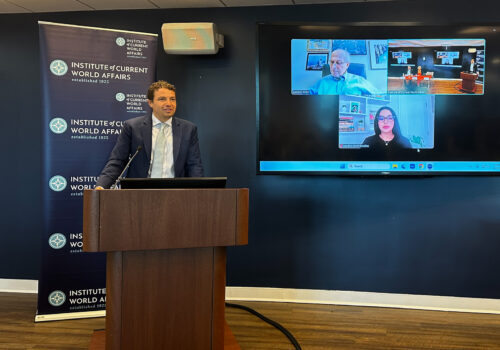
As I transition to my next chapter, I’m emboldened to spread my lessons learned through writing and speaking engagements and building a stronger online presence to support the coalitions fighting for drug policy change. I’m also very excited by my plans to start a non-profit that would foster short international policy exchanges for Americans working on the opioid crisis, to democratize access to the hands-on learning experiences that transformed my own thinking and promote international best practices across the United States.
Thank you ICWA, thank you all.
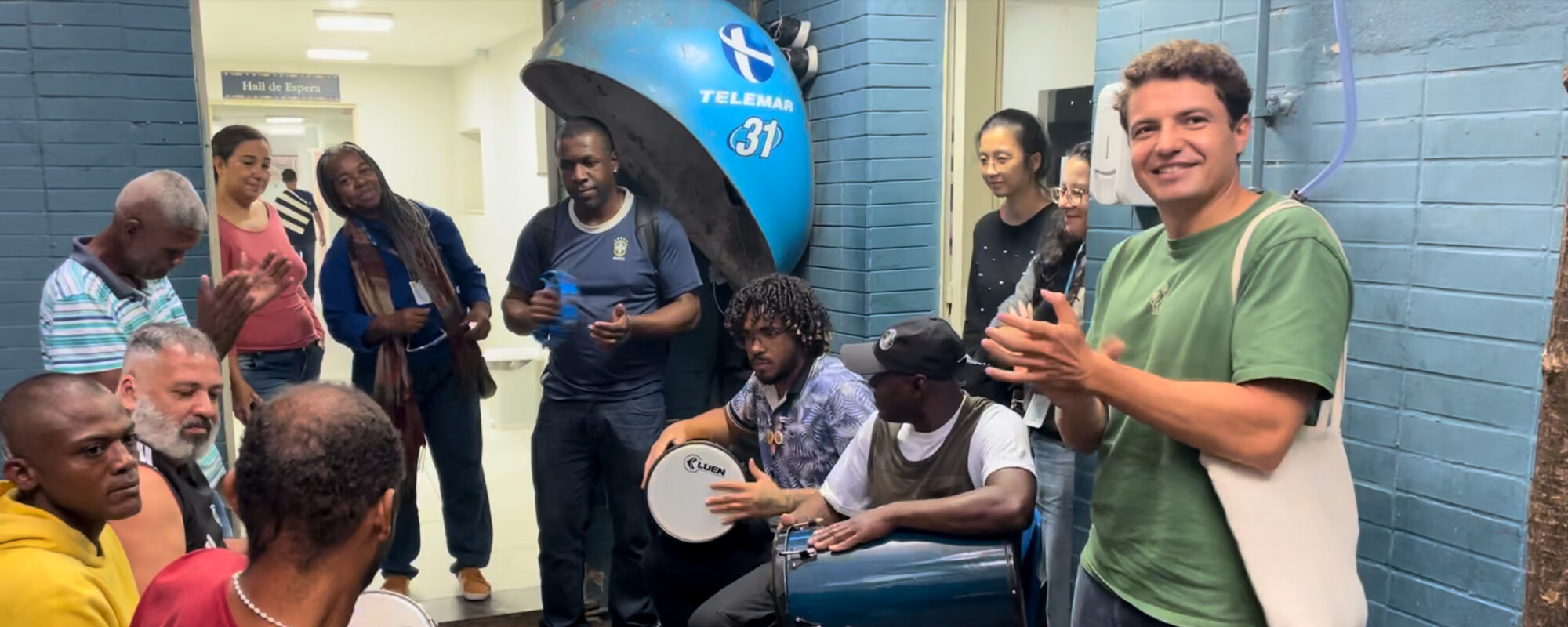
Top photo: Rowland joining Roda de Samba at a center serving people who live on the street, Rio de Janeiro, Brazil